Category
page 1Boletales genera
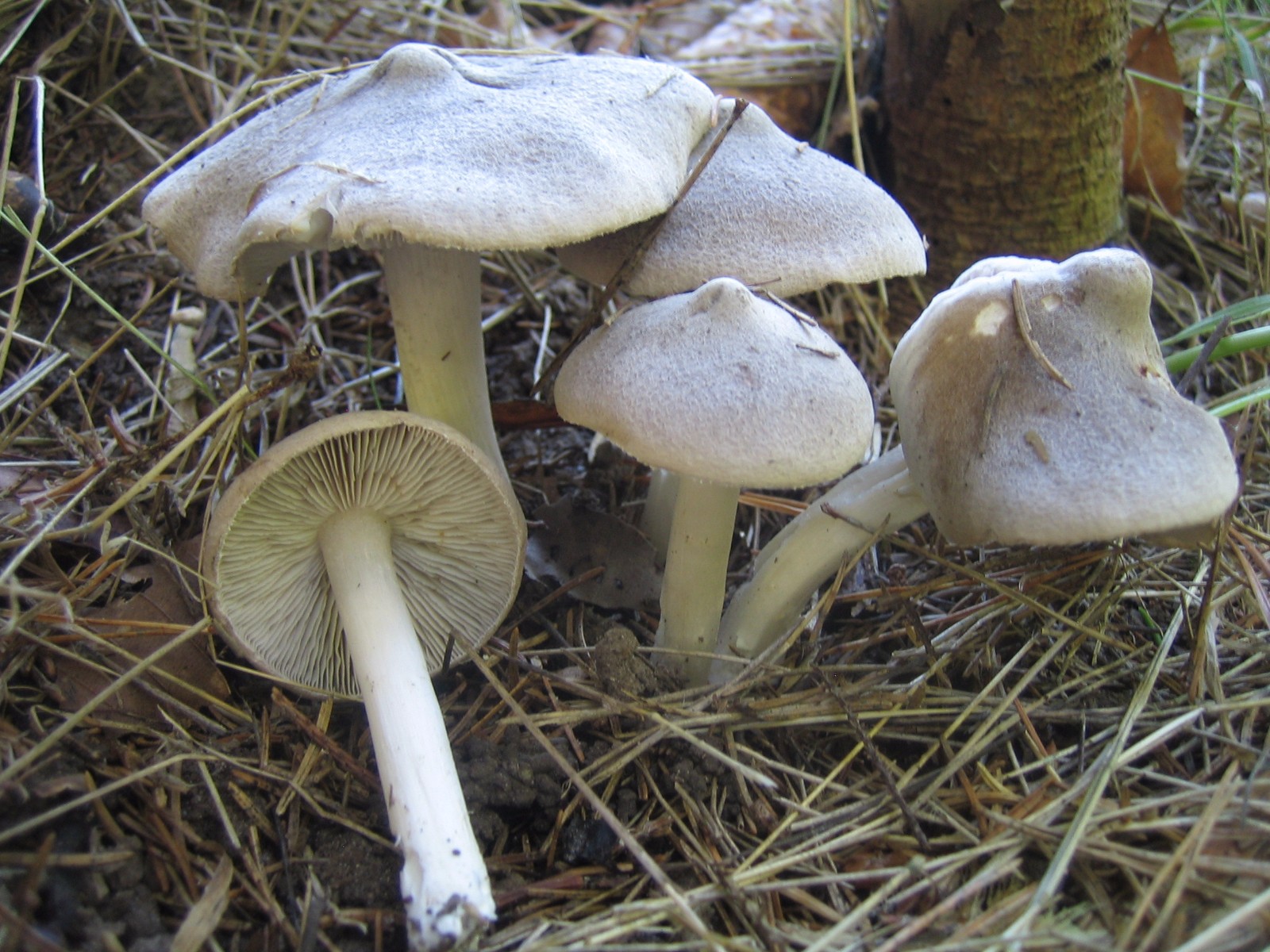
Boletus
Boletus is a genus of mushroom-producing fungi, comprising over 100 species. The genus Boletus was originally broadly defined and described by Carl Linnaeus in 1753, essentially containing all fungi with hymenial pores instead of gills. Since then, other genera have been defined gradually, such as Tylopilus by Petter Adolf Karsten in 1881, and old names such as Leccinum have been resurrected or redefined. Some mushrooms listed in older books as members of the genus have now been placed in separate genera. These include such as Boletus scaber, now Leccinum scabrum, Tylopilus felleus, Chalciporu

Suillus
Suillus is a genus of basidiomycete fungi in the family Suillaceae and order Boletales. Species in the genus are associated with trees in the pine family (Pinaceae), and are mostly distributed in temperate locations in the Northern Hemisphere, although some species have been introduced to the Southern Hemisphere.

Leccinum
Leccinum is a genus of fungi in the family Boletaceae. It was the name given first to a series of fungi within the genus Boletus, then erected as a new genus last century. Their main distinguishing feature is the small, rigid projections (scabers) that give a rough texture to their stalks. The genus name was coined from the Italian Leccino, for a type of rough-stemmed bolete. The genus has a widespread distribution, especially in north temperate regions, and contains about 135 species.

Paxillus
Paxillus is a genus of mushrooms of which most are known to be poisonous or inedible. Species include Paxillus involutus and Paxillus vernalis. Two former species—Tapinella panuoides and Tapinella atrotomentosa—have now been transferred to the related genus Tapinella in the family Tapinellaceae.

Xerocomus
thumb|260x260px|Xerocomus silwoodensis
thumb|260x260px|Xerocomus squamulosus
thumb|260x260px|Xerocomus ferrugineus
thumb|343x343px|Xerocomus illudens
Xerocomus is a genus of poroid fungi related to Boletus. Most members of Xerocomus are edible, though of mediocre gastronomical value and inferior to the sought-after porcini.

Chalciporus
Chalciporus is a genus of fungi in the family Boletaceae (suborder Boletineae). There are approximately 25 species in the genus.

Gyroporus
The Gyroporaceae are a family of fungi in the order Boletales. The family is monogeneric, containing the single genus Gyroporus, which, according to a 2008 estimate, contains ten widely distributed species, though a more recent study suggested the species-level diversity to be far higher. , according to Index Fungorum and Mycobank databases, the genus had 46 species.

Scleroderma
genus of fungi

Tylopilus
Tylopilus is a genus of over 100 species of mycorrhizal bolete fungi separated from Boletus. Its best known member is the bitter bolete (Tylopilus felleus), the only species found in Europe. More species are found in North America, such as the edible species T. alboater. Australia is another continent where many species are found. All members of the genus form mycorrhizal relationships with trees. Members of the genus are distinguished by their pinkish pore surfaces.

Rhizopogon
Rhizopogon is a genus of ectomycorrhizal basidiomycetes in the family Rhizopogonaceae. Species form hypogeous sporocarps commonly referred to as "false truffles". The general morphological characters of Rhizopogon sporocarps are a simplex or duplex peridium surrounding a loculate gleba that lacks a columnella. Basidiospores are produced upon basidia that are borne within the fungal hymenium that coats the interior surface of gleba locules. The peridium is often adorned with thick mycelial cords, also known as rhizomorphs, that attach the sporocarp to the surrounding substrate. The scientific n

Hygrophoropsis
Hygrophoropsis is a genus of gilled fungi in the family Hygrophoropsidaceae. It was circumscribed in 1888 to contain the type species, H. aurantiaca, a widespread fungus that, based on its appearance, has been affiliated with Cantharellus, Clitocybe, and Paxillus. Modern molecular phylogenetic analysis shows that the genus belongs to the suborder Coniophorineae of the order Boletales.
%20Fr%20281102.jpg)
Gomphidius
Gomphidius is a genus of mushrooms, commonly known as spike-caps, that are members of the Boletales (suborder Suillineae), or pored fungi. They appear to have gill-like structures which resemble those of agarics, however the similarity is superficial only. The best-known member is the slimy spike-cap (Gomphidius glutinosus). The genus has a widespread distribution, especially in north temperate areas, and contains 10 species.

Strobilomyces
Strobilomyces is a genus of boletes (mushrooms having a spongy mass of pores under the cap). The only well-known European species is the type species S. strobilaceus (also named S. floccopus), known in English as "old man of the woods".

Chroogomphus
Chroogomphus is a genus of fungi commonly known as pine-spikes or spike-caps, based on the shape of the mushrooms and because they often grow in association with pines. The genus is distributed throughout the Northern Hemisphere, including North America and Eurasia.

Butyriboletus
Butyriboletus is a genus of fungi in the family Boletaceae. The genus was circumscribed in 2014 by mycologists David Arora and Jonathan L. Frank to accommodate "butter bolete" species that were shown by molecular analysis to be phylogenetically distinct from Boletus. Butyriboletus contains 24 ectomycorrhizal species found in Asia, Europe, North America and north Africa.
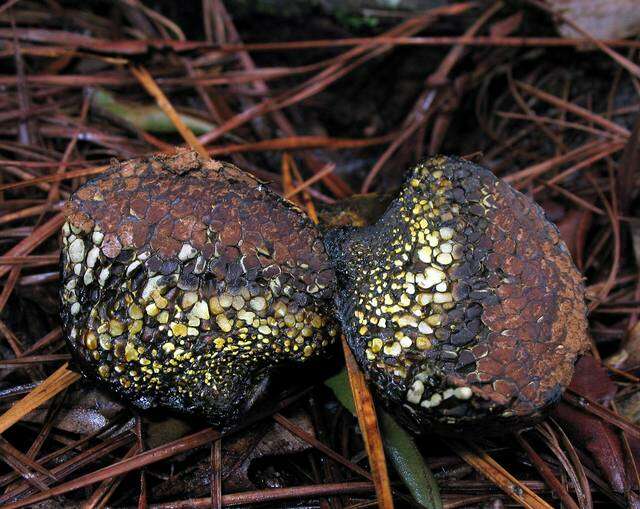
Pisolithus
Pisolithus is a genus of fungi within the family Sclerodermataceae (suborder Sclerodermatineae).

Xerocomellus
Xerocomellus is a genus of fungi in the family Boletaceae. The genus, as it was described in 2008, contained 12 species. However X. rubellus and X. engelii were transferred to the new genus Hortiboletus and X. armeniacus was transferred to the new genus Rheubarbariboletus in 2015. Molecular analysis supports the distinction of Xerocomellus species from Boletus and Xerocomus, within which these species were formerly contained. Xerocomellus in fact is only distantly related to Xerocomus and is most closely related to Tylopilus, Boletus sensu stricto, Porphyrellus, Strobilomyces, and Xanthoconium

Rubroboletus
Rubroboletus is a genus of bolete fungi in the family Boletaceae. It was circumscribed by Chinese mycologists in 2014 with Rubroboletus sinicus as the type species. Species are characterized by having a reddish cap surface, yellow tubes on the underside of the cap, and an orange-red to blood-red pore surface. Pinkish to red spots (reticula) are present on the stipe surface, and a bluish color change occurs when the bolete flesh is injured. Rubroboletus mushrooms have an olive-brown spore print, and produce smooth spores. Eight species were included in the original circumscription (seven new co

Aureoboletus
Aureoboletus is a genus of bolete fungi in the family Boletaceae. It was circumscribed by Czech mycologist Zdeněk Pouzar in 1957. A taxonomic monograph was published in 2010 by Wolfgang Klofac. At least 11 species in these genus are edible and have been traditionally consumed in different regions of the world

Imleria
Imleria is a genus of fungi in the family Boletaceae. It was established in 2014 by Alfredo Vizzini as a new genus for what had previously been named Boletus badius or Xerocomus badius. It was placed in its own genus because of its distinct morphological features and because it had previously been found to belong in its own genus in a molecular phylogenetics study by Gelardi et al. (2013). Zhu et al. (2014) placed three more species in Imleria. Species of Imleria which can be found in Europe, North America and Asia. The genus is named in honor of the Belgian mycologist Louis Imler (1900–1993).
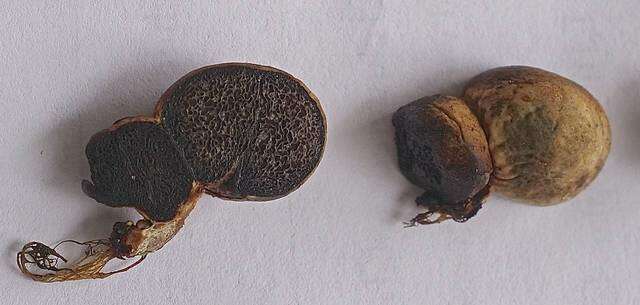
Chamonixia
Chamonixia is a genus of truffle-like fungi in the family Boletaceae. The genus is widely distributed, especially in temperate regions, and contains eight species. Chamonixia was circumscribed by French mycologist Léon Louis Rolland in 1899.

Caloboletus
Caloboletus is a fungal genus in the family Boletaceae. It was circumscribed by Italian mycologist Alfredo Vizzini with Caloboletus calopus as the type species. The erection of Caloboletus follows recent molecular studies that outlined a new phylogenetic framework for the Boletaceae. Boletus peckii was also transferred to this genus by Vizzini, but was subsequently moved to the genus Butyriboletus based on molecular evidence. The generic name Caloboletus, derived from the Greek calos "nice", refers to the attractive red coloring of the stipe.

Serpula
genus of fungi
%20Sutara%20258674.jpg)
Pseudoboletus
Pseudoboletus is a genus of fungus in the family Boletaceae. The genus contains two species found in north temperate areas that grow in a parasitic association with species of Scleroderma and Pisolithus, or Astraeus.
==Species==
, Index Fungorum lists the following species in Pseudoboletus:
{| class="wikitable sortable"
! Image !!Name !! Taxon author !! Year
|-
|||Pseudoboletus astraeicola || (Imazeki) Šutara || 2005
|-
|120px||Pseudoboletus parasiticus || (Bull.) Šutara || 1991
|}
==References==

Suillellus
Suillellus is a genus of bolete fungi in the family Boletaceae. It was originally described by William Alphonso Murrill in 1909 with Suillellus luridus (originally described as a species of Boletus) as the type species. The genus was later merged with Boletus, but was eventually resurrected in 2014, after molecular phylogenetics research demonstrated that Suillellus species comprised a different lineage than Boletus.
%20Bresinsky%20%26%20Manfr.%20Binder%20154221%202011-06-27.jpg)
Leccinellum
Leccinellum is a genus of fungi in the family Boletaceae. Mycologists Andreas Bresinsky and Manfred Binder circumscribed the genus in 2003 to contain Leccinum species with a yellow pore surface and a trichoderm-like cap cuticle. Leccinellum nigrescens (originally Leccinum nigrescens Singer 1947) was designated the type species; this taxon has since been renamed to Leccinellum crocipodium (Letell.) Della Maggiora & Trassinelli.

Hemileccinum
Hemileccinum is a genus of fungi in the family Boletaceae. It was erected in 2008 by Josef Šutara to contain two species united by a number of shared morphological features: H. depilatum and the type H. impolitum. In 2014, Wu et al. found it to be distinct from other bolete genera in a molecular phylogenetic study and found it to be most closely related to Corneroboletus. In 2015, H. subglabripes was transferred to Hemileccinum from Boletus based on DNA evidence, while subsequent studies further confirmed the monophyly of the genus.
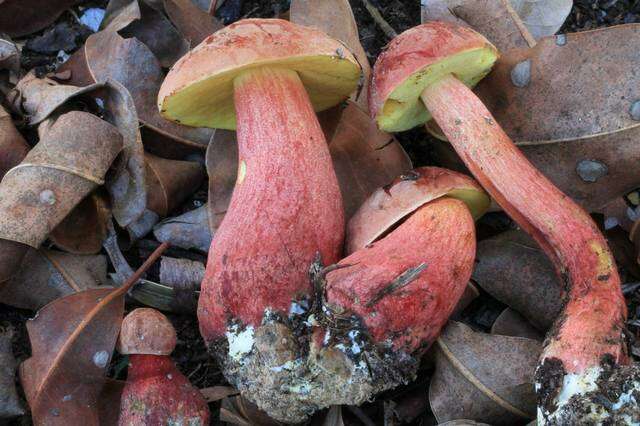
Heimioporus
Heimioporus is a genus of fungi in the family Boletaceae. The genus is widely distributed in tropical and subtropical regions, and contains about 15 species.

Melanogaster
genus of fungi
%20Both%20%26%20B.%20Ortiz%201288209.jpg)
Buchwaldoboletus
Buchwaldoboletus is a genus of bolete fungi in the family Boletaceae. It was circumscribed by mycologist Albert Pilát in 1969. According to a 2011 survey of the genus, Buchwaldoboletus contains about a dozen species that are saprotrophic and lignicolous.
==Taxonomy==
The genus name of Buchwaldoboletus is in honour of Niels Fabritius Buchwald (1898 - 1986), a Danish botanist and Professor of Phytopathology at a Agriculture College in Copenhagen. It was established by Albert Pilát in 1969, moving Pulveroboletus lignicola to position of the Buchwaldoboletus type species on account of its occurren

Gyrodon
Gyrodon is a genus of pored mushroom bearing close affinity to the genus Paxillus. Recent molecular research has confirmed this relationship of the two genera as sister taxa, together diverging as one of the most basal lineages in the Boletineae, and sister to the Boletaceae.

Astraeus
genus of fungi

Boletellus
Boletellus is a genus of fungi in the family Boletaceae. The genus has a widespread distribution, especially in subtropical regions, and contains about 50 species. The genus was first described by American mycologist William Alphonso Murrill in 1909. The genus name means "small Boletus".

Imperator
genus of fungi
Gastroboletus
Gastroboletus is a genus of fungi in the family Boletaceae. Species in the genus have misshapen caps, poorly developed or absent stipes, and are often buried or partially buried. Gastroboletus has tubes arranged irregularly, rather than vertically as in typical boletes. The edibility of most species is unknown, and those known to be edible are not highly rated.
%20Figure%203.jpg)
Neoboletus
Neoboletus is a genus of fungi in the family Boletaceae, native to holarctic regions. It was circumscribed in 2014 by Italian mycologists Matteo Gelardi, Giampaolo Simonini and Alfredo Vizzini, and further by Chinese mycologists Gang Wu and Zhu L. Yang in 2015. Closely related to the genus Sutorius, members of this genus differ by staining blue when bruised. They have brown pores and lack a reticulated pattern on their stipes. The erection of Neoboletus follows recent molecular studies that outlined a new phylogenetic framework for the Boletaceae. The type species is Neoboletus luridiformis. F
Tapinella
genus of fungi
%20Singer%20635704%202016-07-13.jpg)
Xanthoconium
Xanthoconium is a genus of bolete fungi in the family Boletaceae. It was circumscribed by mycologist Rolf Singer in 1944, who included Boletus affinis and what was then known as Gyroporus stramineus as the type species. These two species were part of the "strange group of species described by Murrill and Snell as white-spored Gyropori, and separated by the latter under the new generic name Leucogyroporus." C.B. Wolfe described three species from the United States in 1987: X. chattoogaense, Xanthoconium montaltoense, and X. montanum. , the nomenclatural database Index Fungorum list se

Hortiboletus
Hortiboletus is a genus of fungi in the family Boletaceae. It was circumscribed in 2015 by Giampaolo Simonini, Alfredo Vizzini, and Matteo Gelardi. The erection of Hortiboletus follows recent molecular studies that outlined a new phylogenetic framework for the Boletaceae. Hortiboletus is derived from the Latin word hortus "garden", referring to a typical habitat of the type species, Hortiboletus rubellus. The bolete H. bubalinus, originally described as a Boletus and later placed in Xerocomus, was transferred to the genus by Bálint Dima. In 2015, Alona Yu. Biketova transferred Boletus cam
%20Figure%202.jpg)
Pulveroboletus
Pulveroboletus is a genus of fungi in the family Boletaceae. The genus has a cosmopolitan distribution and contains 41 species.
Porphyrellus
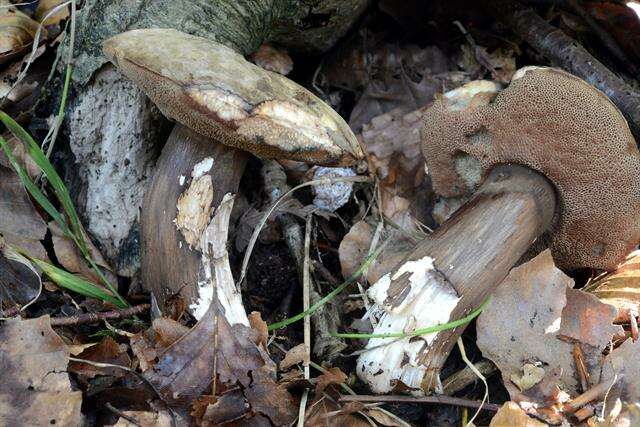
Porphyrellus is a genus of fungi of the family Boletaceae.

Austroboletus
Austroboletus is a genus of fungi in the family Boletaceae. The widely distributed genus contains species that form mycorrhizal relationships with plants.
.jpg)
Fistulinella
Fistulinella is a genus of bolete fungi in the family Boletaceae. The genus has a pantropical distribution, and contains 15 species. Fistulinella was circumscribed by German mycologist Paul Christoph Hennings in 1901.
Leucogyrophana
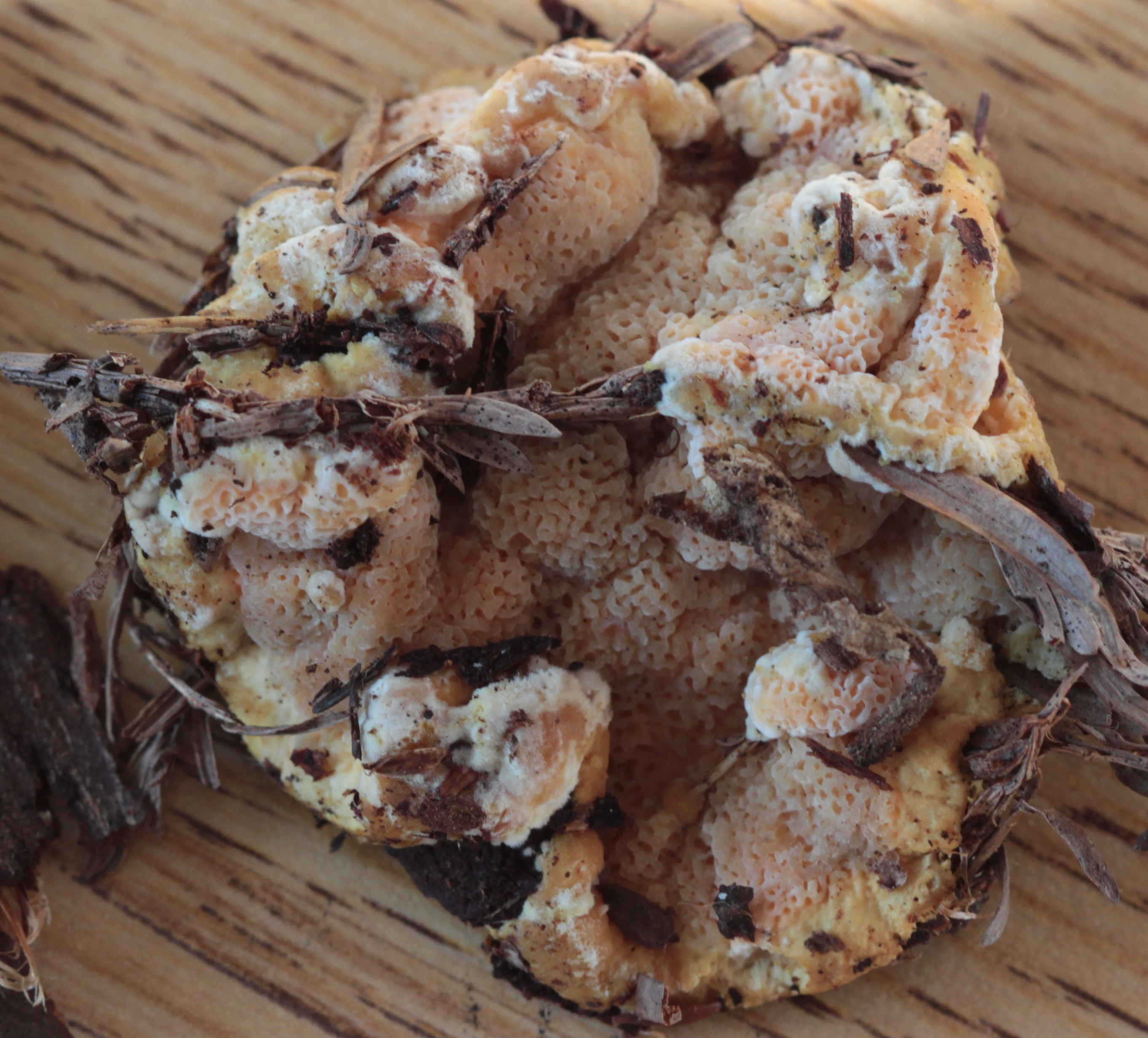
Leucogyrophana is a genus of fungi in the family Hygrophoropsidaceae (suborder Coniophorineae of the order Boletales). The genus was erected in 1958 to accommodate the species then known as Merulius molluscus ( Leucogyrophana mollusca). Several more species were described, but DNA testing in 2001 found that L. mollusca was isolated genetically from the others, and most closely related instead to Hygrophoropsis.

Calostoma
Calostoma is a genus of 29 species of gasteroid fungi in the suborder Sclerodermatineae. Like other gasteroid fungi, Calostoma do not have the spore discharge mechanism associated with typical gilled fungi (ballistospory), and instead have enclosed spore-bearing structures. Resembling round puffballs with raised, brightly colored spore openings (ostioles), elevated on a thick, gelatinous stalks, species have been collected in regions of deciduous, temperate, tropical or subtropical forests. Their distribution includes eastern North America, Central America, Asia, and Australasia. The common na

Coniophora
Coniophora is a genus of fungi within the order Boletales. Basidiocarps (fruit bodies) are corticioid (patch-forming). There are 20 species in the genus, which has a widespread distribution. One notable member is the cellar fungus (C. puteana), which causes wet rot in wood. Molecular analysis has revealed that there are cryptic species in the fungal lineages Coniophora olivacea, C. arida, and C. puteana.
Phylloporus
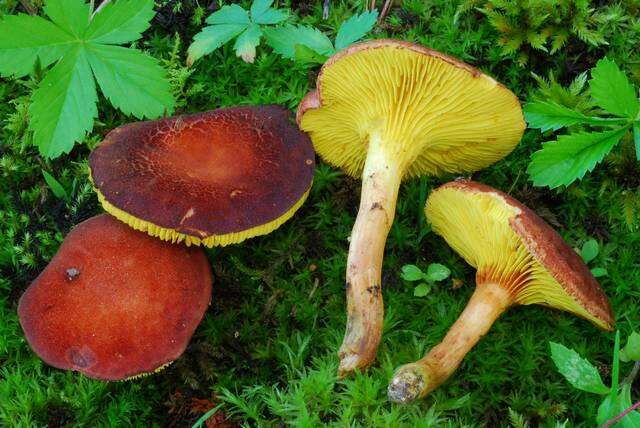
Phylloporus is a genus of fungi in the family Boletaceae (suborder Boletineae). The genus has a cosmopolitan distribution, and contains about 50 species, mostly in tropical areas.
Pseudomerulius
Pseudomerulius is a genus of fungi in the Tapinellaceae family. The genus is widespread and contains two species. P. aureus is noted as being inedible.
Boletochaete
Boletochaete is a genus of fungi in the family Boletaceae. The genus contains three species found in Africa and southeast Asia. American mycologist Rolf Singer circumscribed the genus in 1944.
==Species==
{| class="wikitable sortable"
!Image !!Scientific name !! Taxon author !! Year !! Distribution
|-
| ||Boletochaete bicolor || Singer || 1986||
|-
| ||Boletochaete hastulifera || (Corner) E. Horak || 2011||Malaysia
|-
| ||Boletochaete mirans || (Corner) E. Horak || 2011||Malaysia
|-
| ||Boletochaete setulosa || M. Zang || 1986||
|-
| ||Boletochaete spinifera || (Pat. & C.F. Baker) Singer || 19
Octaviania
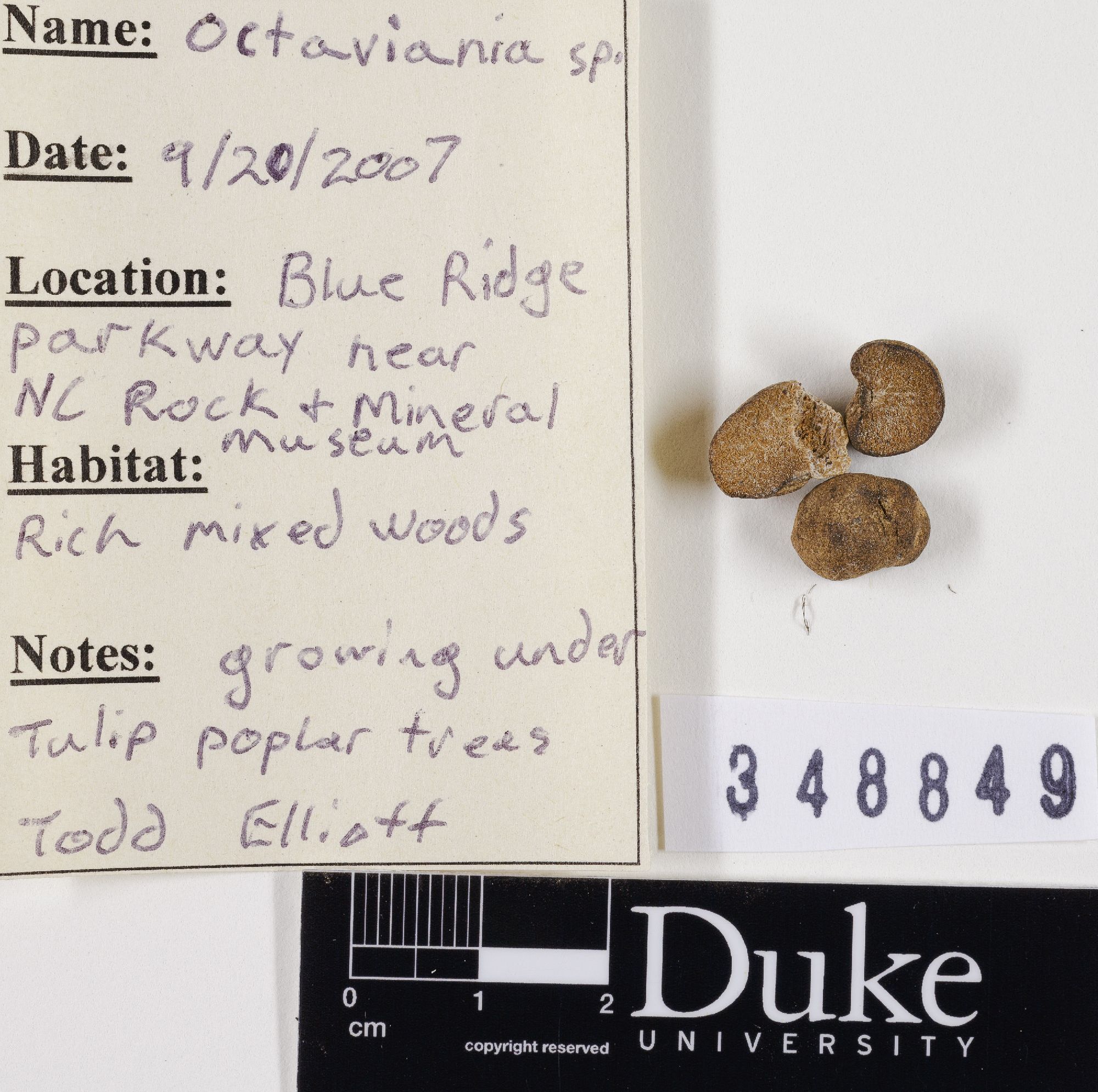
Octaviania is a genus of truffle-like fungi in the family Boletaceae. The widespread genus is estimated to contain 15 species.
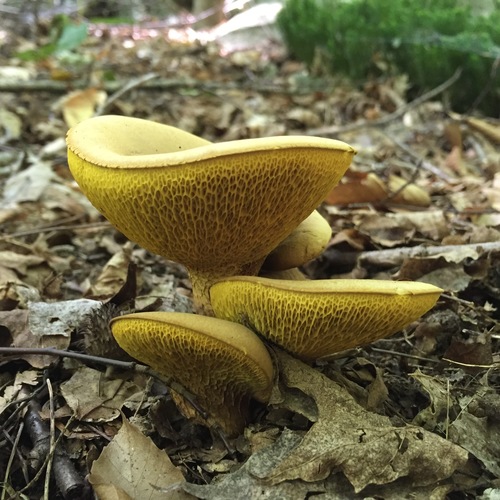
Boletinellus
Boletinellus is a genus of fungi in the family Boletinellaceae (suborder Sclerodermatineae of the Boletales). The genus was first described by American mycologist William Alphonso Murrill in 1909.
Cyanoboletus
Cyanoboletus is a fungal genus in the family Boletaceae. Circumscribed in 2014, it contains four species: C. flavosanguineus, C. rainisii, C. sinopulverulentus, and the type, C. pulverulentus. The generic name is derived from the Ancient Greek cyano ("blue"), referring to the rapid blue bruising reaction of the fruit bodies when cut.
Sinoboletus
Sinoboletus is a genus of fungi in the family Boletaceae.
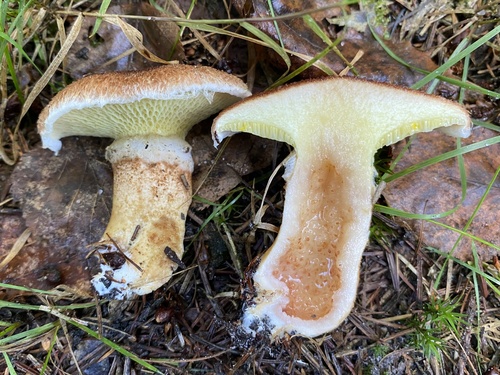
Boletinus
Boletinus is a genus of fungi belonging to the family Suillaceae.
Veloporphyrellus
Veloporphyrellus is a genus of fungi in the family Boletaceae. Species are characterized by having a pinkish to pinkish-gray hymenophore, a membrane-like partial veil that hangs from the cap margin, smooth spores, and a trichoderm-like cap cuticle.
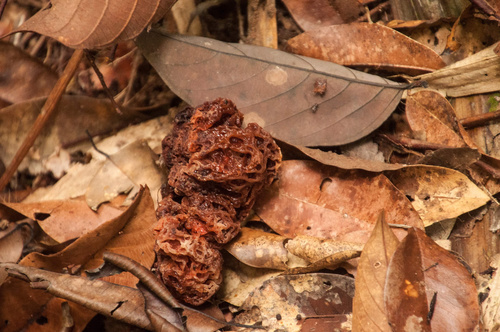
Spongiforma
Spongiforma is a genus of sponge-like fungi in the family Boletaceae. Newly described in 2009, the genus contains two species: S. thailandica and S. squarepantsii. The type species S. thailandica is known only from Khao Yai National Park in central Thailand, where it grows in soil in old-growth forests dominated by dipterocarp trees. The rubbery fruit bodies, which has a strong odour of coal-tar similar to Tricholoma sulphureum, consists of numerous internal cavities lined with spore-producing tissue. S. squarepantsii, described as new to science in 2011, is found in Malays
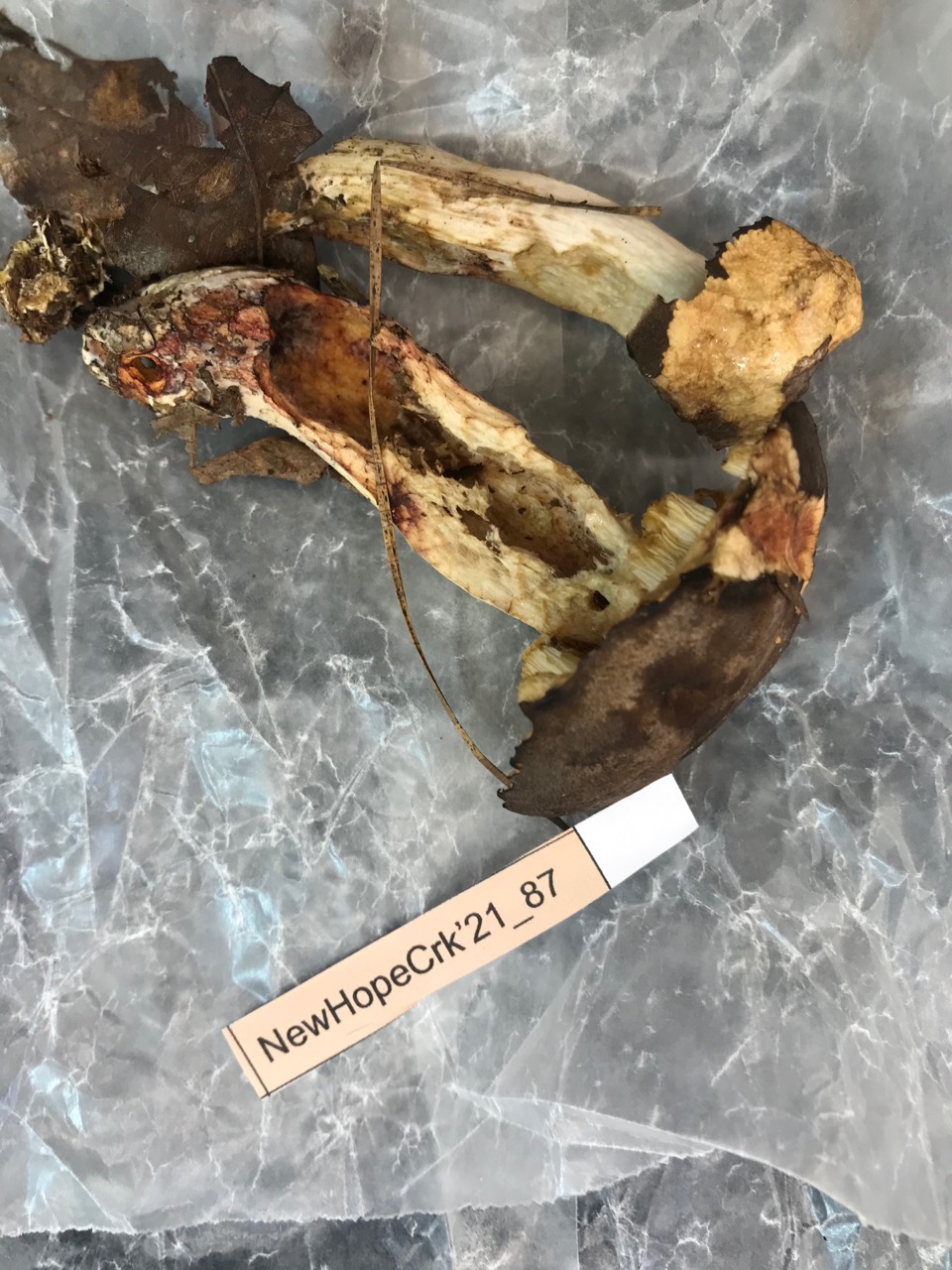
Retiboletus
Retiboletus is a genus of fungi in the family Boletaceae. The genus, first described in 2002, contained six species distributed in north temperate regions.
==Species==
, Index Fungorum lists the following species:
{| class="wikitable sortable"
! Image !!Name !! Taxon author !! Year
|-
|120px ||Retiboletus ater || Yan C. Li & T. Bau || 2020
|-
| ||Retiboletus brevibasidiatus || Raspé & Chuankid || 2021
|-
| ||Retiboletus brunneolus || Yan C. Li & Zhu L. Yang || 2021
|-
|120px||Retiboletus flavoniger || (Halling, G.M. Muell. & L.D. Gómez) Manfr. Binder & Halling || 2002
|-
|120px||Retiboletus fu

Afroboletus
Afroboletus is a genus of fungi in the family Boletaceae. The genus, circumscribed in 1981, contains seven species found in tropical Africa.
Lanmaoa
Lanmaoa is a fungal genus in the family Boletaceae. It was circumscribed by Chinese mycologists Nian-Kai Zeng and Zhu L. Yang in 2015 to contain several species formerly classified in the genus Boletus (L. carminipes, L. flavorubra, L. pseudosensibilis), as well as the newly described Asian boletes L. angustispora and L. asiatica. The erection of this genus follows recent molecular studies that outlined a new phylogenetic framework for the family Boletaceae. Zeng and Yang named the genus after Chinese naturalist (1397-1476).
==Species==
{| class="wikitable"
|-
! Image

Alpova
Alpova is a genus of fungi in the family Paxillaceae. It contains about 20 species of ectomycorrhizal false-truffles that collectively have a widespread distribution, especially in northern temperate areas. The genus was circumscribed by Carroll William Dodge in 1931.