Category
page 1Book of Leviticus

Leviticus
third book of the Bible (Hebrew, Protestant, Catholic)

Yom Kippur
Yom Kippur is the holiest day of the year in Judaism. It occurs annually on the 10th of Tishrei, corresponding to a date in late September or early October.
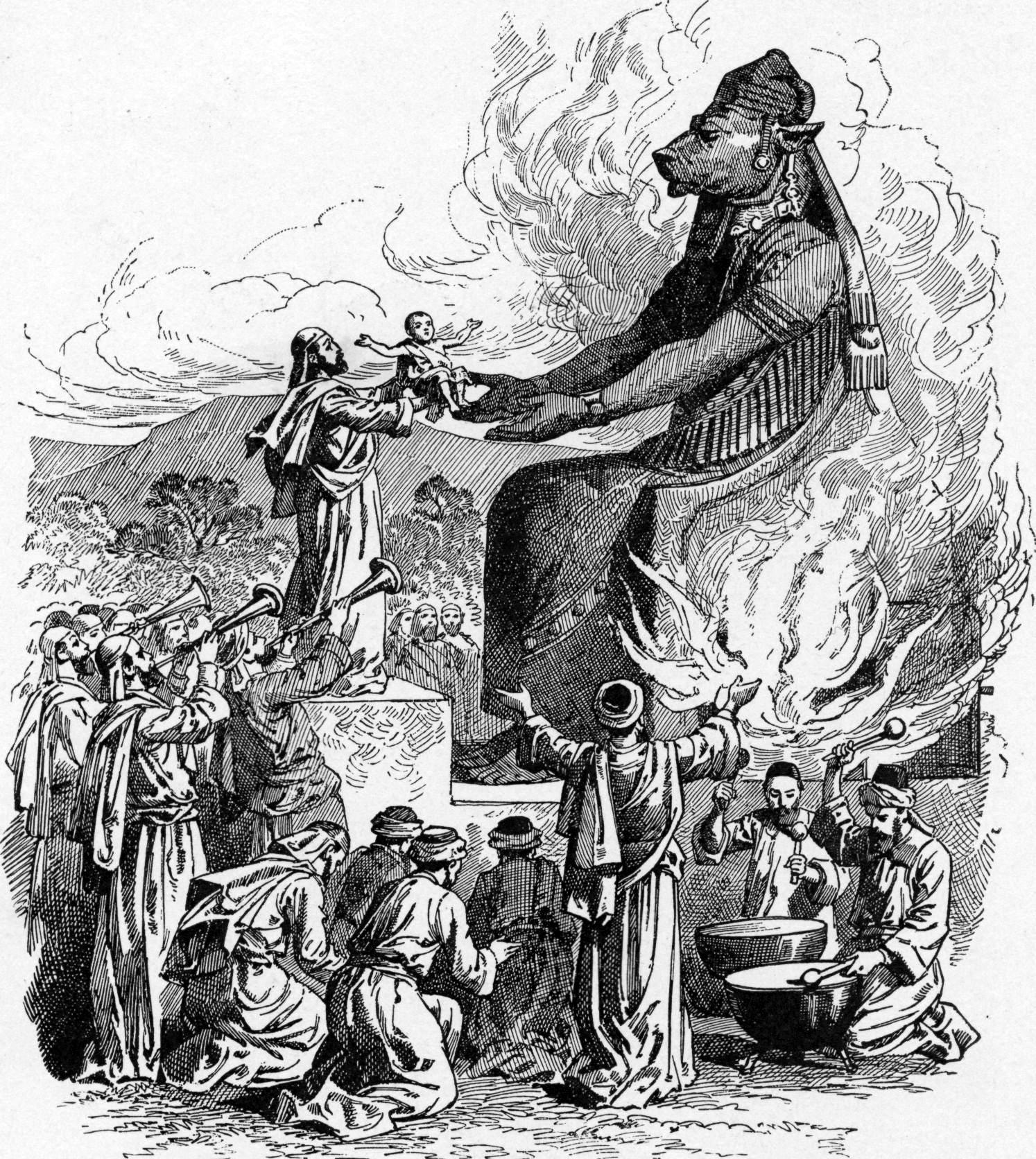
Moloch
thumb|Offering to Molech in Bible Pictures and What They Teach Us, by Charles Foster, 1897. The drawing is typical of Moloch depictions in nineteenth-century illustrations.
Moloch, Molech, or Molek is a word which appears in the Hebrew Bible several times, primarily in the Book of Leviticus. The Greek Septuagint translates many of these instances as "their king", but maintains the word or name Moloch in others, including one additional time in the Book of Amos where the Hebrew text does not attest the name. The Bible strongly condemns practices that are associated with Moloch, which are heavil
.jpg)
scapegoat
thumb|upright=1.35|Scapegoat ceremony depicted at [[Lincoln Cathedral in stained glass: "[Aaron] is to take the two goats and present them before the Lord at the entrance to the tent of meeting. He is to cast lots for the two goats—one lot for the Lord and the other for the scapegoat. Aaron shall bring the goat whose lot falls to the Lord and sacrifice it for a sin offering. But the goat chosen by lot as the scapegoat shall be presented alive before the Lord to be used for making atonement by sending it into the wilderness as a scapegoat." (NIV, Leviticus 16:7–10)]]
Azazel
thumb|"And Aaron shall cast lots over the two goats, one lot for the LORD and the other lot for Azazel." Lincoln Cathedral
thumb|The Scapegoat (painting)|The Scapegoat, by [[William Holman Hunt, 1854]]
thumb|Illustration of Azazel in Dictionnaire infernal by Collin de Plancy (1863)
In the Hebrew Bible, the name Azazel (; ʿĂzāʾzēl) represents a desolate place where a scapegoat bearing the sins of the Jews was sent during Yom Kippur. During the late Second Temple period (after the closure of the Hebrew Bible canon), Azazel came to be viewed as a fallen angel responsible for introducing humans to
Great Commandment
Jesus's paraphrase of the Old Testament: “Hear, O Israel; The Lord our God is one Lord: And thou shalt love the Lord thy God with all thy heart, and with all thy soul, and with all thy mind, and with all thy strength” (Mk 12:29–30)

Niddah
A niddah (alternative forms: nidda, nida, or nidah; nidá), in traditional Judaism, is a woman who has experienced a uterine discharge of blood (most commonly during menstruation), or a woman who has menstruated and not yet completed the associated requirement of immersion in a mikveh (ritual bath).

Tophet
In the Hebrew Bible, Tophet or Topheth (; ; ) is a location in Jerusalem in the Valley of Hinnom (Gehenna), where worshipers engaged in a ritual involving "passing a child through the fire", most likely child sacrifice. Traditionally, the sacrifices have been ascribed to a god named Moloch. The Bible condemns and forbids these sacrifices, and the tophet is eventually destroyed by king Josiah, although mentions by the prophets Jeremiah, Ezekiel, and Isaiah suggest that the practices associated with the tophet may have persisted.
fat-tailed sheep
general type of domestic sheep
Holiness code
chapters 17–26 of Leviticus, characterized by repeated use of the word ‘holy’ (קדוש), hypothesized to have been originally an independent document
Leviticus 18
Book of Leviticus, chapter 18
Sifra
Sifra () is the Midrash halakha to the Book of Leviticus. It is frequently quoted in the Talmud and the study of it followed that of the Mishnah. Like Leviticus itself, the midrash is occasionally called Torat Kohanim, and in two passages Sifra debbe Rav.
Leviticus 19
Book of Leviticus, chapter 19
Guilt offering
type of Biblical sacrifice

Stumbling block
in the Bible, a behavior or attitude that leads another to sin
Orlah
The prohibition on orlah fruit (lit. "uncircumcised" fruit) is a command found in the Bible not to eat fruit produced by a tree during the first three years after planting.