Category
page 1Boselaphini

Boselaphus tragocamelus
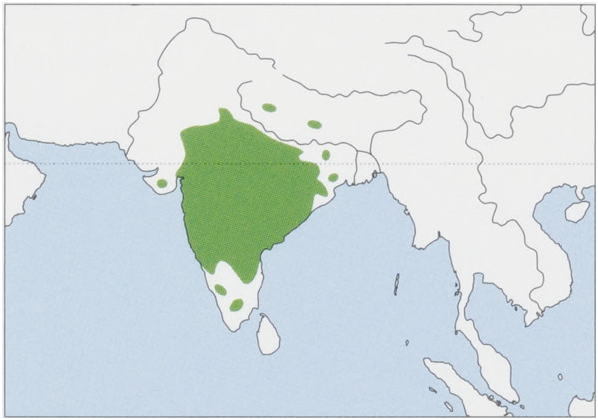
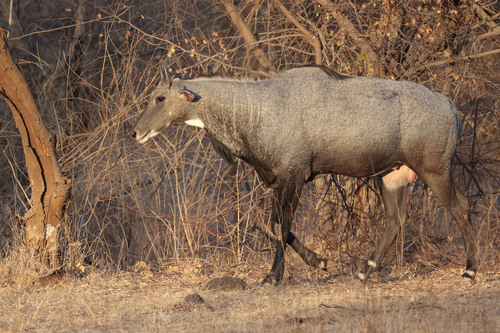
The nilgai (Boselaphus tragocamelus) (, literally meaning "blue cow") is the largest antelope of Asia, and is ubiquitous across the northern Indian subcontinent. It is the sole member of the genus Boselaphus, which was first scientifically described by Peter Simon Pallas in 1766. It is a sturdy, thin-legged antelope with a sloping back, a deep neck with a white patch on the throat, a short crest of hair along the neck terminating in a tuft, and white facial spots. A column of pendant, coarse hair hangs from the dewlap ridge below the white patch. It stands at the shoulder; males weigh , and th
Tetracerus quadricornis
species of mammal
%20male.jpg)
Boselaphini
Boselaphini is a tribe of bovines. It contains only two extant genera, each with a single extant species.

Eotragus
Eotragus is an extinct genus of early bovid. Members of this genus had a wide range inhabiting Europe, Africa, and Asia during the Miocene around 20-18 million years ago. It is related to the modern nilgai and four-horned antelope. It was small and probably lived in woodland environments.
Boselaphus
Boselaphus is a genus of bovid. The nilgai is the sole living representative, although one other species is known from the fossil record.
Tragoportax
Tragoportax is an extinct genus of bovid ungulate. It lived from the upper Miocene to the earliest Pliocene, and its fossils have been found in southeastern Europe, parts of Africa, and the Indian Subcontinent. Tragoportax was formerly considered a close relative of the extant nilgai, though more recent studies suggest that it, and several other Miocene "boselaphins", formed a tribe of their own. The number of Tragoportax species has varied over the years, and some have been reassigned to the related genus Miotragocerus. The first Tragoportax specimens were discovered in Greece, and were origi
Miotragocerus
left|thumb|Skeletal reconstruction of Miotragocerus