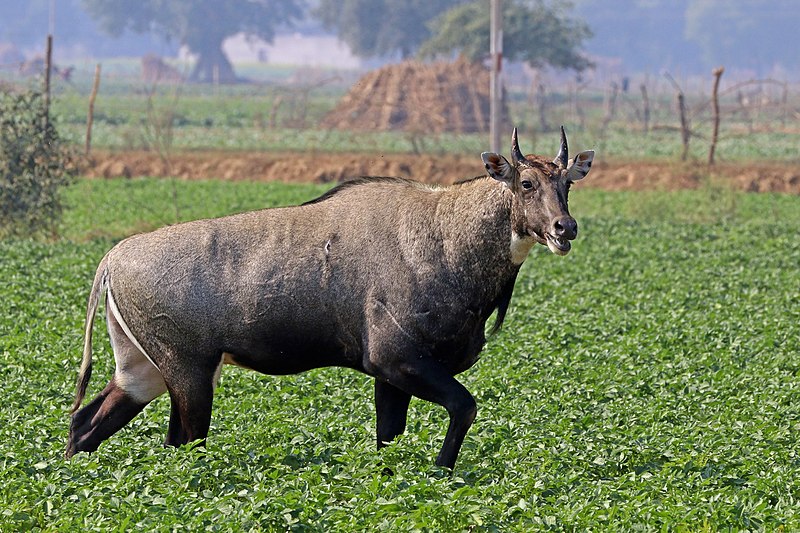
File:Nilgai_(Boselaphus_tragocamelus)_male.jpg · Wikimedia Commons · See Wikimedia Commons
Boselaphus tragocamelus
Sign in to saveAlso known as Nilgai, Blue bull, Nilgai antelope, Nilghai, Nylghai, Nylghau, Antilope tragocamelus, Antilope albipes
The nilgai (Boselaphus tragocamelus) (, literally meaning "blue cow") is the largest antelope of Asia, and is ubiquitous across the northern Indian subcontinent. It is the sole member of the genus Boselaphus, which was first scientifically described by Peter Simon Pallas in 1766. It is a sturdy, thin-legged antelope with a sloping back, a deep neck with a white patch on the throat, a short crest of hair along the neck terminating in a tuft, and white facial spots. A column of pendant, coarse hair hangs from the dewlap ridge below the white patch. It stands at the shoulder; males weigh , and th
OverviewAI-generated
Boselaphus tragocamelus, commonly known as the Nilgai, is a species of mammal belonging to the family Bovidae. It is classified within the order Artiodactyla, class Mammalia, and phylum Chordata. The scientific name for this organism is Boselaphus tragocamelus (Pallas, 1766).
The species is not extinct and has a gestation period of 8 months with a litter size of 1.5. The longest observed lifespan is 21.7 years. Its conservation status is listed as Least Concern by the IUCN Red List in 2016. Records from iDigBio indicate presence in the United States, India, and Dr Congo, with specimens held by institutions including MSB, ASNHC, UMZM, UCM, and RBINS-SCIENTIFIC HERITAGE.
Synthesized by Vinony from 30 facts across 7 sources: Wikidata, GBIF, iNaturalist, Gbif Occ, IUCN Red List, iDigBio, Vinony graph. Generated from structured data (not the Wikipedia text) and checked against those facts — may still contain errors.
Species
Least ConcernNilgai
Boselaphus tragocamelus
SPECIES
- KingdomAnimalia
- PhylumChordata
- ClassMammalia
- OrderArtiodactyla
- FamilyBovidae
二名法 Boselaphus tragocamelus(Pallas, 1766) 藍牛羚(學名:Boselaphus tragocamelus)是印度中部及北部和巴基斯坦東部最為普遍的野生動物。牠們是亞洲最大的羚羊,但成年的公羚卻像牛。 目录 1 特徵 2 分佈 3 棲息地 4 習性 5 保育狀況 6 參考 7 外部連結 特徵 藍牛羚肩高1.2-1.5米及長1.8-2米。牠們的尾巴長40-45厘米。成年的藍牛羚一般重120-240公斤;幼牛出生時重約13.6-15.9公斤。妊娠期為8星期,超過60%出生的都是孖胎,但也有生1-3頭幼牛的。牠們要到18個月大才達至性成熟,壽命為21歲。 藍牛羚的腳很幼,身體結實,由肩膀起一直向下斜。頭部窄長,有兩隻小圓角,稍為向前傾。公牛的角一般長21.6-25.4厘米。牠們的頸上有豎起的鬃毛。 雌羚的毛較短及呈黃褐色。公羚的毛色會一直變深色至成年的灰藍色。牠們兩頰上有白點,唇邊有白斑。牠們頸上有白色圍繞,沿腹部有白色斑紋一直延伸至後部。 藍牛羚的群落大小約有4-20頭,可以是單一性別或混合的,而年老的公羚有時會是獨居的。 分佈 藍牛羚分佈在由喜瑪拉雅山至卡納塔克邦的印度北部平原,與及吉爾森林國家公園(Gir Forest National Park)及巴基斯坦東部橫跨拉賈斯坦邦至阿薩姆邦和西孟加拉邦。在尼泊爾,牠們疏落的分佈在南部低地。牠們在中印度的數量每平方公里約為0.07頭。歷史紀錄上指牠們曾分佈在印度南部,但有可能流落野生的群落。 藍牛羚於1920年代被帶到美國德克薩斯州。經年有很多逃脫了人的飼養,並在南部出沒。 棲息地 雌羚。 雌羚及幼羚。 藍牛羚是日間活動的,棲息在草原及林地,主要吃草、葉子、芽及果實。 在野外,雌羚和幼羚會聚成15頭的群落,而公羚多是獨居的。公羚於冬天會聚成30-100頭的群落。牠們會避開茂密的森林,喜歡棲息在草原及有叢林的小山。牠們很少會橫渡沼澤。 習性 藍牛羚很多時會與印度黑羚一起在遼闊的平原出沒,但很少會與花鹿或豚鹿一起。花鹿和豚鹿的體型較細小,一般會與較大的藍牛羚保持距離。水鹿經常會在山區和森林中出沒,很少會與藍牛羚一起生活。 藍牛羚的天敵是老虎及獅子。豹並不足以殺死成年的藍牛羚,故會以幼羚為目標。 藍牛羚缺水下可以生存幾天,但牠們也會選擇近水源的地方生活。沙漠最初影響著牠們的分佈,但因灌溉的運河及開挖水井,令牠們可以在焦特布爾等沙漠地區生存。 藍牛羚一般會在同一地方大解。 保育狀況 藍牛羚的估計數量約為10萬頭。在美國亞拉巴馬州及德克薩斯州都有從飼養中走失的野生群落。德克薩斯州估計就有15000頭藍牛羚。 藍牛羚像其他印度的動物,是車禍下的犧牲者,在印度北部的公路中很多時都可以見到牠們的屍體。牠們的主要威脅就是人類的發展。 現時國際自然保護聯盟將牠們列為無危。[1] 參考 ^ 1.0
via GBIF · IUCN
Museum specimens
- Specimen records
- 290
- With media
- 29
- Family
- Bovidae
- Collections
- MSB, ASNHC, UMZM, UCM, RBINS-SCIENTIFIC HERITAGE, TCWC
- Recorded in
- United States, India, Dr Congo
Wikidata facts
- Instance of
- taxon
- Parent taxon
- Boselaphus
- Image
- Female neelgai 1 gir 2006 karthick.jpg
Show 12 more facts
- taxon rank
- species
- IUCN conservation status
- Least Concern
- taxon name
- Boselaphus tragocamelus
- Commons category
- Boselaphus tragocamelus
- taxon common name
- nijlgau
- Commons gallery
- Boselaphus tragocamelus
- gestation period
- 8
- described by source
- Encyclopædia Britannica 11th edition
- litter size
- 1.5
- longest observed lifespan
- 21.7
- short name
- B. tragocamelus
- time period
- Holocene
Sources (2)
via Wikidata · CC0
~23 min read
Encyclopedic overview
14 sectionsContents
- Taxonomy
- Etymology
- Evolution
- Description
- Distribution and habitat
- Behavior and ecology
- Diet
- Reproduction
- Threats and conservation
- Cultural significance
- Culling and conservation
- References
- Notes
- External links
The nilgai (Boselaphus tragocamelus) (, literally meaning "blue cow") is the largest antelope of Asia, and is ubiquitous across the northern Indian subcontinent. It is the sole member of the genus Boselaphus, which was first scientifically described by Peter Simon Pallas in 1766. It is a sturdy, thin-legged antelope with a sloping back, a deep neck with a white patch on the throat, a short crest of hair along the neck terminating in a tuft, and white facial spots. A column of pendant, coarse hair hangs from the dewlap ridge below the white patch. It stands at the shoulder; males weigh , and the lighter females . A Sexual dimorphism is prominent; while females and juveniles are orange to tawny, adult males have a bluish-grey coat. Only males possess horns, long.
Major nilgai populations occur in the Indian and Nepal Terai. The diurnal nilgai prefers areas with short bushes and scattered trees in scrub forests and grassy plains. It commonly occurs on agricultural land and rarely in dense forests. Its diet encompasses grasses and herbs, though it also eats woody plants in the dry tropical forests of India. Females become sexually mature by two years, while males do not become sexually active until four or five years old. The time of the year when mating takes place varies geographically, but a peak breeding season lasting three to four months can be observed at most places. Gestation lasts eight to nine months, following which a single calf is born, sometimes also twins or even triplets. Nilgai calves stay hidden for the first few weeks of their lives. Three distinct kinds of groups have been observed: one or two females with young calves, three to six adult and yearling females with calves, and all-male groups with two to 18 members. The lifespan of the nilgai is around 10 years. Typically tame, the nilgai may appear timid and cautious if harassed or alarmed; it flees up to , or even , galloping away from the source of danger.
Excerpted from Wikipedia’s “Boselaphus tragocamelus” article, available under the CC BY-SA 4.0 licence.
Gallery (48)
Available in 65 languages
- Español
- Français
- Deutsch
- 中文
- 日本語
- Русский
- Português
- Italiano
- العربية
- हिन्दी
- Afrikaans
- Azerbaijani
- Bahasa Indonesia
- Bangla
- Basque
- Bhojpuri
- Breton
- Bulgarian
Show 46 more
- Catalan
- Cebuano
- Czech
- Danish
- Egyptian Arabic
- Finnish
- Galician
- Georgian
- Hebrew
- Hungarian
- Ido
- Irish
- Kannada
- Kotava
- Lezghian
- Lithuanian
- Macedonian
- Malay
- Malayalam
- Marathi
- Mari
- Navajo
- Nederlands
- Nepali
- Northern Frisian
- Norwegian
- Norwegian Nynorsk
- Polski
- Punjabi
- Scots
- Serbian
- simple
- Sindhi
- Slovak
- Svenska
- Swahili
- Tamil
- Tiếng Việt
- Udmurt
- Ukrainian
- Waray
- Western Panjabi
- Wu Chinese
- فارسی
- ไทย
- 한국어
via Wikidata sitelinks · CC0