Category
page 1Brewing

beer
thumb|Schlenkerla Rauchbier, a traditional [[smoked beer, being poured from a cask into a beer glass]]

fermentation
thumb|Phylogenetic tree of bacteria and archaea, highlighting those that carry out fermentation. Their end products are also highlighted. Figure modified from Hackmann (2024).
Fermentation is a type of anaerobic metabolism that harnesses the redox potential of the reactants to make adenosine triphosphate (ATP) and organic end products. Organic molecules, such as glucose or other sugars, are catabolized and their electrons are transferred to other organic molecules (cofactors, coenzymes, etc.). Anaerobic glycolysis is a related term used to describe the occurrence of fermentation in organisms (

hydrometer
thumb|upright=0.65|Schematic drawing of a hydrometer. The lower the density of the fluid, the deeper the weighted float B sinks. The depth is read off the scale A.
barrel
unit of volume with different values

brewing
right|thumb|A 16th-century brewery
microbrewery
brewery that produces small amounts of beer
fermented food
food produced by a method converting substrates to fermentation end products
fermentation starter
method of encouraging the natural process of fermentation for foodstuffs

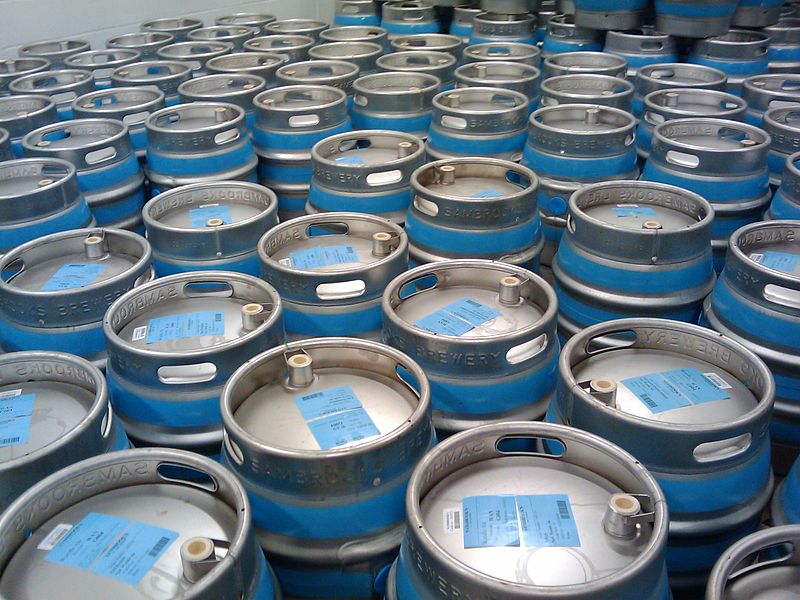
keg
thumb|250px|50 litre DIN keg, cutaway.
International Bittering Units scale
unit used to approximately quantify the bitterness of beer; 1 mg/L of iso-alpha acids

hogshead
thumb|upright=1.4|A hogshead in relation to other barrels
A hogshead (abbreviated "hhd", plural "hhds") is a large cask of liquid (or, less often, of a food commercial product) for manufacturing and sale. It refers to a specified volume, measured in either imperial or US customary measures, primarily applied to alcoholic beverages, such as wine, ale, or cider.

zymology
thumb|upright=1.2|Beer fermenting at a [[brewery]]

mashing
thumb|upright=1.3|A close-up view of grains steeping in warm water during the mashing stage of brewing

wort
Wort () is the liquid extracted from the mashing process during the brewing of beer or whisky. Wort contains the sugars, the most important being maltose and maltotriose, that will be fermented by the brewing yeast to produce alcohol. Wort also contains crucial amino acids to provide nitrogen to the yeast as well as more complex proteins contributing to beer head (froth) retention and flavour.
brewer's spent grain
brewing residue
Portal:Beer
Wikimedia portal

malting
thumb|Traditional floor malting at Highland Park Single Malt|Highland Park Distillery in Scotland
Malting is the process of steeping, germinating, and drying grain to convert it into malt. Germination and sprouting involve a number of enzymes to produce the changes from seed to seedling and the malt producer stops this stage of the process when the required enzymes are optimal. Among other things, the enzymes convert starch to sugars such as maltose, maltotriose and maltodextrines.
beer head
frothy foam on top of beer
alpha acid
group of chemical compounds
hard seltzer
alcoholic carbonated water
gravity
technical term; relative density compared to water, of the wort or must at various stages in the fermentation of alcoholic beverages
degree Plato
unit of measurement for sugar content of an aqueous solution
Standard Reference Method
method to specify beer color

World Barista Championship
barista competition
Racking
thumb|right|225px|Racking red wine
Racking, often referred to as Soutirage or Soutirage traditionnel (meaning racking in French), also filtering or fining, is the process of moving wine or beer from one container to another using gravity rather than a pump, which can be disruptive to the beverage. The process is also known as Abstich in German and travaso in Italian.
beer measurement
Methods of measurement of beer
coolship
thumb|A coolship at
A coolship (Anglicized version of the Dutch/Flemish koelschip) is a type of brewing vessel traditionally used in the production of beer. It is a broad, open-top, flat vessel in which wort cools. The high surface to volume ratio allows for more efficient cooling. Contemporary usage includes any open fermenter used in the production of beer, even when using modern mechanical cooling techniques. Traditionally, coolships were constructed of wood, but later were lined with iron or copper for better thermal conductivity.
women in brewing
history and modern sociology of women who brew alcohol
barrel-aged beer
beer that has been aged in a wooden barrel
Beer from bread
Beer brewed using bread
brewhouse
thumb|The Brewhouse Svindersvik in Nacka, Sweden.
thumb|Brewhouse from Tinn, Norway.
thumb|The Helsinki Bryggeri Brewhouse in Helsinki, Finland.
A brewhouse is a building made for brewing beer and ale. This could be a part of a specialized brewery operation, but historically a brewhouse is a private building only meant for domestic production.