Category
page 1Buddhism and death
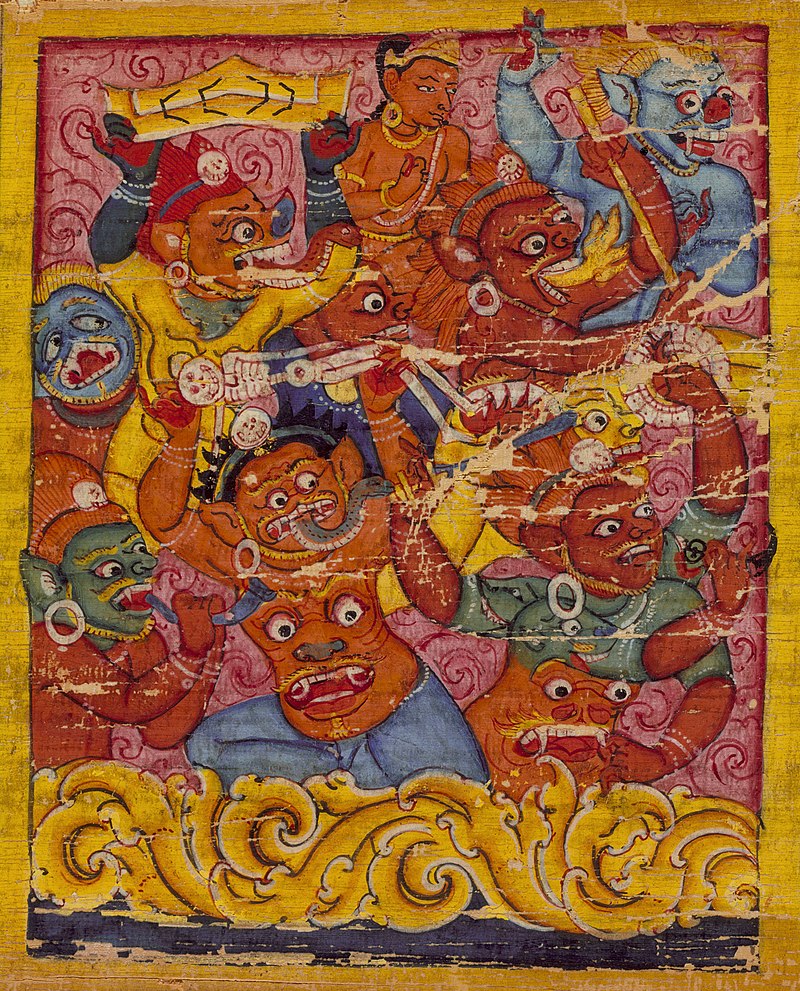
Māra Pāpīyān
God of death and sin. Ruler of the 6th heaven in the Kāmadhātu

Bardo Thodol
Nyingma terma text revealed by Karma Lingpa

Bon Festival
or just is a fusion of the ancient Japanese belief in ancestral spirits and a Japanese Buddhist custom to honor the spirits of one's ancestors. This syncretic folk Buddhist custom has evolved into a family reunion holiday during which people return to ancestral family places and visit and clean their ancestors' graves when the spirits of ancestors are supposed to revisit the household altars. It has been celebrated in Japan for more than 500 years and traditionally includes a dance, known as .

parinirvana
thumb|The death of the Gautama Buddha|Buddha, or Mahaparinirvana, [[Gandhara 2–3rd century]]

bardo
thumb|Tibetan art|Tibetan illustration of the Peaceful and Wrathful Deities of the post-mortem intermediate state (bardo). Some Tibetan Buddhists hold that when a being goes through the intermediate state, they will have visions of various deities.
In some schools of Buddhism, bardo ( Wylie: bar do) or antarābhava (Sanskrit, Chinese and Japanese: 中有, romanized in Chinese as zhōng yǒu and in Japanese as ''chū'u'') is an intermediate, transitional, or liminal state between death and rebirth. The concept arose soon after Gautama Buddha's death, with a number of earlier Buddhist schools accepting
rebirth
being is born again into one of many realms of existence after physical death, a doctrine in Buddhism
sokushinbutsu
is a type of Buddhist mummy. In Japan the term refers to the practice of Buddhist monks observing asceticism to the point of death and entering mummification while alive. Although mummified monks are seen in a number of Buddhist countries, especially in Southeast Asia where monks are mummified after dying of natural causes, it is believed that it is only in Japan where monks have induced their own deaths by starvation.
Yama (Buddhism)
a Buddhist dharmapala (wrathful god) said to judge the dead, preside over the Narakas (Hells) and the cycle of afterlife saṃsāra
death poem
genre of poetry

Shmashana
thumb|A shmashana outside an Indian village
A shmashana () is a Hindu crematory ground, where dead bodies are brought to be burnt on a pyre. It is usually located near a river or body of water on the outskirts of a village or town; as they are usually located near river ghats, they are also regionally called smashan ghats.
hungry ghost
Chinese conception of the preta of Buddhist mythology
Dharma name
name for a Buddhist who has taken refuge in three treasures, following the five precepts
Hell money
form of joss paper printed to resemble bank notes
nine stages of decay
Japanese painting with Buddhist theme
Buddhist funeral
buddhist rites after a person's death