Category
page 1Buddhist cosmology

classical elements
group of constituent basic elements of matter (water, earth, fire, air and sometimes aether), used to explain nature patterns since ancient times
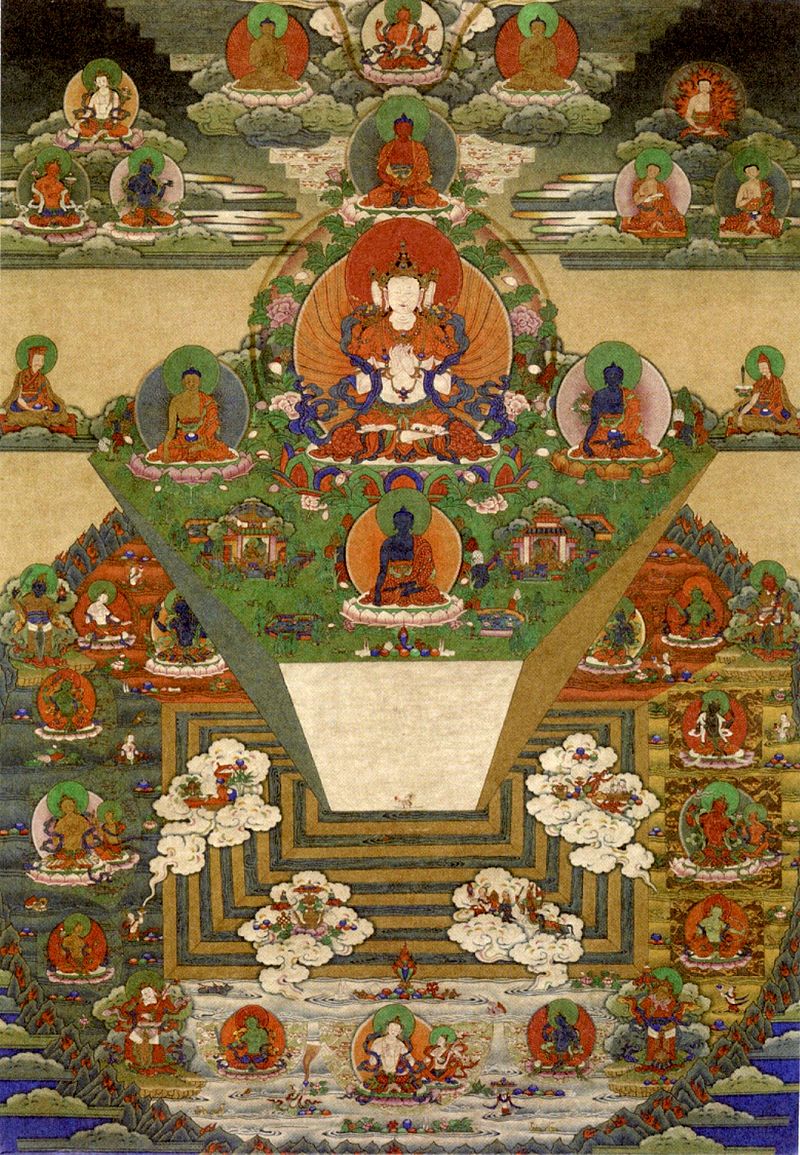
Mount Meru
sacred geographical object

kalpa
Cyclic day of Brahma in Hindu cosmology lasting 1,000 Yuga Cycles containing 14 Manvantaras and 15 Sandhyās. It is followed by a night (pralaya) of equal length, forming one 24-hour day of Brahma's 100 360-day years.
Four Heavenly Kings
Buddhist gods
Deva
supernatural beings in Buddhism; more powerful, longer-lived, and, in general, much happier than humans

loka
thumb|upright|Rajaloka, Saṁgrahaṇīratna by Śrīcandra, 17th century.

Tushita
thumb|Stone relief carving of Tushita Heaven, carved during the Kushan Dynasty
thumb|Maitreya [[Bodhisattva in Tushita Heaven. Palm leaf manuscript. Nalanda, Bihar, India]]

Kalachakra
thumb|A Kālacakra Mandala with the deities Kalachakra and Vishvamata
Śakra
deva and heavenly king in Buddhism; lord of the heavenly realm Trāyastriṃśa; regarded as king of the gods and wielder of the thunderbolt

Jambudvīpa
thumb|The Prakrit name Jambudīpasi
[[Pali Brahmi name 𑀚𑀀𑀩𑀼𑀤𑀻𑀧𑀸𑀲𑀺 (Sanskrit "Jambudvīpa") for "India" in the Sahasram Minor Rock Edict of Ashoka, circa 250 BCE (Brahmi script)]]
Jambudvīpa () is a term for the Indian Subcontinent, often used in ancient Indian sources.
Brahmā
deva and heavenly king in Buddhism; lord of the heavenly realm Brahmaloka; not regarded as a creator deity (unlike the deity of the same name in Hinduism)
Naraka
concept of hell in Buddhism
Buddhist cosmology
description of the universe in Buddhist texts

Trāyastriṃśa
thumb|The Buddha and Nanda visit the in the Trāyastriṃśa heaven, Gandhāra (present-day Pakistan), schist, late 2nd century, [[San Diego Museum of Art]]
thumb|300px|Descent of the Buddha from the Trāyastriṃśa heaven at Sankissa, Northern Gateway, Stupa No. 1, Sanchi
'''''' (; ; ) is a celestial realm of the in Buddhist cosmology and constitutes the second of the six heavens of the desire realm (). The term is a Sanskrit adjectival form derived from the numeral (), meaning "thirty-three", a reference to the pantheon of devas who preside over it, modeled after the thirty-three Vedic deities. It i

Trailokya
thumb|Sculpture of Vamana, an avatar of Vishnu, who is associated with the legend of taking three strides upon the three worlds
Trailokya (; ; , Tibetan: khams gsum; ; ) literally means "three worlds". It can also refer to "three spheres," "three planes of existence," and "three realms".

Avīci
thumb|Avīci hell, 13th century, collected in Japan
Avīci or Avici (Sanskrit and Pali for "without waves") is one of the hells (naraka) in Hinduism and Buddhism. In Hinduism, it is one of the twenty-eight hells located in the kingdom of Yama, where individuals are reborn for bearing false witness and outright lying while transacting business or giving charity. In Buddhism, it is the lowest level of the Naraka or "hell" realm, with the most suffering, into which the dead who have committed grave misdeeds may be reborn. It is said to be a cube 20,000 yojanas () on each side, buried deep underneat
desire realm
aspect of Buddhist cosmology
Fourteen unanswerable questions
Questions that Buddha refused to answer

ten realms
Buddhist cosmology
Eight Legions
group of Buddhist deities whose function is to protect the Dharma
Yāma
Yāma is the third of the six heavenly worlds of the desire realm in Buddhist cosmology. It is located between Trāyastriṃśa and Tushita. This world is variously translated as "wonderful times", "virtuous", "excellent times" or "of the hours."
Sumeru
Central world-mountain in Buddhist cosmology
Three Ages of Buddhism
3 divisions of time after Buddha's death: Former Day, lasting 1000 or 500 years, when the Dharma is upheld; Middle Day, lasting 1000 or 500 years, when a semblance of the Dharma remains; Latter Day, lasting 10000 years, when the Dharma declines
Akaniṣṭha
right|thumb|Vajradhara, the Sambhogakaya Buddha.
In classical Buddhist cosmology, Akaniṣṭha (Pali: Akaniṭṭha, meaning "Nothing Higher", "Unsurpassed") is the highest of the Pure Abodes, and thus the highest of all the form realms. It is the realm where devas like Maheśvara live.
Cāturmahārājakāyika
Cāturmahārājakāyika (; ) heaven is the first world of the devas in Buddhist cosmology. The word Cāturmahārājakāyika refers to the Four Heavenly Kings (Cāturmahārāja) who rule over this world along with the assemblage or multitude (kāyika) of beings that dwell there.
Pure Abodes
Buddhist philosophical concept
Anavatapta
thumb|Anavatapta on a Japanese Buddhist world map (1710)
Anavatapta (Sanskrit अनवतप्त "the Unheated", , also called "the Pond without Heat") is the lake lying at the center of the world, according to ancient Indian tradition. The name Anavatapta means "heat-free"; the waters of the lake were thought to be able to soothe the fires that torment living beings.
Sahā
Sahā or more formally the Sahā world (Sanskrit: sahāloka or sahālokadhātu) in Mahāyāna Buddhism refers to the mundane world, essentially the sum of existence that is other than nirvana.

Traibhūmikathā
Thai literary work