Category
page 1Buddhist goddesses

Saraswati
Saraswati (, ), also spelled as Sarasvati, is one of the principal goddesses in Hinduism, revered as the goddess of knowledge, education, learning, arts, speech, poetry, music, creativity, purification, language and culture. Together with the goddesses Lakshmi and Parvati, she forms the trinity of chief goddesses, known as the Tridevi. Saraswati is a pan-Indian deity, venerated not only in Hinduism but also in Jainism and Buddhism.

Kālī
Kali (; , ), also called Kalika, is a major goddess in Hinduism, primarily associated with time, death, and destruction. Kali is also connected with transcendental knowledge and is the first of the ten Mahavidyas, a group of goddesses who provide liberating knowledge. Of the numerous Hindu goddesses, Kali is held as the most famous. She is the preeminent deity in the Hindu tantric and the Kalikula worship traditions, and is a central figure in the goddess-centric sects of Hinduism as well as in Shaivism. Kali is chiefly worshipped as the Divine Mother, Mother of the Universe, and Divine femini
%20(6843511981).jpg)
Lakshmi
Lakshmi (; , , sometimes spelled Laxmi), also known as Shri (, ), is one of the principal goddesses in Hinduism, revered as the goddess of happiness, fortune, wealth, prosperity, beauty, fertility, sovereignty, and abundance. She, Parvati, and Sarasvati form the trinity of goddesses called the Tridevi.

Parvati
Parvati (, ), also known as Uma (, ) and Gauri (, ), is one of the principal goddesses in Hinduism, revered as the goddess of power, energy, nourishment, harmony, love, beauty, devotion, and motherhood. Along with Lakshmi and Sarasvati, she forms the trinity, known as the Tridevi.

Apsara
thumb|A 12th-century sandstone statue of an apsara from Madhya Pradesh, India

Gangā
goddess personifying the river Ganges in Hinduism

Nüwa
Nüwa, also read Nügua, is a mother goddess, culture hero, and/or member of the Three Sovereigns of Chinese mythology. She is a goddess in Chinese folk religion, Chinese Buddhism, Confucianism and Taoism. She is credited with creating humanity and repairing the Pillar of Heaven.

Mazu
Mazu or Matsu is a sea goddess in Chinese folk religion, Chinese Buddhism, Confucianism, and Taoism. She is also known by several other names and titles. Mazu is the deified form of Lin Moniang (), a shamaness from Fujian who is said to have lived in the late 10th century. After her death, she became revered as a tutelary deity of Chinese seafarers, including fishermen and sailors.
.jpg)
Guan Yin
Guanyin () is a common Chinese name of the Bodhisattva associated with compassion known as Avalokiteśvara (). Guanyin is short for Guanshiyin, which means "[The One Who] Perceives the Sounds of the World". Originally regarded as male in Indian Buddhism, Guanyin has been more commonly depicted as female in China and most of East Asia since about the 12th century. Due to sociogeographical factors, Guanyin may also be historically depicted as genderless or androgynous. On the 19th day of the sixth lunar month, Guanyin's attainment of Buddhahood is celebrated. Guanyin has been incorporated in othe
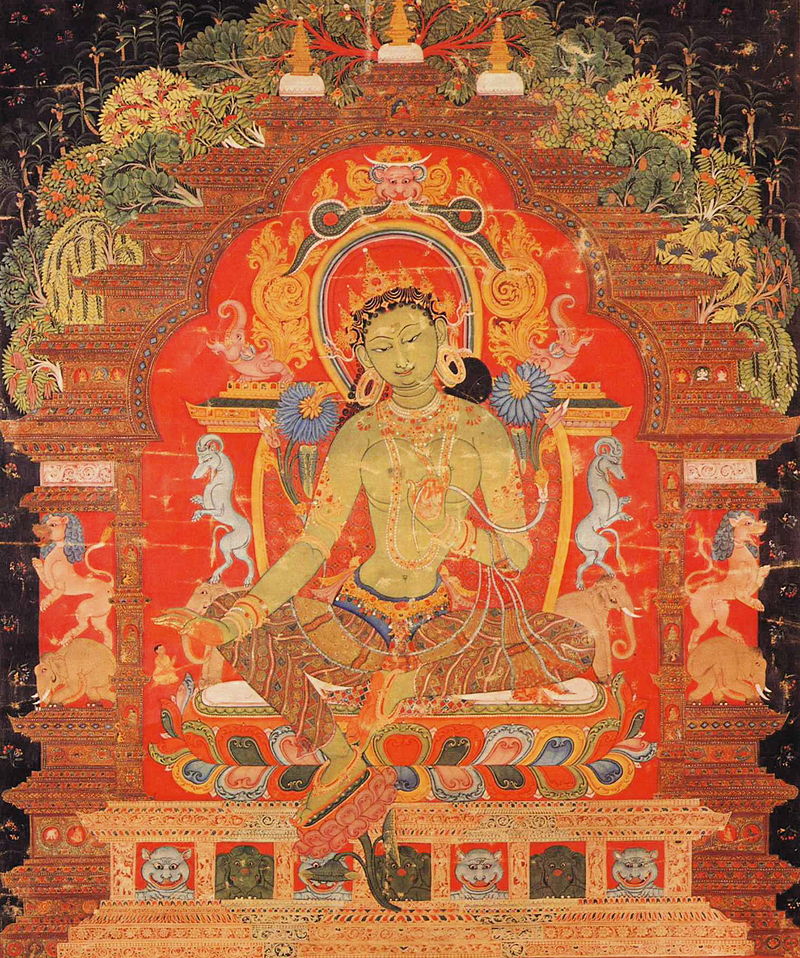
Tārā
female Bodhisattva

Benzaiten
or simply Benten is an East Asian Buddhist goddess who originated from the Hindu Saraswati, the patroness of speech, the arts, and learning.
Mārīcī
Buddhist god

Hariti
Hārītī (Sanskrit), also known as , , is a female rākṣasī or yakṣinī (nature spirit) in Buddhism. She appears as a character in all Buddhist traditions and she is revered as a fierce Dharma Protector and a fertility goddess in Mahayana Buddhism. Hārītī appears in various Mahayana sutras, including in the Lotus Sutra, where she vows to protect those who uphold the sutra. She is also mentioned as a protector in the Candragarbhasūtra.

Manimekhala
thumb|300px|Illustrated of Mekhala and Ramasura, from a samut khoi of Thai poetry in the second half of the 19th century. Now in the collection of [[Bavarian State Library, Germany.]]

Revatī
Revati () is a goddess featured in Hindu scriptures. She is King Kakudmi's daughter and Krishna's elder brother Balarama's consort, and one of the Dashavatara. Her account is given within a number of Hindu texts such as the Mahabharata and the Bhagavata Purana.

Suvannamaccha
Suvannamaccha (; ; , ALA-LC: Suvaṇṇmacchā; , ; literally "golden fish") is a daughter of Ravana (Thotsakan) appearing in the Thailand and other Southeast Asian versions of Ramayana. She is a mermaid princess who tries to spoil Hanuman's plans to build a bridge to Lanka but falls in love with him instead.
Kisshōten
Śrīmahādevī, (Chinese: 吉祥天, pinyin: Jíxiángtiān, romaji: Kichijōten or Kisshōten, lit: "Auspicious Devi"), also known as Lakshmi (Chinese: 功德天, pinyin: Gōngdétiān, romaji: Kudokuten, lit: "Meritorious Devi"), is a devi in Mahayana Buddhism. She is particularly respected in East Asian Buddhist traditions as a protector deity due to her appearance in the Golden Light Sutra where she introduced her mantra and made vows to protect any bhikṣu who will uphold and teach the sutra.

Nang Kwak
Thai household spirit
Sunthareevani
Phra Sunthariwani, also known as Nang Sunthariwani, is a goddess in the Thai Buddhist tradition, regarded as the protector of the Dhamma and the Tripiṭaka. She is venerated especially at Wat Suthat Thepwararam Ratchaworamahawihan. Depicted with a pure white body, she is adorned in royal Thai attire, dressed in white, with two arms. Her right hand is in a beckoning gesture (later changed to the vitarka mudrā), and her left hand holds a crystal ball in her lap.

Parṇa-śāvari
thumb|Goddess Parnashavari
Zennyo Ryūō
rain-god dragon in Japanese mythology
Pattini
Pattini (, ) is considered a guardian deity of Sri Lanka in both Sri Lankan Buddhism and Sinhalese folklore. She is also worshipped by Sri Lankan Tamil Hindus under the name Kannaki Amman.
Ananta
one of the names of Vishnu
Prajñāpāramitā Devī
Buddhist goddess that symbolizes and embodies Prajñāpāramitā, the perfection of transcendent wisdom