Category
page 1Buddhist mythology
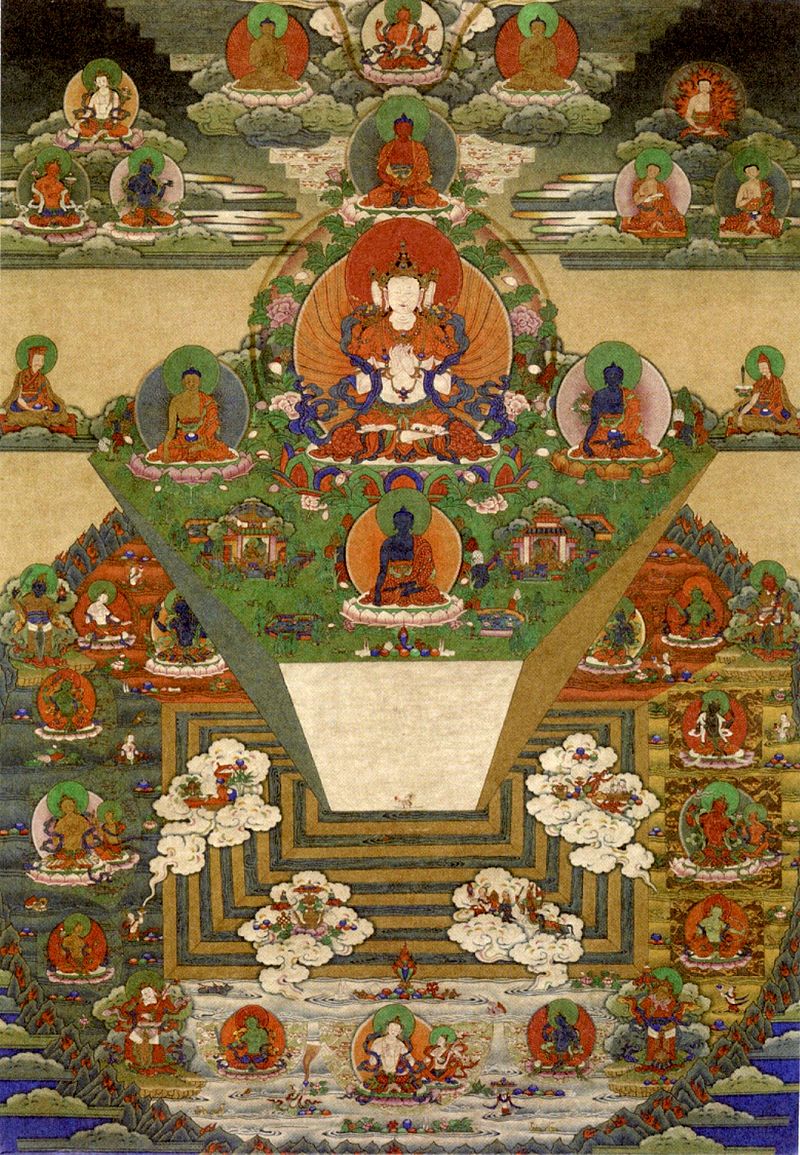
Mount Meru
sacred geographical object

Vamana
Vamana (, ), also known as Trivikrama (), Urukrama (), Upendra (), Dadhivamana (, ), Ulagalanthan (lit. 'the one who measured the world) and Balibandhana (), is an avatar of the Hindu deity Vishnu. He is the fifth avatar of Vishnu and the first Dashavatara in the Treta Yuga, after Narasimha.

amrita
thumb|Mohini, the female form of [[Vishnu, holding the pot of amrita, which she distributes amongst all the devas, leaving the asuras without it. Darasuram, Tamil Nadu, India|alt=A stone carving of a standing woman with a pot in her left hand and lotus in right]]
.jpg)
Bayon
The Bayon (, ; BAI-on) is a richly decorated Theravada Buddhist temple of the Khmer Empire located at Angkor in Cambodia. Built in the late 12th or early 13th century as the state temple of King Jayavarman VII (), it stands at the centre of Jayavarman’s capital city, Angkor Thom ().
The Bayon reflects the strong Buddhist orientation of Jayavarman VII’s reign. Originally conceived as a Mahayana Buddhist monument centered on the cult of the Bodhisattva of compassion, the temple later adapted to the spread of Theravada Buddhism in Cambodia. Its iconography, spatial organization, and emphasis on c

Saraca asoca
species of plant

Mahāmaudgalyāyana
Maudgalyāyana (), also known as Mahāmaudgalyāyana or by his birth name Kolita, was one of the Buddha's closest disciples. Described as a contemporary of disciples such as Subhuti, Śāriputra (''''), and Mahākāśyapa (), he is considered the second of the Buddha's two foremost male disciples, together with Śāriputra. Traditional accounts relate that Maudgalyāyana and Śāriputra become spiritual wanderers in their youth. After having searched for spiritual truth for a while, they come into contact with the Buddhist teaching through verses that have become widely known in the Buddhist world. Eventua

Rāhula
Rāhula (born ) was the only son of Siddhārtha Gautama, commonly known as the Buddha, and his wife, princess Yaśodharā. He is mentioned in numerous Buddhist texts, from the early period onward. Accounts about Rāhula indicate a mutual impact between Prince Siddhārtha's life and the lives of his family members.

Mohinī
Mohini (Sanskrit: मोहिनी, '') is the Hindu goddess of enchantment. She is the only female avatar of the Hindu god Vishnu. She is portrayed as a femme fatale, an enchantress, who maddens lovers and demons, sometimes leading them to their doom. Mohini is introduced into Hinduism in the narrative epic of the Mahabharata''. Here, she appears as a form of Vishnu following the Churning of the Ocean, a mesmerising beauty who distributes the amrita (the elixir of immortality) to the weakened devas (gods) and depriving it to the dominant asuras (demons), allowing the former to defeat the latter with th

Cintāmaṇi
thumb|572x572px|Japanese depiction of Lakshmi (Kichijōten), bearing the Cintāmani
Cintāmaṇi (Sanskrit; Devanagari: ; ; ; Korean: 여의보주/Yeouiboju; Japanese Romaji: ), also spelled as Chintamani (or the Chintamani Stone), is a wish-fulfilling jewel resembling a pearl described in Hindu and Mahayana Buddhist traditions. It is one of several Mani Jewel images found in Buddhist scripture.
Chakravartin
ancient Indian term used to refer to an ideal universal ruler

Diyu
Diyu () is the realm of the dead or "hell" in Chinese mythology. It is loosely based on a combination of the Buddhist concept of Naraka, traditional Chinese beliefs about the afterlife, and a variety of popular expansions and reinterpretations of these two traditions. The concept parallels purgatory in certain Christian denominations.
Great Renunciation
event in the life of Gautama Buddha
Buddhist mythology
mythology that operates within the Buddhist belief system
.jpg)
Longnü
thumb|right|Avalokiteśvara with Longnü (left) and Sudhana (right).
Maheśvara
figure in Buddhist Mythology
Nimi
First King of Videha (Mithila region)
Straw Millionaire
Japanese folk tale

Maha Sammata
Mahāsammata (; also spelled Maha Samrat; lit. "the Great Elect"), also known as first Khattiya and Rāja, was the first farmer monarch of the world according to Buddhist tradition. The chronicles of Theravada Buddhist tradition such as Mahāvaṃsa and Maha Yazawin states that he was the founder of the Shakya dynasty, to which the historical Buddha belonged. According to the Agganna Sutta, he was a rice farmer who was elected by the other farmers to rule them as per Dhamma. He was the first of the eleven world monarchs called Maha Sammata, each of whom founded the eleven dynasties that existed fro
Trailokyavijaya
thumb|260px|Trailokyavijaya tramples on Maheśvara and his consort as the great victor
thumb|Ming dynasty (1368–1644) Shuilu ritual painting of Trailokyavijaya (Xiangsanshi Mingwang), one out of a set depicting the Ten Wisdom Kings, at Baoning Temple in [[Shanxi, China]]
thumb|Sculpture of Trailokavijaya from Bodh Gaya, [[Bihar dated to the 8th to 12th century CE. ]]Trailokyavijaya (, Japanese: Gōzanze Myōō; Korean: Hangsamse Myeongwang; Sanskrit: त्रैलोक्यविजय) is a Buddhist wrathful deity and one of the Wisdom Kings (Myōō). He is regarded as a fierce manifestation of the bodhisattva Vajrapāṇi
Sumedha
In Buddhist texts, Sumedha is a previous life of Gotama Buddha (Pāli; ) in which he declares his intention to become a Buddha. Buddhist texts describe that this takes place when Gotama Buddha is still a Buddha-to-be (', '). Traditions regard Sumedha's life as the beginning of the spiritual journey leading up to the attainment of Buddhahood by Gotama in his last life, a journey which takes place through many lifetimes. Born in a brahmin family, Sumedha begins to live as an ascetic in the mountains. One day he meets Dīpankara Buddha () and offers his own body for him to walk over. During this sa
Youdu
Youdu () in Chinese mythology is the capital of Hell, or Diyu. Among the various other geographic features believed of Diyu, the capital city has been thought to be named Youdu. It is generally conceived as being similar to a typical Chinese capital city, such as Chang'an, but surrounded with and pervaded with darkness.
Sacca-kiriya
thumb|The motif of the sacca-kiriyā presumes a natural moral force operating in the world.
Sacca-kiriyā (Pāli; , but more often: satyādhiṣṭhāna) is a solemn declaration of truth, expressed in ritual speech. Most often found in Buddhism, it can be an utterance with regard to one's own virtue, or with regard to a certain fact, followed by a command or resolution. Such a statement is believed to effect a wonder-working power that can benefit oneself and others, depending on the truthfulness of the person making the statement. The sacca-kiriyā is a motif found in the scriptural stories from the Pā