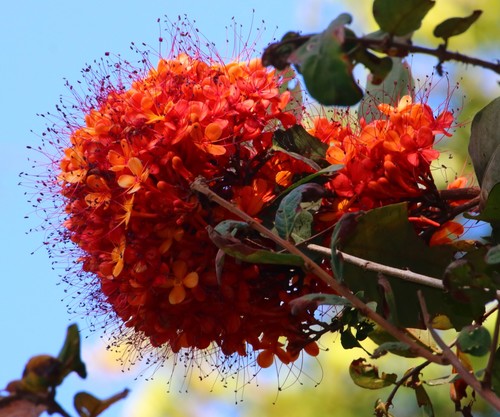
(c) Shiwalee Samant, some rights reserved (CC BY-NC), uploaded by Shiwalee Samant · cc-by-nc
OverviewAI-generated
Saraca asoca, commonly known as the Ashoka tree, is a species of plant in the family Fabaceae. It belongs to the genus Saraca and is classified within the order Fabales, class Magnoliopsida, and phylum Tracheophyta. The taxon is listed as Near Threatened on the IUCN Red List for 2025, though it has also been categorized as Vulnerable.
The native range of S. asoca includes Assam, Bangladesh, the East Himalaya, India, Myanmar, Nepal, and Sri Lanka. It has been introduced to the Andaman Islands, Jawa, the Laccadive Islands, Malaya, New Guinea, Pakistan, Sulawesi, and Sumatera. Records of the species are held by institutions in the US, BRIT, UNESP-FCA, BPBM, and MNHN, with occurrences documented in Sri Lanka, Bangladesh, Brasil, India, and Fiji.
Synthesized by Vinony from 37 facts across 8 sources: Wikidata, GBIF, iNaturalist, Gbif Occ, IUCN Red List, Plants of the World, iDigBio, Vinony graph. Generated from structured data (not the Wikipedia text) and checked against those facts — may still contain errors.
Species
Near ThreatenedAshoka
SPECIES
- KingdomPlantae
- PhylumTracheophyta
- ClassMagnoliopsida
- OrderFabales
- FamilyFabaceae
Saraca asoca ist eine Pflanzenart innerhalb der Familie der Hülsenfruchtgewächse (Fabaceae). Die natürliche Heimat ist der Indische Subkontinent: Bangladesch, Indien sowie Sri Lanka und das westliche Myanmar.[1] Die Sanskrit-Bezeichnung ashoka bedeutet „ohne Sorgen“, davon abgeleitet wird manchmal diese, aber auch eine andere Art Ashokabaum genannt. Inhaltsverzeichnis 1 Beschreibung 1.1 Erscheinungsbild und Blatt 1.2 Blütenstand, Blüte, Frucht und Samen 2 Verbreitung 3 Taxonomie 4 Nutzung 5 Kulturelle Bedeutung 6 Quellen 7 Einzelnachweise 8 Ergänzende Literatur 9 Weblinks Beschreibung Paarig gefiedertes, ledriges Laubblatt Ashokabaum mit Laubblättern und Blütenständen Erscheinungsbild und Blatt Saraca asoca wächst als immergrüner, aufrechter kleiner Baum[2] und erreicht Wuchshöhen von maximal 8 bis 12 Meter. Er verzweigt sich früh; seine Äste bilden eine weitausladende Krone aus. Die gestielten Laubblätter sind 30 cm lang und paarig gefiedert mit nur vier bis sechs Paaren von Fiederblättern. Die kahlen, ledrigen Fiederblätter sind mit einer Länge von 10 bis 20 cm relativ groß und länglich oder lanzettlich. Die kleinen, intrapetiolaren Nebenblätter fallen früh ab.[2] Blütenstand, Bl
via GBIF · IUCN · Kew POWO
Museum specimens
- Specimen records
- 126
- With media
- 120
- Family
- Fabaceae
- Collections
- US, BRIT, UNESP-FCA, BPBM, MNHN, MO
- Recorded in
- Sri Lanka, Bangladesh, Brasil, India, Fiji, United States, Egypte, Indonesia
Wikidata facts
Show 9 more facts
- taxon rank
- species
- IUCN conservation status
- Near Threatened
- Commons category
- Saraca asoca
- taxon name
- Saraca asoca
- taxon common name
- 印度无忧花
- described by source
- Brockhaus and Efron Encyclopedic Dictionary
- short name
- S. asoca
- taxon range
- Tibet Autonomous Region
Sources (1)
via Wikidata · CC0
~8 min read
Encyclopedic overview
Saraca asoca, commonly known as the ashoka tree (lit. "sorrow-less"), is a plant belonging to the Detarioideae subfamily of the Fabaceae family of plants (also referred to as the legume, pea, or bean family).
The tree is native to the Indian subcontinent, with its native range extending from Pakistan to the west, through India and Bangladesh to Myanmar in the east, and from Bhutan and Nepal in the north to Sri Lanka in the south. Within its native range, it is primarily growing in seasonally dry tropical forests.
Excerpted from Wikipedia’s “Saraca asoca” article, available under the CC BY-SA 4.0 licence.