Category
page 1Buddhist poets

Matsuo Bashō
Japanese poet (1644–1694)

Murasaki Shikibu
Japanese novelist and poet (c.973–c.1014)

Bai Juyi
Chinese poet of the Tang Dynasty (772-846)

Dōgen
was a Japanese Zen Buddhist monk, writer, poet, philosopher, and founder of the Sōtō school of Zen in Japan. He is also known as Dōgen Kigen (), Eihei Dōgen (), Kōso Jōyō Daishi (), and Busshō Dentō Kokushi ().
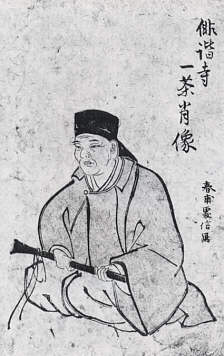
Kobayashi Issa
Japanese writer (1763-1828)

Kūkai
, born posthumously called , was a Japanese Buddhist monk, calligrapher, and poet who founded the esoteric Shingon school of Buddhism. He travelled to China, where he studied Tangmi (Chinese Vajrayana Buddhism) under the monk Huiguo. Upon returning to Japan, he founded Shingon—the Japanese branch of Vajrayana Buddhism. With the blessing of several Emperors, Kūkai was able to preach Shingon teachings and found Shingon temples. Like other influential monks, Kūkai oversaw public works and constructions. Mount Kōya was chosen by him as a holy site, and he spent his later years there until his deat

Kenji Miyazawa
Japanese poet and author of children's literature (1896-1933)

Gary Snyder
American poet (born 1930)

Saigyō
was a Japanese poet of the late Heian and early Kamakura period.

Kamo no Chōmei
Japanese poet

Hōnen
Jien
was a Japanese poet, historian, and Buddhist monk.

Ryōkan
was a quiet and unorthodox Sōtō Zen Buddhist monk who lived much of his life as a hermit. Ryōkan is remembered for his poetry and calligraphy, which present the essence of Zen life.
Ocean Vuong
Vietnamese American poet, essayist and novelist (born 1988)
Hanshan
Chinese monk and poet
Anne Waldman
American poet (1945-)
Fujiwara no Toshinari
poet and court noble

Jakuren
200px|thumb|right|Jakuren in the Hyakunin Isshu.
' (also known as Fujiwara no Sadanaga' (藤原定長) before becoming a monk) (1139–1202) was a Japanese Buddhist priest and poet. He was adopted by the noted poet Fujiwara no Shunzei upon the death of Shunzei's younger brother. Shunzei originally intended for Sadanaga to be his heir; however, he subsequently had two male offspring of his own, and Sadanaga was forced to step aside in favor of Fujiwara no Sadaie. As was common practice at the time, he became a monk, and acquired the religious name of Jakuren. Taking Saigyo as his model, he traveled aroun
Santōka Taneda
Japanese poet (1882–1940)

Sōgi
thumb|A print (by Tsukioka Yoshitoshi) depicts Sōgi writing a couplet for a ghost.
Iio Sōgi, (or Inō Sōgi) generally known as , was a Japanese poet. He came from a humble family from the province of Kii or Ōmi, and died in Hakone on September 1, 1502. Sōgi was a Zen monk from the Shōkoku-ji temple in Kyoto and he studied poetry, both waka and renga. In his 30s, he became a professional renga poet.

Nōin
right|thumb|, from the Ogura Hyakunin Isshu.
, also known was , was a Japanese poet and monk of the late Heian period.
Kyunyeo
Kyunyŏ (or Kyunyeo, ; 923–973) was a Korean Buddhist monk and poet. He came from the Hwangju Byeon clan and his hometown was Hwangju. Among his works are the first extant collection of poetry in Korean, Songs of the Ten Vows Samantabhara, which can be found in The Life of Kuehne (c. 1075).
Shunzei's Daughter
poet
Shide
Chinese Zen monk and poet
Fenggan
Fenggan (, Japanese Bukan, fl. 9th century) was a Chinese Chan monk-poet lived in the Tang dynasty, associated with Hanshan and Shide in the famed "Tiantai Trio" (天台三聖).
Paramanuchitchinorot
Paramanuchitchinorot (, or ; also spelt Paramanujita Jinorasa, Paramanujit Jinoros, etc.; 11 December 1790 – 9 December 1853) was a Buddhist writer and a prince of the Chakri dynasty. One of his well-known epic poems is Lilit Taleng Phai. In 1851 he was appointed the Supreme Patriarch of the Rattanakosin kingdom and remained in that position until his death.
Albert Saijo
poet
Ton'a
200px|thumb|Ton'a
, also read as Tonna; lay name – Nikaidō Sadamune (二階堂貞宗), was a Japanese Buddhist poet who was a student of Nijō Tameyo. Ton'a took a tonsure at Enryaku-ji Temple, but was later associated with the Ji sect (founded by Ippen). He looked up to Saigyō's poetic genius.
Kagami Shikō
Japanese poet and writer
Khuông Việt
Vietnamese Buddhist monk and poet
Sakugen Shūryō
Japanese diplomat (1501–1579)