Category
page 1Byzantine art

mosaic
A mosaic () is a pattern or image made of small regular or irregular pieces of colored stone, glass or ceramic, held in place by plaster/mortar, and covering a surface. Mosaics are often used as floor and wall decoration, and were particularly popular in the Ancient Roman world.

Byzantine art
art of the Byzantine (Eastern Roman) Empire
Daphni Monastery
11th-century Byzantine monastery in Greece
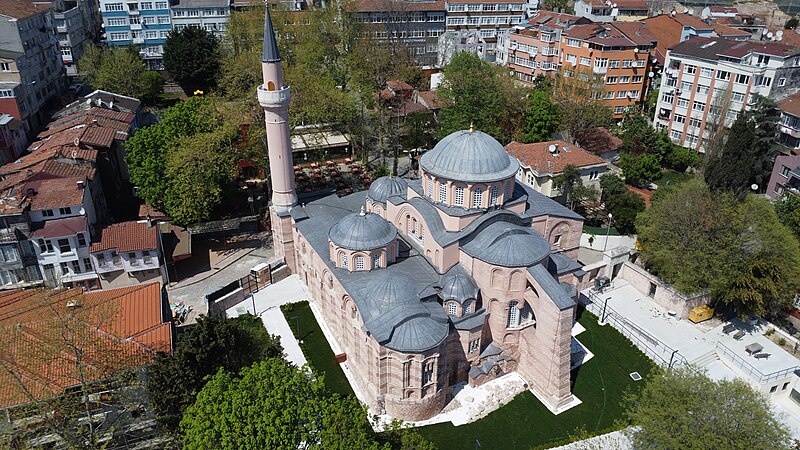
Chora Church
church converted to mosque in Turkey

Holy Crown of Hungary
coronation crown in the Kingdom of Hungary
Nea Moni of Chios
11th-century monastery on the island of Chios, Greece
Cefalù Cathedral
cathedral in Italy
Basilica of Sant'Apollinare in Classe
Byzantine-style minor basilica in Ravenna, Italy
Pammakaristos Church
former church, at present a mosque and museum in Istanbul
Cappella Palatina
royal chapel in Palermo, Sicily

Deesis
thumb|Icon of the Deesis – St. Catherine's Monastery Sinai, 12th century
thumb| Great Deesis with Prophets; 16th century; Walters Art Museum
In Byzantine art, and in later Eastern Orthodox iconography generally, the Deësis or Deisis (, ; , "prayer" or "supplication") is a traditional iconic representation of Christ in Majesty or Christ Pantocrator: enthroned, carrying a book, and flanked by the Virgin Mary and St. John the Baptist, and sometimes other saints and angels. Mary and John, and any other figures, are shown facing towards Christ with their hands raised in supplication on behalf of h
Our Lady of Perpetual Help
title for the Virgin Mary and a 15th century icon
Macedonian Renaissance
Byzantine empire cultural movement during the reign of the Macedonian dynasty
Santa Prassede
medieval church in Rome
Eleusa
type of depiction of the Virgin Mary in icons in which the infant Jesus Christ is nestled against her cheek
Norman-Arab-Byzantine culture
cultural interaction in Medieval Sicily
Christ in Majesty
Christian image of Christ seated on a throne as ruler of the world, often surrounded by other Christian figures
Pala d'Oro
altar in the Basilica di San Marco, Venice
Monomachus Crown
Byzantine crown
Palaeologan Renaissance
Period in Byzantine art

Hetoimasia
thumb|250px|The empty throne with cushion, crux gemmata and cloth, flanked by Saints Peter and Paul. [[Arian Baptistery, Ravenna, early 6th century.]]
Disc of Theodosius
large ceremonial silver dish
Byzantine mosaics
sacred art that uses mosaic in places of worship, between the 6th and 15th centuries in the Byzantine Empire
Macedonian art
period of Byzantine art
Antioch Chalice
silver-gilt metalwork in the Met
Gunthertuch
thumb|The , Diocesan Museum, Bamberg
The '''''' () is a Byzantine silk tapestry which represents the triumphal return of a Byzantine Emperor from a victorious campaign. The piece was purchased, or possibly received as a gift, by Gunther von Bamberg, Bishop of Bamberg, during his 1064–65 pilgrimage to the Holy Land. Gunther died on his return journey, and was buried with it in the Bamberg Cathedral. The fabric was rediscovered in 1830, and is now exhibited in the Bamberg Diocesan Museum.
Military saint
Wikimedia list article
Nicopeia
thumb|Example in Hagia Sophia, Istanbul.
Nicopeia (sometimes transliterated Nikopoia, Nikopea or Nikopeia; literally 'bringer of victory', from ) is a title of the Virgin Mary and a type of icon in Byzantine art showing Mary frontally, seated on a throne and holding the Christ Child in her arms. A conceptually similar idea in the Western Church is Our Lady of Victory. It is similar to the Theotokos Kyriotissa (enthroned Madonna) and the Tuscan 'Maestà'.
Preslav Treasure
artifacts found in Castana, Bulgaria
Byzantine Museum of Kastoria
museum in Greece
Cross of Justin II
processional cross and reliquary of the True Cross
Byzantine Institute of America
preservation organization for Byzantine art USA
The Queen stands at your right hand
icon of Christ the King of Kings flanked by Mary and John the Baptist
Aachen Gospels
manuscript
Hestia Tapestry
Byzantine-era pagan tapestry in the Dumbarton Oaks Collection
Dagmar Cross
11th-12th-century Slavic reliquary cross made of gold
Limburg Staurotheke
reliquary in Limburg an der Lahn, Hesse, Germany
art of Byzantine illumination
illumination of manuscripts across the Byzantine Empire
Byzantine enamel
metal and glass-working tradition