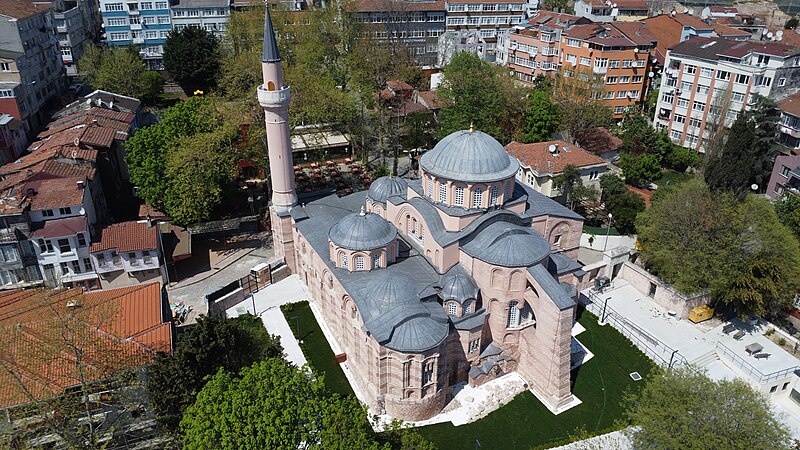
File:Chora_Church_2024.jpg · Wikimedia Commons · See Wikimedia Commons
Chora Church
Sign in to saveAlso known as Kariye Church, Kariye Mosque, Kariye Museum, Church of the Holy Saviour in Chora, Kariye Camii
church converted to mosque in Turkey
Key facts
- Affiliation
- Greek Orthodox Church (before 1500), Sunni Islam (1500–1945, 2020–present), Directorate of Religious Affairs of Turkey (1924–1945, 2020–present)
- Status
- Mosque (since 2020)
- Location
- Istanbul , Turkey
- Type
- Church
- Style
- Byzantine architecture , Ottoman architecture , Islamic
via Wikipedia infobox
Described at

Chora Monastery
The Monastery of Christ at Chora (now Kariye Mosque) is extensively decorated with mosaics and frescoes
thebyzantinelegacy.com →The Monastery of Christ at Chora (Μονή του Χριστού της Χώρα) was located in northwestern Byzantine Constantinople (modern Istanbul, Turkey) near Charisios Gate (Edirnekapı), south of the Palace of the Porphyrogenitus (Tekfur Sarayı) . The well-preserved mosaics and frescoes of the surviving katholikon of the monastery are important examples of monumental art of the Late Byzantine period. After serving as a mosque (known as Kariye Mosque or Ali Pasha Kenise Mosque), it was converted into a museum in 1945 and is now part of the Historic Areas of Istanbul of UNESCO World Heritage. The rural character of the site seems to account for the name chora (χώρα), which can be interpreted as “land” or “in the country”. The site was originally outside the city walls built by Constantine, but also would have continued to be sparsely inhabited even during much of the Ottoman era. The word chora can also mean “dwelling place”, and may have been interpreted in a mystical sense. Inscriptions of its decoration identifies Christ as “the land of the living” and the Virgin as “the container of the uncontainable”, both of which involve a play on the word chora. The early history of Chora is obscure due in part to the many contradictions in the sources. According to one tradition, the relics of St. Babylas were located here in the early 4th century. Another tradition attributes its foundation to St. Theodore, an uncle of Theodora, the wife of Justinian I. A more reliable founder is general Crispus, the son-in-law of Emperor Phocas, who supposedly founded the monastery in the 7th century when Heraclius forced him to retire. The earliest archaeological evidence is the vaulted substructures under the naos, which have been dated as early as the 6th century. Chora was a center of the resistance to Iconoclasm in the 8th and 9th centuries, with the iconodule saint Michael Synkellos serving as its abbot. Other iconodule saints were buried there, including deposed Patriarch Germanos and Theophanes Graptos. The first phase of the current structure dates to the 11th century, when Maria Doukaina, the mother-in-law of Alexios I, restored the monastery around 1077-1081. Chora was again renovated in the 12th century (perhaps after being damaged by an earthquake) by the sebastokrator Isaac Komnenos (depicted in the Deesis mosaics in the inner narthex), when it took the form of an atrophied Greek cross. Isaac Komnenos, the younger brother of Emperor John II (1118-1143), had a tomb built at Chora, though he was later buried at the Kosmosoteira Monastery in Bera (modern Feres, Greece). Patriarch Kosmas was also buried at Chora in 1081. Chora was either damaged or falling into ruin during the Latin Occupation of Constantinople (1204-1261). The scholar Maximos Planudes and Patriarch Athanasios both commented on its poor state after the city was reconquered. The nun Melane (formerly Maria, daughter of Emperor Michael VIII) made donations to the monastery and might have sponsored some repairs around this time, as she is depicted in the Deesis mosaic in the inner narthex. Theodore Metochites began to restore Chora on a grand scale around 1315. He was first the minister of the treasury when he began the project and subsequently was promoted to be the grand logothete (1316-1321). He was also one of the greatest scholars of his era and the first non-imperial founder of a monastery in the Late Byzantine era. His portrait is located above the entrance to the naos (nave), where he is depicted offering the church to Christ. The church was extensively rebuilt and lavishly decorated with mosaics and frescoes by Metochites. The monastery he refounded was endowed with substantial estates, as well as a hospital and a public kitchen. He also donated his extensive collection of books, making it the most comprehensive library of Constantinople in the Late Byzantine era. After falling from power in 1328 and being exiled from the city for two years, he returned to Chora as a monk and was b
Excerpt from a page describing this subject · 27,986 chars · not written by Vinony
Wikidata facts
- Instance of
- mosque
- Part of
- Historic Areas of Istanbul
- Named after
- Mary
- Religion
- Islam
- Country
- Turkey
- Located in
- Fatih
- Dedicated to
- Jesus
- Image
- Chora Church 2024.jpg
- Has use
- mosque
Show 5 more facts
- Commons category
- Kariye Mosque
- architectural style
- Ottoman architecture
- inception
- 1001-01-17
- described at URL
- www.thebyzantinelegacy.com/chora
- located in/on physical feature
- Marmara Region
via Wikidata · CC0
~21 min read
Encyclopedic overview
Exterior rear
Front
Excerpted from Wikipedia’s “Chora Church” article, available under the CC BY-SA 4.0 licence.