Category
page 1Caliciales genera
.JPG)
Physcia
Physcia is a genus of lichen-forming fungi in the family Physciaceae. The widely distributed genus contains about 80 species. The genus is cosmopolitan, and has been extensively studied in various regions in the past several decades, with significant biodiversity in South America identified as a central diversity hotspot. Physcia species are foliose, lichens that grow with a loose to close appressed habit. Their upper surface is typically whitish, pale greenish, green-grey, or dark grey in colour. The thallus colour remains relatively unchanged when moistened. Physcia lichens typically grow on

Anaptychia
Anaptychia is a genus of lichen-forming fungi in the family Physciaceae. Anaptychia species are foliose (leafy) to fruticose (bushy) lichens. They have brown, thin-walled spores with a single septum, and a upper .

Physconia
Physconia is a genus of lichen-forming fungi in the family Physciaceae. It comprises 13 species. The genus was established in 1965 by the lichenologist Josef Poelt and is characterized by leaf-like growth forms with typically less than 3 mm wide that often have a whitish, powdery coating on their tips. These lichens can be distinguished from similar genera by their distinctive brown ascospores that have thick walls, fine warts, and a single dividing wall but lack the end thickenings found in related groups.

Calicium
Calicium is a genus of leprose lichens. It is in the family Caliciaceae, and has 40 species.

Diplotomma
Diplotomma is a genus of lichen-forming fungi in the family Caliciaceae. The genus has a widespread distribution and contains 14 species. These lichens form firmly attached, crust-like patches that range from pale to dark grey and can appear smooth or cracked into an irregular mosaic pattern on their substrate. They produce black, disc-shaped fruiting bodies that start buried in the crust and later emerge to sit roughly flush with the surface, often dusted with a greyish-white powder.

Rinodina
Rinodina is a genus of lichen-forming fungi in the family Physciaceae. The genus has a widespread distribution and contains about 265 species. It is hypothesized that a few saxicolous species common to dry regions of western North America, southern Europe, North Africa and central Asia may date back 240 million years to the Middle Triassic.

Buellia
Buellia is a genus of mostly lichen-forming fungi in the family Caliciaceae. The fungi are usually part of a crustose lichen. In this case, the lichen species is given the same name as the fungus. But members may also grow as parasites on lichens (lichenicolous). The algae in the lichen (the photobiont partner) is always a member of the genus Trebouxia.

Hyperphyscia
Hyperphyscia is a genus of lichen-forming fungi in the family Physciaceae. These lichens form tightly attached, leaf-like crusts that spread outward in rosettes, with individual radiating in shallow, overlapping tiers that are seldom more than a millimetre or two wide and range in colour from pale brownish-grey to dark brown. They reproduce through brown, disc-shaped fruiting bodies that sit directly on the upper surface and contain thick-walled brown ascospores divided by a single cross-wall, typical of many members of their family.

Phaeophyscia
Phaeophyscia is a genus of lichen-forming fungi in the family Physciaceae. These lichens typically appear as leaf-like (foliose) growths that spread across tree bark, rocks, or other surfaces, usually in well-lit, nutrient-rich environments. Their structure consists of short or long that range in colour from pale grey to dark brown, becoming dark green when wet, and they often have dark undersides with root-like attachments (rhizines). The genus is distinguished from its relatives by its unique chemical composition and reproductive features, lacking a substance called atranorin and producing e

Dimelaena
Dimelaena is a genus of lichenized fungi in the family Caliciaceae. Members of the genus are commonly called mountain lichens, or moonglow lichens. They are placodioid crustose lichens, ranging in form from rimose to areolate. The genus has a widespread distribution and contains eight species.

Thelomma
Thelomma is a genus of lichenized fungi in the family Caliciaceae. The genus is widely distributed and contains seven species. Thelomma was circumscribed by Italian lichenologist Abramo Bartolommeo Massalongo in 1860.

Physciella
Physciella is a genus of lichen-forming fungi in the family Physciaceae. Circumscribed by the lichenologist Ted Esslinger in 1986, it is distinguished from the similar genera Physcia and Phaeophyscia by its (comprising long, narrow, wavy, parallel hyphae) lower cortex, the lack of the secondary metabolite (lichen product) atranorin in the upper cortex, and short, ellipsoid-shaped conidia.

Amandinea
Amandinea is a genus of lichenized fungi in the family Caliciaceae. Genetic studies indicates that the genus Amandinea and Buellia are the same, although this is not widely accepted.

Dirinaria
Dirinaria is a genus of lichenized fungi in the family Caliciaceae. The genus has a widespread distribution, especially in tropical regions, and contains about 35 species.

Diploicia
Diploicia is a genus of lichen-forming fungi in the family Caliciaceae. The genus has a widespread distribution, especially in temperate regions, and contains seven species. These lichens form small, tightly attached rosettes with a distinctive pale grey-green colour and a fine, powdery coating that becomes more noticeable when dry. They reproduce through tiny black, pin-prick fruiting bodies that emerge from the crust surface and through powdery outgrowths that can break off and spread the lichen to new locations.

Rinodinella
Rinodinella is a genus of lichen-forming fungi in the family Physciaceae.

Cyphelium
Cyphelium is a genus of crustose areolate lichens with cup-like apothecia filled with sooty black spores. The genus is in the family Caliciaceae . The genus has a widespread distribution, especially in north and south temperate regions, and contains about 12 species. Members of the genus are commonly called soot lichens.

Tetramelas
Tetramelas is a genus of lichen-forming fungi in the family Caliciaceae. The genus is distinguished by its distinctive spores, which are divided into four compartments and turn brown as they mature, giving rise to the name Tetramelas from the Greek words for 'four' and 'dark'. These lichens typically form greyish crusts on rocks, bark, or other surfaces, with small black disc-shaped fruiting bodies that contain the characteristic four-chambered spores.

Tholurna dissimilis
Tholurna is a fungal genus in the family Caliciaceae. The genus is monotypic, containing the single species Tholurna dissimilis. Long thought to be confined to Scandinavia, it has since been recorded in western North America, where a 1983 survey documented 47 localities from coastal British Columbia to Oregon and as far north-east as the Yukon and Northwest Territories.
Endohyalina
Endohyalina is a genus of 10 species of corticolous (bark-dwelling) crustose lichens in the family Caliciaceae. These lichens either form thin, tightly attached crusts on tree bark or live as parasites on other lichens, sometimes becoming so reduced that they are nearly invisible to the naked eye. They produce small, black, disc-shaped fruiting bodies that begin buried in the crust and later emerge flush with the surface, containing spores that are divided once by a cross-wall and darken to brown as they mature.
Baculifera
Baculifera is a genus of lichens in the family Caliciaceae. It was circumscribed in 2000 by Bernhard Marbach and Klaus Kalb. Species in this genus are characterized by having bacilliform conidia typically measuring 8–11 μm long, and a non- hymenium. The genus is roughly similar in morphology to Buellia.
Pyxine
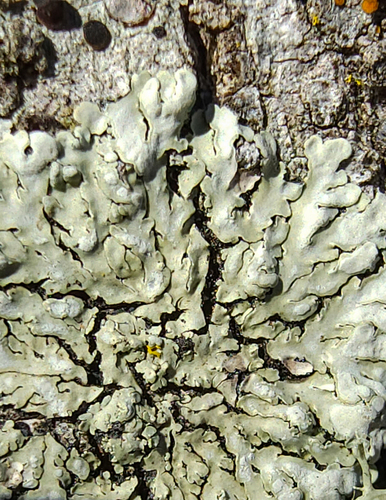
Pyxine is a genus of foliose lichens in the family Caliciaceae. The genus has a widespread distribution in tropical regions. It was established in 1825 by the Swedish botanist Elias Fries and is distinguished from similar lichens by its characteristic golden fluorescence under ultraviolet light due to the compound lichexanthone. These small, leaf-like lichens form radiating rosettes with narrow and tiny white lines called pseudocyphellae that act as air vents on their upper surface.

Culbersonia
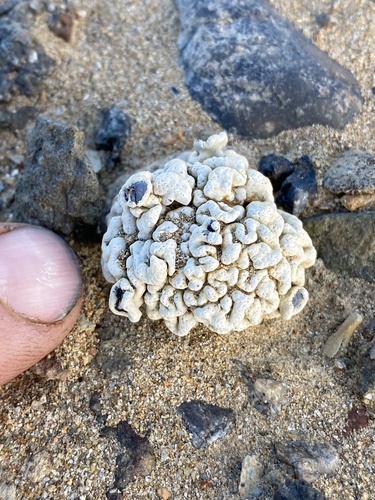
Culbersonia is a fungal genus in the family Caliciaceae. This is a monotypic genus, containing the single foliose lichen Culbersonia nubila (formerly called Culbersonia americana). This species, which grows on trees and rocks, is found in dry subtropical regions of the world, particularly in Africa and Central America.
Mobergia
Mobergia is a genus of lichen-forming fungi in the family Physciaceae.

Stigmatochroma
Stigmatochroma is a genus of lichenized fungi in the family Caliciaceae. The genus has a widespread distribution, and contains 9 species.
Acroscyphus
Acroscyphus is a fungal genus in the family Caliciaceae. This is a monospecific genus, containing the single fruticose lichen species Acroscyphus sphaerophoroides. It is found in various locations in the cordilleras of western North America, including Mexico and British Columbia, as well as high-elevation, exposed regions of Asia (China, Japan), South Africa, Peru, and Patagonia. Commonly known as '''crab's eye lichen''', it forms distinctive cushion-like growths with finger-shaped branches and has a yellow to orange interior. The species typically grows on exposed rocks or dead wood in harsh,

Hafellia
Hafellia is a genus of lichen-forming fungi in the family Caliciaceae. The genus has a widespread distribution, especially in tropical regions. The genus is named in honour of the Austrian lichenologist Josef Hafellner. The genus was proposed by the German lichenologist Klaus Kalb in 1986 to contain two bark-dwelling species, formerly in genus Buellia, with callispora-type spores. These ascospores have ridged walls, and are thin walled at their tips at early states of their differentiation.
Tornabea
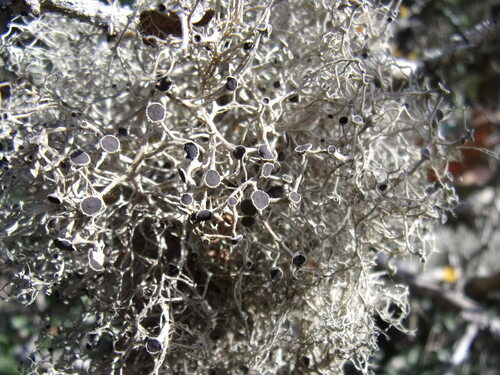
Tornabea is a monotypic genus of lichenized fungi in the family Physciaceae.
It only contains the one accepted species, Tornabea scutellifera

Dermatiscum
Dermatiscum is a genus of lichen-forming fungi in the family Caliciaceae. The genus contains two species found in South Africa and North America.
Tylophoropsis Sambo (1938) non N.E.Br. (1894)
later homonym, do not use

Texosporium
Texosporium is a genus of lichenized fungi in the family Caliciaceae. It is a monotypic genus, containing the single species Texosporium sancti-jacobi, found in the United States. The genus is characterized by microscopic features: the ascospores are coated with a layer of cells that are derived from the paraphyses. Texosporium was originally circumscribed by Josef Nádvorník in 1942, albeit the name was not validly published. In 1968, Leif Tibell and Angelica van Hofsten published the name validly. In 2020, Texosporium sancti-jacobi was added to the global IUCN Red List, where it is classified

Acolium
Acolium is a genus of lichenized fungi in the family Caliciaceae. The genus has a widespread distribution and contains six species. These lichens are found on bark and wood, occasionally on rocks, or growing on other lichens.

Santessonia
Santessonia is a genus of lichenized fungi in the family Caliciaceae. The genus was circumscribed in 1978 by lichenologists Mason Hale and Gernot Vobis, with Santessonia namibensis assigned as the type species, and at that time, only species. This species, endemic to the Namib Desert, has deep depressions (lacunae) in the thallus, which are interpreted as an adaptation to take advantage of the infrequent moisture provided by fog. The genus name honours Norwegian lichenologist Rolf Santesson.

Gassicurtia
Gassicurtia is a genus of lichenized fungi in the family Caliciaceae.

Cratiria
Cratiria is a genus of lichen-forming fungi in the family Caliciaceae. The genus has a widespread distribution, especially in tropical regions, and contains about 20 species. The genus was circumscribed by Austrian lichenologist Bernhard Marbach in 2000, with Cratiria lauri-cassiae assigned as the type species.
Hypoflavia
Hypoflavia is a genus of lichenized fungi in the family Caliciaceae. The genus in found in South America, especially in tropical regions, and contains two species.
Monerolechia
Monerolechia is a genus of lichen-forming fungi in the family Caliciaceae. These lichens form crusty patches that break into small blocks or flakes, typically coloured chocolate to grey-brown, and produce black fruiting bodies for reproduction. Most species in this genus start life as parasites on other lichens before developing their own independent growth, which helps distinguish them from similar-looking lichen groups.