Category
page 1Canaanite religion

Baal
Baal (), or '''Ba'al''' (), was a title and honorific meaning "owner" or "lord" in the Northwest Semitic languages spoken in the Levant during antiquity. From its use among people, it came to be applied to gods. Scholars previously associated the theonym with solar cults and with a variety of unrelated patron deities, but inscriptions have shown that the name Baal was particularly associated with the storm and fertility god Hadad and his local manifestations. The Ugaritic god Baal (𐎁𐎓𐎍) is the protagonist of one of the lengthiest surviving epics from the ancient Near East, the Baal Cycle.

Beelzebub
thumb|Beelzebub's appearance from the Dictionnaire Infernal, akin to a [[fly]]
thumb|"Beelzebub and them that are with him shoot arrows" from John Bunyan's ''[[The Pilgrim's Progress (1678)]]
thumb|upright|Beelzebub as a character in the mummers play|mumming play St George and the Dragon'' by the St Albans Mummers, 2015

Astarte
Astarte (; ) is the Hellenized form of the Ancient Near Eastern goddess ʿAṯtart. ʿAṯtart was the Northwest Semitic equivalent of the East Semitic goddess Ishtar.
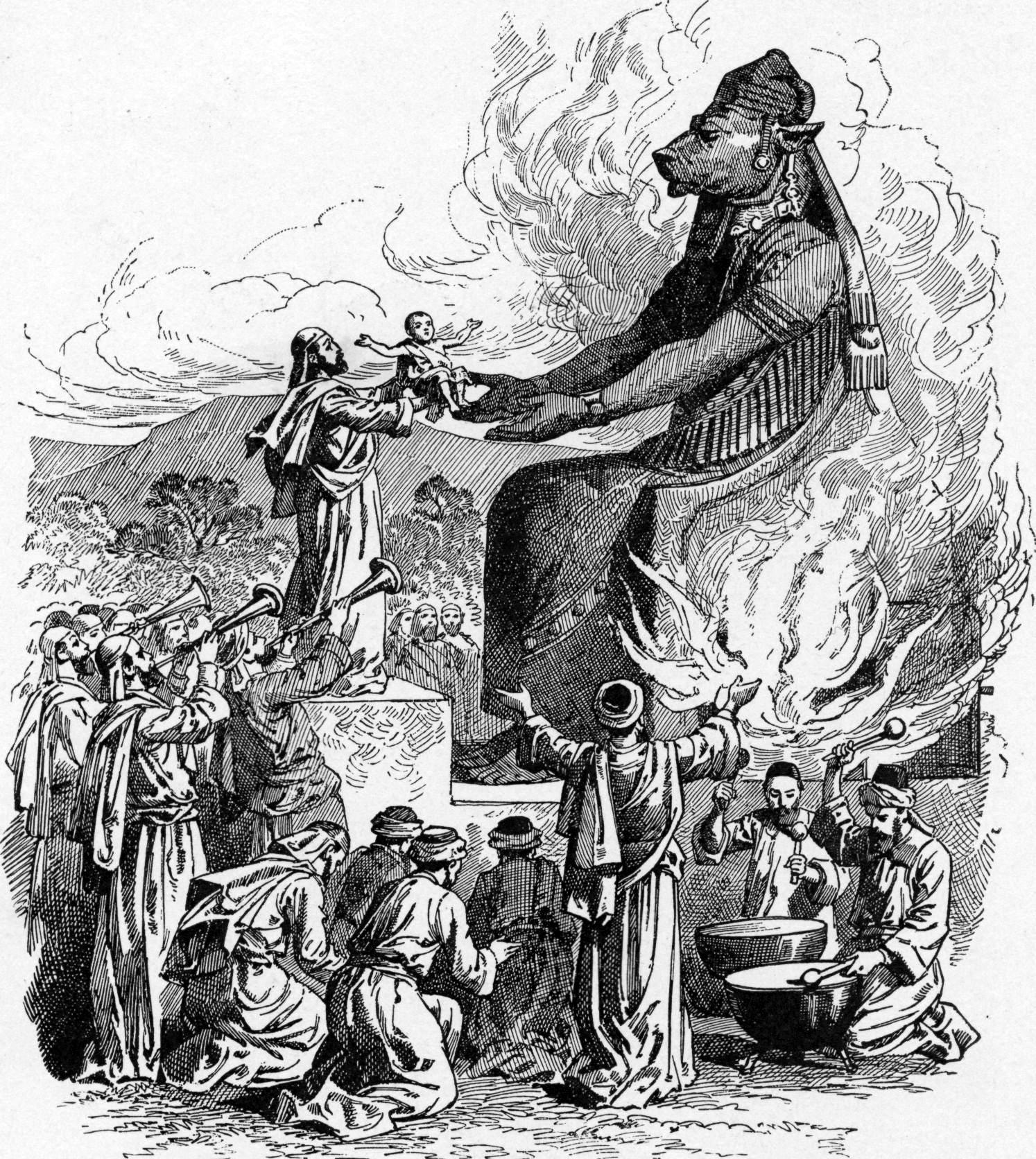
Moloch
thumb|Offering to Molech in Bible Pictures and What They Teach Us, by Charles Foster, 1897. The drawing is typical of Moloch depictions in nineteenth-century illustrations.
Moloch, Molech, or Molek is a word which appears in the Hebrew Bible several times, primarily in the Book of Leviticus. The Greek Septuagint translates many of these instances as "their king", but maintains the word or name Moloch in others, including one additional time in the Book of Amos where the Hebrew text does not attest the name. The Bible strongly condemns practices that are associated with Moloch, which are heavil

Dagon
Dagon or Dagan (; ) was a god worshipped in ancient Syria, across the middle of the Euphrates, with primary temples located in Tuttul and Terqa, though many attestations of his cult come from cities such as Mari and Emar as well. In settlements situated in the upper Euphrates area, he was regarded as the "father of gods" similar to Mesopotamian Enlil or Hurrian Kumarbi, as well as a lord of the land, a god of prosperity, and a source of royal legitimacy. A large number of theophoric names, both masculine and feminine, attests that he was a popular deity. He was also worshiped further east, in

El
Northwest Semitic word for "god"

Asherah
Asherah (; ; ; ; Qatabanian: '') was a goddess in ancient Semitic religions. She also appears in Hittite writings as Ašerdu(š) or Ašertu(š)'' (), and as Athirat in Ugarit as the consort of ʾEl. Asherah was a major goddess in ancient Northwest Semitic cultures, often associated with fertility, motherhood, and sacred trees. Asherah was the goddess of the sea while "her husband El" was the god of 'heaven.'

Hadad
Hadad (), Haddad, Adad (Akkadian: DIM, pronounced as Adād), or Iškur (Sumerian) was the storm- and rain-god in the Canaanite and ancient Mesopotamian religions.
He was attested in Ebla as "Hadda" in c. 2500 BCE.

Baalshamin
thumb|right|300px|Aglibol, Baalshamin (center), and [[Malakbel (1st century; found near Palmyra, Syria)]]

Atargatis
Atargatis (known as Derceto by the Greeks) was the chief goddess of northern Syria in Classical antiquity. Primarily she was a fertility goddess, but, as the baalat ("mistress") of her city and people she was also responsible for their protection and well-being. Her chief sanctuary was at Hierapolis, modern Manbij, northeast of Aleppo, Syria.

Resheph
Resheph (also Reshef and many other variants, see below; Eblaite , Rašap, , ršp, Egyptian '', , ršp, Rešep̄'') was a god associated with war and plague, originally worshiped in Ebla in the third millennium BCE. He was one of the main members of the local pantheon, and was worshiped in numerous hypostases, some of which were associated with other nearby settlements, such as Tunip. He was associated with the goddess Adamma, who was his spouse in Eblaite tradition. Eblaites considered him and the Mesopotamian god Nergal to be equivalents, most likely based on their shared role as war deities.
Canaanite religion
group of ancient Semitic religions
Mot
ancient Canaanite god of death and the Underworld
Yam
Canaanite sea, rivers and water god

Chemosh
Chemosh (; ) is a Canaanite deity worshipped by Ancient Semitic-speaking peoples who occupied the region known as Moab, in modern-day Jordan east of the Dead Sea, during the Levantine Bronze and Iron Ages.

Attar
ʿAṯtar is a deity whose role, name, and even gender varied across ancient Semitic religion. In both genders, ʿAṯtar is identified with the planet Venus, the morning and evening star. ʿAṯtar is a prominent character in the Baal Cycle. It has been suggested that ʿAṯtar as a masculine Venus god was syncretized into the depiction of feminine Venus goddess Inanna in her depiction as having a masculine beard.
Ba‘alat Gebal
Phoenician deity
Kothar-wa-Khasis
Kothar-wa-Khasis (), also known as Kothar or Hayyānu, was an Ugaritic god regarded as a divine artisan. He could variously play the roles of an architect, smith, musician or magician. Some scholars believe that this name represents two gods, Kothar and Khasis, combined into one.
Shapshu
Shapshu (Ugaritic: 𐎌𐎔𐎌 špš, "sun") or Shapsh, and also Shamshu, was a Canaanite sun goddess. She also served as the royal messenger of the high god El, her probable father. Her most common epithets in the Ugaritic corpus are nrt ỉlm špš ("Shapshu, lamp of the gods", also translated as "torch" or "luminary" of the gods by various authors), rbt špš ("great lady Shapshu"), and špš ʿlm ("eternal Shapshu"). In the pantheon lists KTU 1.118 and 1.148, Shapshu is equated with the Akkadian dšamaš.

Hauron
Hauron, Horon, Haurun or Hawran (from Egyptian ḥwrwnꜣ) was an ancient Egyptian god worshiped in Giza. He was closely associated with Harmachis, with the names in some cases used interchangeably, and his name as a result could be used as a designation of the Great Sphinx of Giza. While Egyptologists were familiar with Hauron since the nineteenth century, his origin was initially unknown, and only in the 1930s it was established that he originated outside Egypt. Today it is agreed that he was the Egyptian form of a god worshiped in Canaan and further north in the city of Ugarit, conventionally r

Milcom
thumb|Statue potentially depicting Milcom or a deified Ammonite ruler as Milcom, 8th century BCE
Milcom, also spelled Milkom (Ammonite: 𐤌𐤋𐤊𐤌 *Mīlkām; Hebrew: ), was either the national god, or an important god, of the Ammonites. He is attested in the Hebrew Bible and in archaeological finds from the former territory of Ammon. His connections to other deities with similar names attested in the Bible and archaeologically are debated, as well as his relationship to the Canaanite supreme deity El, or the putative deity Moloch.
Shahar
Canaanite dawn deity
Lotan
right|250px|thumb|The Destruction of Leviathan by [[Gustave Doré (1865)]]
Lotan (Ugaritic: 𐎍𐎚𐎐 LTN, meaning "coiled"), also transliterated Lôtān, Litan, or Litānu, is a servant of the sea god Yam defeated by the storm god Hadad-Baʿal in the Ugaritic Baal Cycle.
Lotan seems to have been prefigured by the serpent Têmtum represented in Syrian seals of the 18th–16th century BC, and finds a later reflex in the sea monster Leviathan, whose defeat at the hands of Yahweh is alluded to in the biblical Book of Job and in Isaiah 27:1.
Lambert (2003) went as far as the claim that Isaiah 27:1 is a
Gad
pan-Semitic god of fortune
Baal-zephon
300px|thumb|Mount Ṣapōn
Ashima
Ashima (; ) is an ancient Semitic goddess.
Kotharat
Kotharat (, kṯrt) were a group of seven goddesses associated with conception, pregnancy, birth and marriage, worshiped chiefly in the northern part of modern Syria in the Bronze Age. They are attested in texts from Mari, Ugarit and Emar. There is no agreement among translators over whether they had individual names in Ugaritic tradition. They were considered analogous to the Mesopotamian Šassūrātu, a collective term referring to assistants of the goddess Ninmah, and to Hurrian Hutena and Hutellura. It has been suggested that the latter were at least in part patterned after the Kotharat.