Category
page 1Carcinogens

radon
Radon is a chemical element; it has symbol Rn and atomic number 86. It is a radioactive noble gas and is colorless and odorless. Of the three naturally occurring radon isotopes, only Rn has a sufficiently long half-life (3.825 days) for it to be released from the soil and rock where it is generated. Radon isotopes are the immediate decay products of radium isotopes.

plutonium
Plutonium is a chemical element; it has symbol Pu and atomic number 94. It is a silvery-gray actinide metal that tarnishes when exposed to air, and forms a dull coating when oxidized. The element normally exhibits six allotropes and four oxidation states. It reacts with carbon, halogens, nitrogen, silicon and hydrogen. When exposed to moist air, it forms oxides and hydrides that can expand the sample up to 70% in volume, which in turn flake off as a powder that is pyrophoric. It is radioactive and can accumulate in bones, which makes the handling of plutonium dangerous.

thorium
Thorium is a chemical element; it has symbol Th and atomic number 90. Thorium is a weakly radioactive light silver metal which tarnishes olive grey when it is exposed to air, forming thorium dioxide; it is moderately soft, malleable, and has a high melting point. Thorium is an electropositive actinide whose chemistry is dominated by the +4 oxidation state; it is quite reactive and can ignite in air when finely divided.

americium
Americium is a synthetic chemical element; it has symbol Am and atomic number 95. It is radioactive and a transuranic member of the actinide series in the periodic table, located under the lanthanide element europium and was thus named after the Americas by analogy.
2.png)
benzene
Benzene is an organic chemical compound with the molecular formula C6H6. The benzene molecule is composed of six carbon atoms joined in a planar hexagonal ring with one hydrogen atom attached to each. As it contains only carbon and hydrogen atoms, benzene is a hydrocarbon.

asbestos
Asbestos or asbestus ( ) is a group of naturally occurring, fibrous silicate minerals, used for thousands of years to create flexible objects that resist fire, such as fireproof fabrics, but are now known to be toxic and carcinogenic.
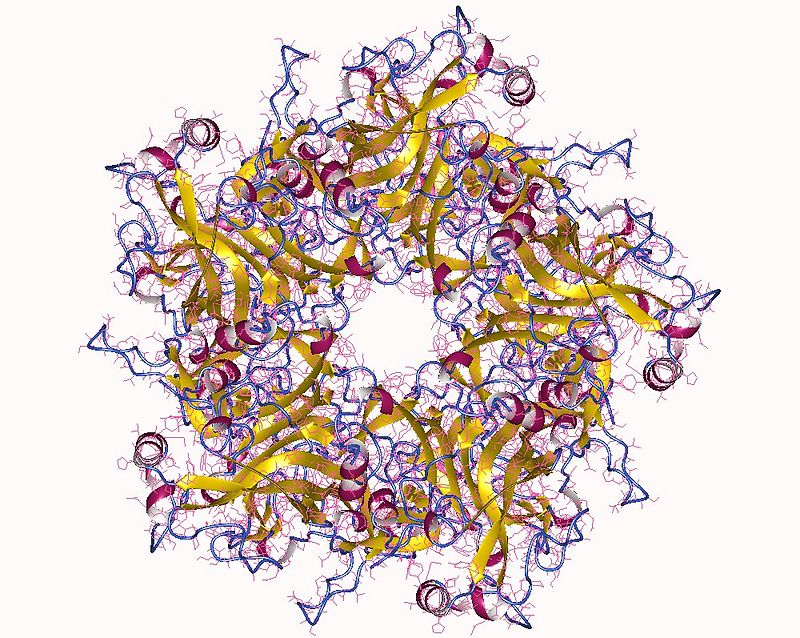
human papillomavirus infection
infection caused by the human papillomavirus (HPV)

ionizing radiation
radiation that carries enough energy to liberate electrons from atoms or molecules

carcinogen
A carcinogen () is any agent that promotes the development of cancer. Carcinogens can include synthetic chemicals, naturally occurring substances, physical agents such as ionizing and non-ionizing radiation, and biologic agents such as viruses and bacteria. Most carcinogens act by creating mutations in DNA that disrupt a cell's normal processes for regulating growth, leading to uncontrolled cellular proliferation. This occurs when the cell's DNA repair processes fail to identify DNA damage allowing the defect to be passed down to daughter cells. The damage accumulates over time. This is typica
Agent Orange
military herbicide
polycyclic aromatic hydrocarbons
hydrocarbons composed of multiple aromatic rings

nitrosamine
thumb|150px|Structure of the nitrosamino group
chromyl chloride
chemical compound

carcinogenesis
thumb|150px|right|Cancers and tumors are caused by a series of mutations. Each mutation alters the behavior of the cell somewhat.
Carcinogenesis, also called oncogenesis or tumorigenesis, is the formation of a cancer, whereby normal cells are transformed into cancer cells. The process is characterized by changes at the cellular, genetic, and epigenetic levels and abnormal cell division. Cell division is a physiological process that occurs in almost all tissues and under a variety of circumstances. Normally, the balance between proliferation and programmed cell death, in the form of apoptosis,

bromate ion
The bromate anion, , is a bromine-based oxoanion. A bromate is a chemical compound that contains this ion. Examples of bromates include sodium bromate () and potassium bromate ().
chlordecone
Chlordecone, better known in the United States under the brand name Kepone, is an organochlorine compound and a colourless solid. It is an obsolete insecticide, now prohibited in the Western world, but only after many thousands of tonnes had been produced and used. Chlordecone is a known persistent organic pollutant that was banned globally by the Stockholm Convention on Persistent Organic Pollutants in 2009.
arsenic tribromide
chemical compound
4-methylimidazole
4-Methylimidazole (4-MeI or 4-MEI) is a heterocyclic organic chemical compound with molecular formula – or . It is formally derived from imidazole through replacement of the hydrogen in position 4 by a methyl group. It is a slightly yellowish solid.
polonium-210
Polonium-210 (210Po, Po-210, historically radium F) is an isotope of polonium. It undergoes alpha decay to stable 206Pb with a half-life of 138.376 days (about months), the longest half-life of all naturally occurring polonium isotopes (210–218Po). First identified in 1898, and also marking the discovery of the element polonium, 210Po is generated in the decay chain of uranium-238 and radium-226. 210Po is a prominent contaminant in the environment, mostly affecting seafood and tobacco. Its extreme toxicity is attributed to intense radioactivity, mostly due to alpha particles, which easily caus
calcium arsenate
chemical compound
DL-ethionine
Ethionine is a non-proteinogenic amino acid structurally related to methionine, with an ethyl group in place of the methyl group.
list of IARC Group 1 carcinogens
Human carcinogens.
%D0%BF%D0%B8%D1%80%D0%B5%D0%BD%20%D1%87%D0%B8%D1%81%D1%82%D0%BE%D1%82%D1%8B%20%D0%B1%D0%BE%D0%BB%D0%B5%D0%B5%2098%25%2C%20%D1%80%D1%83%D1%81%D1%81%D0%BA%D0%B8%D0%B9%20%D1%80%D1%83%D0%B1%D0%BB%D1%8C%20%D0%B4%D0%BB%D1%8F%20%D0%BC%D0%B0%D1%81%D1%88%D1%82%D0%B0%D0%B1%D0%B0%2C%20%D0%B2%D1%81%D0%B5%20%D0%BE%D0%B1%D1%8A%D0%B5%D0%BA%D1%82%D1%8B%20%D0%BD%D0%B0%20%D1%84%D0%BE%D1%82%D0%BE%20%D0%BF%D1%80%D0%B8%D0%BD%D0%B0%D0%B4%D0%BB%D0%B5%D0%B6%D0%B0%D1%82%20%D0%BC%D0%BD%D0%B5.jpg)
benzopyrene
thumb|Benzopyrene with a purity of over 98%, with a Russian ruble for scale
[[File:Benzo-a-pyrene.svg|thumb|right|Chemical structure of benzo[a]pyrene|200px]]
[[File:Benzo(e)pyrene.png|thumb|right|Chemical structure of benzo[e]pyrene|125px]]
A benzopyrene is an organic compound with the formula C20H12. Structurally speaking, the colorless isomers of benzopyrene are pentacyclic hydrocarbons and are fusion products of pyrene and a phenylene group. Two isomeric species of benzopyrene are [[benzo(a)pyrene|benzo[a]pyrene]] and the less common [[benzo(e)pyrene|benzo[e]pyrene]]. They belong to the ch
list of cigarette smoke carcinogens
Wikimedia list article
smokeless tobacco
tobacco product used by means other than smoking
furylfuramide
Furylfuramide (also known as AF-2) is a synthetic nitrofuran derivative which was widely used as a food preservative in Japan since at least 1965, but withdrawn from the market in 1974 when it was observed to be mutagenic to bacteria in vitro and thus suspected of carcinogenicity. This was confirmed later when animal testing found it to cause benign and malignant tumors in the mammary glands, stomachs, esophagi, and lungs of rodents of both sexes, although insufficient evidence exists in human exposure.
12-O-tetradecanoylphorbol-13-acetate
'12-O-Tetradecanoylphorbol-13-acetate (TPA), also commonly known as tetradecanoylphorbol acetate, tetradecanoyl phorbol acetate, and phorbol 12-myristate 13-acetate (PMA') is a diester of phorbol. It is a potent tumor promoter often employed in biomedical research to activate the signal transduction enzyme protein kinase C (PKC). The effects of TPA on PKC result from its similarity to one of the natural activators of classic PKC isoforms, diacylglycerol. TPA is a small molecule drug.
azoxymethane
Azoxymethane (AOM) is a carcinogenic and neurotoxic chemical compound used in biological research. It is the oxide of azomethane and is particularly effective for the induction of a colon carcinoma.
7,12-dimethylbenzanthracene
'7,12-Dimethylbenz[a]anthracene (DMBA') is an immunosuppressor and a powerful organ-specific laboratory carcinogen. DMBA is widely used in many research laboratories studying cancer. DMBA serves as a tumor initiator. Tumor promotion can be induced with treatments of 12-O-tetradecanoylphorbol-13-acetate (TPA) in some models of two-stage carcinogenesis. This allows for a greatly accelerated rate of tumor growth, making many cancer studies possible.

methylcholanthrene
Methylcholanthrene is a highly carcinogenic polycyclic aromatic hydrocarbon produced by burning organic compounds at very high temperatures. Methylcholanthrene is also known as 3-methylcholanthrene, 20-methylcholanthrene or the IUPAC name 3-methyl-1,2-dyhydrobenzo[j]aceanthrylene. The short notation often used is 3-MC or MCA. This compound forms pale yellow solid crystals when crystallized from benzene and ether. It has a melting point around 180 °C and its boiling point is around 280 °C at a pressure of 80 mmHg. Methylcholanthrene is used in laboratory studies of chemical carcinogen

N-nitroso-N-methylurea
'''N-Nitroso-N-methylurea (NMU''') is a highly reliable carcinogen, mutagen, and teratogen. NMU is an alkylating agent, and exhibits its toxicity by transferring its methyl group to nucleobases in nucleic acids, which can lead to AT:GC transition mutations.
GW-501516
GW501516 (also known as GW-501,516, GW1516, GSK-516, cardarine, and on the black market as endurobol) is a PPARδ receptor agonist that was invented in a collaboration between Ligand Pharmaceuticals and GlaxoSmithKline in the 1990s. It entered into clinical development as a drug candidate for metabolic and cardiovascular diseases, but was abandoned in 2007 because animal testing showed that the drug caused cancer to develop rapidly in several organs.
ptaquiloside
Ptaquiloside is a norsesquiterpene glucoside produced by bracken ferns (majorly Pteridium aquilinum) during metabolism. It is identified to be the main carcinogen of the ferns and to be responsible for their biological effects, such as haemorrhagic disease and bright blindness in livestock and oesophageal, gastric cancer in humans. Ptaquiloside has an unstable chemical structure and acts as a DNA alkylating agent under physiological conditions. It was first isolated and characterized by Yamada and co-workers in 1983.
2-acetylaminofluorene
2-Acetylaminofluorene (AAF, 2-AAF) is a carcinogenic and mutagenic derivative of fluorene. It is used as a biochemical tool in the study of carcinogenesis. It induces tumors in a number of species in the liver, bladder and kidney. The metabolism of this compound in the body by means of biotransformation reactions is the key to its carcinogenicity. 2-AAF is a substrate for cytochrome P-450 (CYP) enzyme, which is a part of a super family found in almost all organisms. This reaction results in the formation of hydroxyacetylaminofluorene which is a proximal carcinogen and is more potent than the p
4-nitroquinoline-N-oxide
chemical compound
mezerein
Mezerein is a toxic diterpene ester found in the sap of Daphne mezereum and related plants. Plants of the genera Euphorbiaceae and Thymelaeaceae possess a wide variety of different phorbol esters, which share the capacity of mimicking diacylglycerol (DAG) and thus activating different isoforms of protein kinase C. Mezerein was first isolated in 1975. It has antileukemic properties in mice, but it is also defined as a weak promoter of skin cancers in the same species. All parts of the plants contain an acrid and irritant sap that contains mezerein, thought to be the principal poison. The sap is
nitrogen heterocycle
any heterocyclic compound having at least one nitrogen heteroatom
4,4'-thiodianiline
4,4′-Thiodianiline (TDA) is the organosulfur compound with the formula (H2NC6H4)2S. It is classified as a diamine and a thioether. It typically appears as an (off-)white solid powder. An analogue of TDA is the drug dapsone, for which the sulphur species is oxidised.
diepoxybutane
Diepoxybutane (also known as butane diepoxide, butadiene diepoxide, or 1,2:3,4-diepoxybutane) is an epoxide which is a colorless liquid at room temperature. Epoxides are very reactive due to ring strain and diepoxybutane contains two of these groups, so it is highly reactive, more than other ethers. It is hydrophilic, very flammable and easily ignited by heat or sparks.
Methyl-n-amylnitrosamine
'Methyl-n-amylnitrosamine' (MNAN) is a potential carcinogen It is metabolized in the liver by the enzyme CYP2A6.
N-hydroxy-2-acetylaminofluorene
Hydroxyacetylaminofluorene is a derivative of 2-acetylaminofluorene used as a biochemical tool in the study of carcinogenesis.
list of IARC Group 2A carcinogens
Wikimedia list article
Acheson process
process to synthesize graphite and silicon carbide
3-nitrobenzanthrone
3-Nitrobenzanthrone (3-nitro-7H-benz[de]anthracen-7-one) is a chemical compound emitted in diesel exhaust; it is a potent carcinogen. It produced the highest score ever reported in the Ames test, a standard measure of the cancer-causing potential of toxic chemicals, far greater than the previous known strongest (1,8-dinitropyrene, which is also found in diesel exhaust).
co-carcinogen
A co-carcinogen is a chemical that promotes the effects of a carcinogen in the production of cancer. Usually, the term is used to refer to chemicals that are not carcinogenic on their own, such that an equivalent amount of the chemical is insufficient to initiate carcinogenesis. A chemical can be co-carcinogenic with other chemicals or with nonchemical carcinogens, such as UV radiation.

N-acetoxy-2-acetamidofluorene
Acetoxyacetylaminofluorene is a derivative of 2-acetylaminofluorene used as a biochemical tool in the study of carcinogenesis. It forms adducts with DNA by reacting with guanine at its C-8 position.; This results in breaks in one strand of the DNA.
list of IARC Group 2B carcinogens
Wikimedia list article