Category
page 1Cardiovascular system anatomy
blood vessel
tubular structure which carries blood

capillary
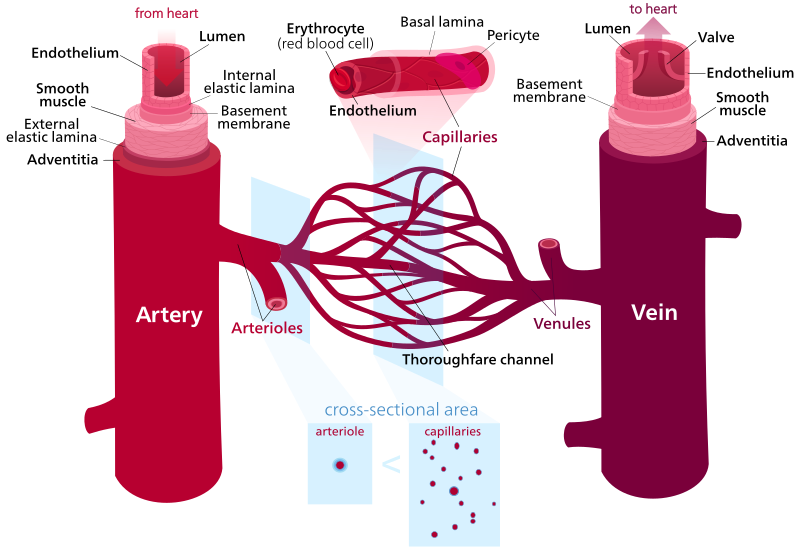
A capillary is a small blood vessel, from 5 to 10 micrometres in diameter, and is part of the microcirculation system. Capillaries are microvessels and the smallest blood vessels in the body. They are composed of only the tunica intima (the innermost layer of an artery or vein), consisting of a thin wall of simple squamous endothelial cells. They are the site of the exchange of many substances from the surrounding interstitial fluid, and they convey blood from the smallest branches of the arteries (arterioles) to those of the veins (venules). Other substances which cross capillaries include wa

blood–brain barrier
semipermable membrane that separates blood and the brain
lymphatic vessel
tubular vessels that are involved in the transport of lymph and lymphocytes
tunica intima
inner layer of blood vessel
rete mirabile
complex of arteries and veins lying very close to each other, found in some vertebrates, mainly warm-blooded ones.
portal venous system
one capillary bed draining into another through veins
tunica media
middle layer of blood vessel
tunica adventitia of blood vessel
outer layer of blood vessel
Precapillary sphincter
A precapillary sphincter is a band of smooth muscle that adjusts blood flow into capillaries mainly in the mesenteric microcirculation
high endothelial venules
venules in some lymphatic organs
liver sinusoid
hepatic sinusoidal
neurovascular bundle
structure binding nerves and vessels