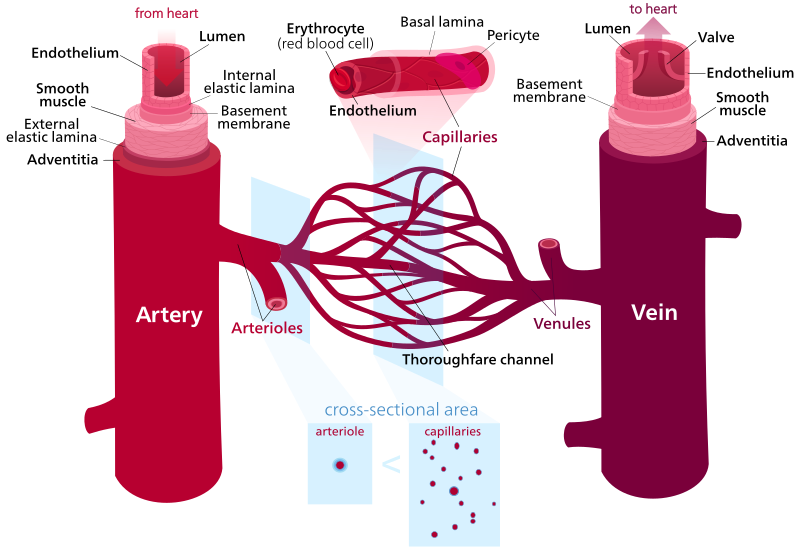
File:Blood_vessels_(retouched)_-en.svg · Wikimedia Commons · See Wikimedia Commons
A blood vessel is a tube-shaped structure in your body that carries blood throughout your system. Blood vessels matter because they deliver oxygen and nutrients to your organs and tissues, and remove waste products, which is essential for keeping you alive.
AI-generated from the Wikipedia summary — may contain errors.
Research
995,627 papers- Blood Vessel Maturation in Health and Disease and its Implications for Vascularization of Engineered Tissues.ReviewCritical reviews in biomedical engineering · 2015Sun X, Evren S, Nunes SSDOI: 10.1615/CritRevBiomedEng.2016016063
- Blood vessel growth in benign tumours can illuminate malignant ones.Nature · 2022Santoro HDOI: 10.1038/d41586-022-03136-2
- Bioengineered blood vessels.ReviewExpert opinion on biological therapy · 2014Niu G, Sapoznik E, Soker SDOI: 10.1517/14712598.2014.880419
- Blood vessel surgery.American journal of surgery · 1953HUGHES CW, BOWERS WFDOI: 10.1016/0002-9610(53)90478-4
- Blood vessel surgery.Canadian Medical Association journal · 1953MURRAY G
- Blood vessel grafting.Postgraduate medical journal · 1953ROB CGDOI: 10.1136/pgmj.29.335.462
- Leptin signaling promotes blood vessel formation in the Xenopus tail during the embryo-larval transition.Developmental biology · 2024Curtis GH, Reeve RE, Crespi EJDOI: 10.1016/j.ydbio.2024.05.001
- Historical Perspective and Future Direction of Blood Vessel Developments.ReviewCold Spring Harbor perspectives in medicine · 2018Dimitrievska S, Niklason LEDOI: 10.1101/cshperspect.a025742
via PubMed
Wikidata facts
- Part of
- circulatory system
- Has part
- tunica intima
- Image
- Meyers b3 s0084a.jpg
- Has use
- blood circulation
Show 3 more facts
- contains
- blood
- Commons category
- Blood vessels
- topic's main category
- Category:Blood vessels
Sources (7)
via Wikidata · CC0
~11 min read
Encyclopedic overview
Blood vessels are the tubular structures of a circulatory system transporting blood in animal bodies. Blood vessels transport blood cells, nutrients, and oxygen to most of the tissues of a body, and also transport waste products and carbon dioxide away from the tissues. Some tissues – such as cartilage, epithelium, and the lens and cornea of the eye – are not supplied with blood vessels, so are termed avascular.
There are five types of blood vessels: the arteries, which carry the blood away from the heart; the arterioles; the capillaries, where the exchange of water and chemicals between the blood and tissues occurs; the venules; and the veins, which carry blood from the capillaries back towards the heart.
Excerpted from Wikipedia’s “blood vessel” article, available under the CC BY-SA 4.0 licence.
Gallery (2)
Available in 110 languages
- Español
- Français
- Deutsch
- 中文
- 日本語
- Русский
- Português
- Italiano
- العربية
- हिन्दी
- Afrikaans
- Albanian
- Amharic
- Aragonese
- Armenian
- Assamese
- azb
- Azerbaijani
Show 91 more
- Bahasa Indonesia
- Bangla
- Bashkir
- Basque
- Belarusian
- Bosnian
- Bulgarian
- Catalan
- Central Kurdish
- Chuvash
- Colognian
- Croatian
- Czech
- Danish
- Divehi
- Esperanto
- Estonian
- Filipino
- Finnish
- fiu_vro
- Galician
- Georgian
- Greek
- Hausa
- Hebrew
- Hungarian
- Icelandic
- Ido
- Ingush
- Interlingua
- Irish
- Javanese
- Kannada
- Kashmiri
- Kazakh
- Kurdish
- Kyrgyz
- Latin
- Latvian
- Limburgish
- Lingala
- Lithuanian
- Low German
- Luxembourgish
- Macedonian
- Malay
- Malayalam
- Mazanderani
- Minangkabau
- Nederlands
- Nepali
- Newari
- Norwegian
- Norwegian Nynorsk
- Oromo
- Pashto
- Polski
- Punjabi
- Quechua
- Romanian
- Scots
- Serbian
- Serbian (Latin)
- Shona
- simple
- Slovenian
- Somali
- Svenska
- Swahili
- Tajik
- Tamil
- Tatar
- Telugu
- Tiếng Việt
- Türkçe
- Ukrainian
- Urdu
- Uzbek
- Waray
- Welsh
- Western Frisian
- Western Panjabi
- Wu Chinese
- Xhosa
- Yakut
- Yiddish
- zh_min_nan
- zh_yue
- فارسی
- ไทย
- 한국어
via Wikidata sitelinks · CC0