Category
page 1Cave crustaceans

Crangonyx dearolfi
species of crustacean

Caecidotea barri
species of crustacean
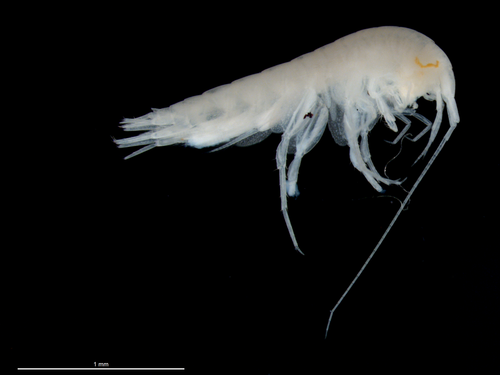
Crangonyx hobbsi
species of amphipod
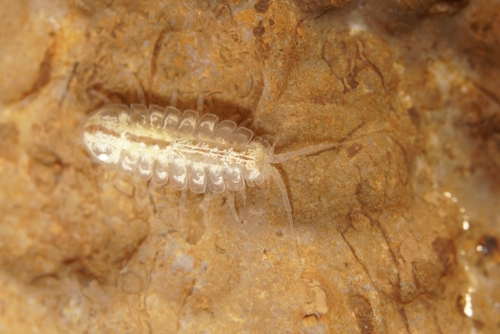
Lirceus usdagalun
species of crustacean
Lirceus culveri
species of crustacean

Gammarus acherondytes
species of crustacean
Antrolana
Antrolana lira, also known as The Madison Cave isopod, is a freshwater, cave-dwelling crustacean species. It is in the family Cirolanidae and it is the only species of its genus Antrolana. This isopod can be found in flooded limestone caves and karst aquifers throughout the Great Appalachian Valley of Virginia and West Virginia. The Madison Cave isopod has been listed as a vulnerable species on the IUCN Red List since 1983 and as a threatened species under the United States Endangered Species Act since 1982. The species was named after the cave in which it was first discovered, Madison Saltpet

Stygobromus
Stygobromus is a genus of amphipod crustaceans that live in subterranean habitats. The majority of the listed species are endemic to North America (one from Canada, the rest from the United States), a smaller number of species are also known from Eurasia. Most of the North American species live in areas which were not covered by the Laurentide Ice Sheet, although a few species seem to have survived under the ice. A number of species are on the IUCN Red List as endangered species (EN) or vulnerable species (VU); one species, S. lucifugus, is extinct.
Allocrangonyx
thumb|Allocrangonyx pellucidus (Oklahoma Cave Amphipod) in a cave spring in the Arbuckle mountains of Oklahoma.
Allocrangonyx is a genus of troglobitic amphipod crustaceans from the South Central United States. The two species are both listed as vulnerable on the IUCN Red List. The animals are blind and unpigmented. During the male's development, the outer ramus of the third uropod differentiates into secondary segments and grows to a length greater than the animal's body length.
Stygobromus balconis
species of crustacean
Stygobromus lucifugus
species of crustacean

Munidopsis polymorpha
species of crustacean
Caecosphaeroma
Caecosphaeroma is a troglodytic isopod genus in the family Sphaeromatidae found in caves of NE and SW France. The genus was split off from Monolistra by Adrien Dollfus in 1896; in both genera, the female carries about 10 fertilized eggs in its external marsupium (brood pouch); they are white in Monolistra but bluish-green in Caecosphaeroma. C. burgundum is the most studied species.
Stygobromus pecki
species of crustacean
Stygobromus parvus
species of crustacean
Stygobromus ozarkensis
species of crustacean
Stygobromus onondagaensis
species of crustacean
Stygobromus hubbsi
species of crustacean
Stygobromus emarginatus
species of crustacean
Stygobromus morrisoni
species of crustacean
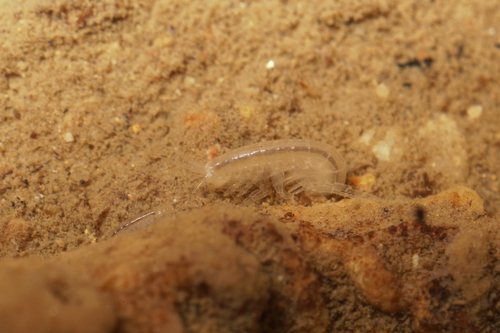
Stygobromus spinatus
species of crustacean

Remasellus parvus
Remasellus parvus, the swimming Florida cave isopod, is an isopod endemic to 4 caves in the Ochlockonee and Aucilla-Suwanee drainages of Florida, United States. It is the only species in the genus Remasellus.
Stygobromus pizzinii
species of crustacean
Stygobromus flagellatus
species of crustacean
Stygobromus mackenziei
species of crustacean
Stygobromus barri
species of crustacean
Stygobromus subtilis
species of crustacean

Stygobromus harai
species of crustacean
Stygobromus longipes
species of crustacean

Stygobromus montanus
species of crustacean
Stygobromus bowmani
species of crustacean

Stygobromus gradyi
species of crustacean

Stygobromus reddelli
species of crustacean

Stygobromus cooperi
species of crustacean
Stygobromus conradi
species of crustacean
Stygobromus ephemerus
species of crustacean

Stygobromus arizonensis
species of crustacean
Stygobromus clantoni
species of crustacean

Stygobromus wengerorum
species of crustacean

Stygobromus stellmacki
species of crustacean
Stygobromus dejectus
species of crustacean

Stygobromus nortoni
species of crustacean
Stygobromus mundus
species of crustacean
Speocirolana xilitla
species of crustacean
Stygobromus bifurcatus
species of crustacean
Stygobromus hadenoecus
species of crustacean
Ingolfiella longipes
species of amphipod crustacean
Niphargobates
Niphargobates is a genus of amphipod crustaceans containing two species from European caves. Niphargobates lefkodemonaki is only known to occur in a cave near Xyloskalo in the Lefka Ori mountains, Crete, Greece. Niphargobates orophobata is only known to occur in caves near Postojna, Slovenia. Both species are listed as vulnerable on the IUCN Red List.

Stygobromus russelli
species of crustacean
Cancrocaeca
Cancrocaeca xenomorpha is a species of troglobitic (cave-dwelling) freshwater crab from Sulawesi, the only species in the monotypic genus Cancrocaeca. It has been described as the world's "most highly cave-adapted species of crab".
Mesoniscus
Mesoniscus is a genus of woodlice, placed in its own family, Mesoniscidae, and section, Microcheta. It contains two species – Mesoniscus alpicolus and Mesoniscus graniger – that live in Central and Eastern Europe, mostly in and around caves.
Hawaiioscia
Hawaiioscia is a genus of woodlouse known from the Hawaii, Rapa Nui, and Costa Rica. The genus was originally described from Hawaii on the presence of four troglobitic species on separate islands. A species within this genus was then described from Rapa Nui which lacked troglobtic traits, but only persists in cave-dwelling relict populations. Surprisingly, another species was then described from along the Pacific Coast of Costa Rica.
Gammarus baysali
cave-dwelling species of freshwater amphipod crustacean
Stygobromus canadensis
species of crustacean