Category
page 1Chemical oceanography

nutrient
A nutrient is a substance used by an organism to survive, grow and reproduce. The requirement for dietary nutrient intake applies to animals, plants, fungi and protists. Nutrients can be incorporated into cells for metabolic purposes or excreted by cells to create non-cellular structures such as hair, scales, feathers, or exoskeletons. Some nutrients can be metabolically converted into smaller molecules in the process of releasing energy such as for carbohydrates, lipids, proteins and fermentation products (ethanol or vinegar) leading to end-products of water and carbon dioxide. All organisms

carbon cycle
biogeochemical cycle by which carbon is exchanged among the biosphere

salinity
thumb|upright=1.3|right|Annual mean sea surface salinity for the World Ocean. Data from the [[World Ocean Atlas 2009.]]
thumb|upright|right|International Association for the Physical Sciences of the Oceans (IAPSO) standard seawater.
Salinity () is the saltiness or amount of salt dissolved in a body of water, called saline water (see also soil salinity). It is usually measured in g/L or g/kg (grams of salt per liter/kilogram of water; the latter is dimensionless and equal to ‰).
sea water
Seawater, or sea water, is water from a sea or ocean. On average, seawater in the world's oceans has a salinity of about 3.5% (35 g/L, 35 ppt, 600 mM). This means that every kilogram (roughly one liter by volume) of seawater has approximately of dissolved salts (predominantly sodium () and chloride () ions). The average density at the surface is 1.025 kg/L. Seawater is denser than both fresh water and pure water (density 1.0 kg/L at ) because the dissolved salts increase the mass by a larger proportion than the volume. The freezing point of seawater decreases as salt concentrati
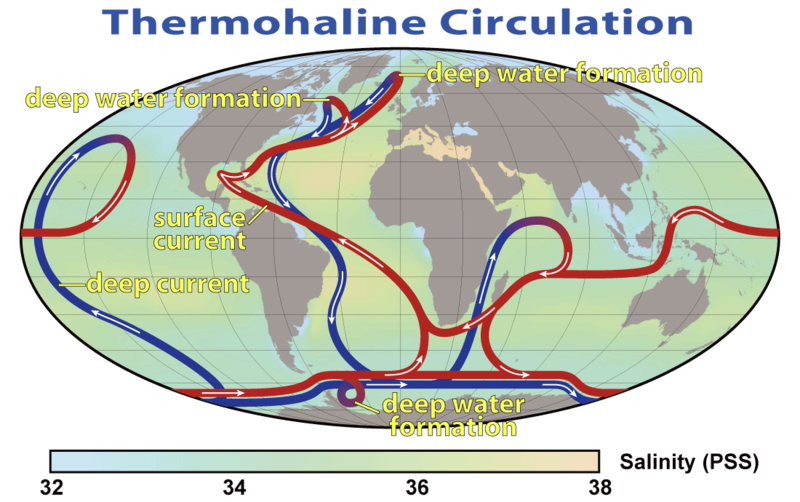
thermohaline circulation
part of the large-scale ocean circulation that is driven by global density gradients created by surface heat and freshwater fluxes
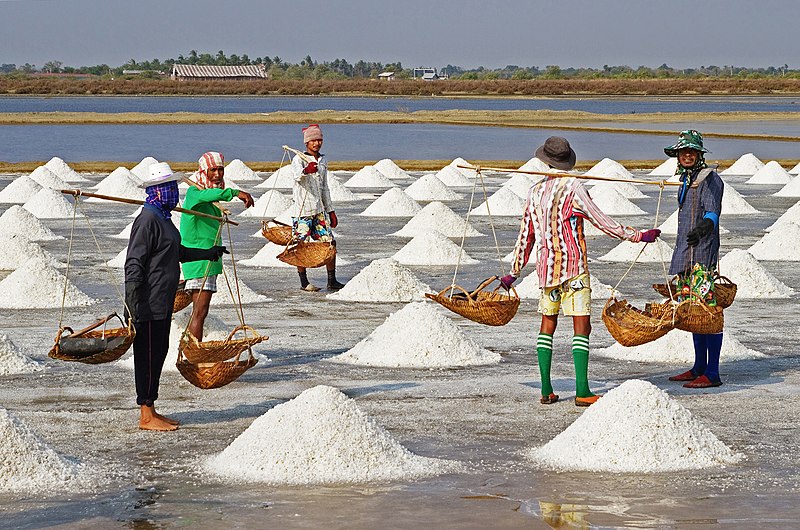
sea salt
salt produced from the evaporation of seawater
ocean acidification
climate change-induced decline of pH levels in the ocean
climate change mitigation
actions to limit climate change in order to reduce the risks of global warming

biogeochemistry
thumb|right|300px|
Cyanobacterial Microbial mat|mat dominated by [[Anabaena sp. (heterocystous) in the Mayotte lagoon at 14 m depth. These cyanobacteria fix nitrogen and influence redox conditions, contributing to biogeochemical cycling in marine environments.]]
chemical oxygen demand
measure of the amount of oxygen that can be consumed by reactions in a solution
oxygen cycle
biogeochemical cycle of oxygen within its four main reservoirs: the atmosphere, the biosphere, the hydrosphere, and the lithosphere
marine snow
shower of mostly organic detritus falling from the upper layers of the water column
anoxic event
intervals in the Earth's past
.png)
alkalinity
thumb|right|200px|Sea surface alkalinity (from the Global Ocean Data Analysis Project|GLODAP [[climatology).]]
Biological productivity
rate of generation of biomass in an ecosystem
hypoxia
low environmental oxygen levels
dead zone
low-oxygen areas in oceans and large lakes caused by nutrient and fertilizer pollution
anoxic waters
sea water, fresh water or groundwater that are depleted of dissolved oxygen
sea foam
foam created by the agitation of seawater
biological pump
ocean's biologically driven sequestration of carbon from the atmosphere to the ocean interior and seafloor
ocean chemistry
chemical composition of marine environments
blue carbon
carbon captured by the world's coastal ocean ecosystems

PCO2
thumb|Carbon dioxide molecule.
'''pCO2, pCO2', or P_\ce{CO2} is the partial pressure of carbon dioxide (CO2), often used in reference to blood but also used in meteorology, climate science, oceanography, and limnology to describe the fractional pressure of CO2 as a function of its concentration in gas or dissolved phases. The units of p''CO2 are mmHg, atm, torr, Pa, or any other standard unit of atmospheric pressure.
Vienna Standard Mean Ocean Water
water standard defining the isotopic composition of fresh water
water mass
identifiable body of water with a common formation history which has physical properties distinct from surrounding water
Total inorganic carbon
sum of inorganic carbon species in a solution
Oceanic carbon cycle
processes that exchange carbon between various pools within the ocean and the atmosphere, Earth interior, and the seafloor.
Bjerrum plot
Graph of concentrations of different species of a polyprotic acid, as a function of pH, when the solution is at equilibrium
oxygen minimum zone
zone with lowest oxygen saturation in seawater
World Ocean Atlas
data product of the Ocean Climate Laboratory of the National Oceanographic Data Center (U.S.)
Euxinia
Euxinia or euxinic conditions occur when water is both anoxic and sulfidic. This means that there is no oxygen (O2) and a raised level of free hydrogen sulfide (H2S). Euxinic bodies of water are frequently strongly stratified; have an oxic, highly productive, thin surface layer; and have anoxic, sulfidic bottom water. The word "euxinia" is derived from the Greek name for the Black Sea (Εὔξεινος Πόντος (Euxeinos Pontos)) which translates to "hospitable sea". Euxinic deep water is a key component of the Canfield ocean, a model of oceans during part of the Proterozoic eon (a part specifically kno
Artificial seawater
mixture of dissolved mineral salts (and sometimes vitamins) that simulates seawater
Cold blob
anomalia de la temperatura freda de les aigües superficials de l'oceà, que afecta la circulació de retorn meridional de l'Atlàntic
Impacts of ocean acidification on the Great Barrier Reef
threat to the reef which reduces the viability and strength of reef-building corals
Brine rejection
process by which salts are expelled from freezing water
Solubility pump
physico-chemical process that transports dissolved inorganic carbon from the ocean's surface to its interior