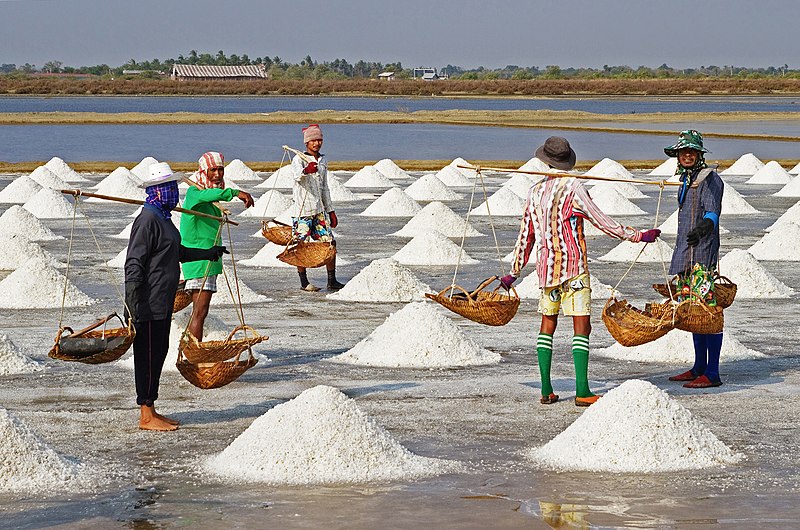
File:Salt_Farmers_-_Pak_Thale-edit1.jpg · Wikimedia Commons · See Wikimedia Commons
sea salt
Sign in to saveAlso known as bay salt, solar salt, salt
salt produced from the evaporation of seawater
Nutrition · Open Food Facts
Typical values per 100 g · averaged across 19 products
- Energy
- 9 kcal
- Fat
- 0.3 g
- — of which saturates
- 0.1 g
- Carbohydrates
- 1.3 g
- — of which sugars
- 0.2 g
- Fibre
- 0 g
- Protein
- 0.2 g
- Salt
- 72.09 g
via Open Food Facts · ODbL
Wikidata facts
- Instance of
- food ingredient
- Subclass of
- table salt
- Material used
- sea water
- Image
- Salt collector in Lake Retba.jpg
Show 3 more facts
- fabrication method
- reduction
- MCN code
- 2501.00.11
- Commons category
- Sea salt
Sources (3)
via Wikidata · CC0
~6 min read
Encyclopedic overview
Sea salt harvesting in Pak Thale, Phetchaburi, Thailand A salt evaporation pond in Tamil Nadu, India Sea salt is salt that is produced by the evaporation of seawater. It is used as a seasoning in foods, cooking, cosmetics and for preserving food. It is also called bay salt, solar salt, or simply salt. Like mined rock salt, production of sea salt has been dated to prehistoric times.
Composition
Excerpted from Wikipedia’s “sea salt” article, available under the CC BY-SA 4.0 licence.