Category
page 1Child sacrifice

Carthage
thumb|upright=1.8|right|The layout of the Punic city-state Carthage, before its fall in 146 BC
Carthage (, '''') was an ancient city in Northern Africa, on the eastern side of the Lake of Tunis in what is now Tunisia. Carthage was one of the most important trading hubs of the Ancient Mediterranean and one of the most affluent cities of the classical world. It became the capital city of the civilization of Ancient Carthage and later Roman Carthage.

Cronus
In ancient Greek religion and mythology, Cronus, Cronos, or Kronos ( or ; ) was the leader and youngest of the Titans, the children of Gaia (Earth) and Uranus (Sky). He overthrew his father and ruled during the mythological Golden Age until he was overthrown by his son Zeus and imprisoned in Tartarus. According to Plato, however, the deities Phorcys, Cronus, and Rhea were the eldest children of Oceanus and Tethys.

Saturn
god in ancient Roman mythology

Atreus
thumb|The Farnese Atreus (1574 engraving by Antonio Lafreri and [[Cornelis Cort) depicts Atreus and one of the sons of Thyestes, whom Atreus is about to kill]]
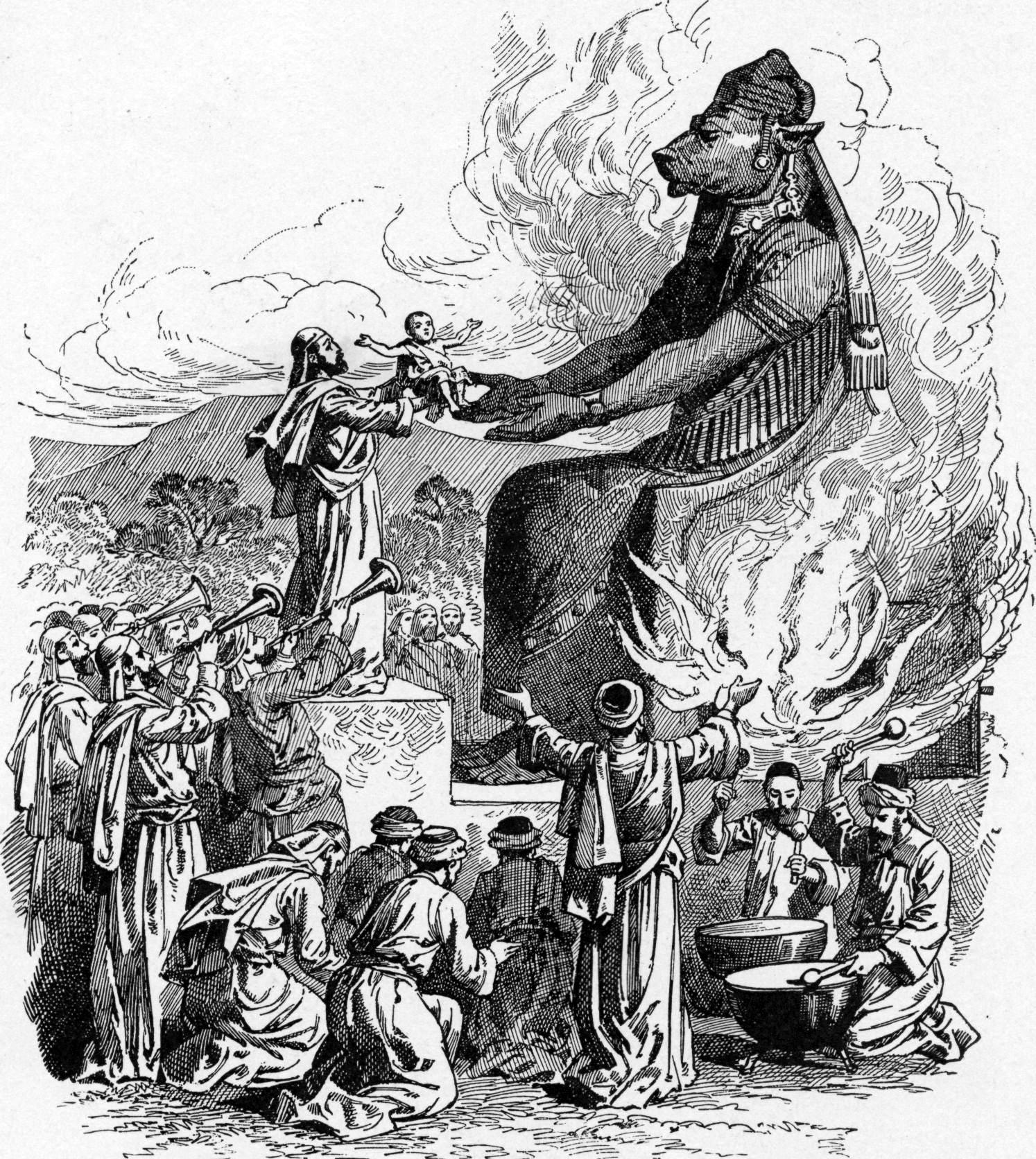
Moloch
thumb|Offering to Molech in Bible Pictures and What They Teach Us, by Charles Foster, 1897. The drawing is typical of Moloch depictions in nineteenth-century illustrations.
Moloch, Molech, or Molek is a word which appears in the Hebrew Bible several times, primarily in the Book of Leviticus. The Greek Septuagint translates many of these instances as "their king", but maintains the word or name Moloch in others, including one additional time in the Book of Amos where the Hebrew text does not attest the name. The Bible strongly condemns practices that are associated with Moloch, which are heavil

Tanit
Tanit or Tinnit (Punic: 𐤕𐤍𐤕 Tīnnīt) was a chief deity of Ancient Carthage. She is the consort of Baal Hammon. As Ammon is a local Libyan deity, so is Tanit, who represents the matriarchal aspect of Numidian society, and whom the Egyptians identify as Neith and the Greeks identify as Athena. She was the goddess of wisdom, civilization and the crafts; she is the defender of towns and homes where she is worshipped. Ancient North Africans used to put her sign on tombstones and homes to ask for protection. Her main temples were in Thinissut (Bir Bouregba, Tunisia), Cirta (Constantine, Algeria),
Chimú culture
civilization

Salammbô
Salammbô is an 1862 historical novel by Gustave Flaubert. It is set in Carthage immediately before and during the Mercenary Revolt (241–237 BCE). Flaubert's principal source was Book I of the Histories, written by the Greek historian Polybius. The novel was enormously popular when first published and jumpstarted a renewed interest in the history of the Roman Republic's conflict with the North African Phoenician outpost of Carthage.
Binding of Isaac
story from the Tanakh
Baal-hamon
chief god in ancient Carthagian religion
Punic religion
religion in Ancient Carthage

Tophet
In the Hebrew Bible, Tophet or Topheth (; ; ) is a location in Jerusalem in the Valley of Hinnom (Gehenna), where worshipers engaged in a ritual involving "passing a child through the fire", most likely child sacrifice. Traditionally, the sacrifices have been ascribed to a god named Moloch. The Bible condemns and forbids these sacrifices, and the tophet is eventually destroyed by king Josiah, although mentions by the prophets Jeremiah, Ezekiel, and Isaiah suggest that the practices associated with the tophet may have persisted.
Joshua Milton Blahyi
Liberian warlord and general

child sacrifice
killing of a child to appease to a tribe, deity, etc
human sacrifice in pre-Columbian cultures
Ritualistic killing of children in pre-Columbian cultures

The Dead Past
short story by Isaac Asimov
Qhapaq hucha
thumb|The replica of the Plomo Mummy on display at the Museo Nacional de Historia Natural in Santiago, Chile
Capacocha or Qhapaq hucha ( 'noble, solemn, principal, mighty, royal', 'crime, sin, guilt', Hispanicized spellings , , , also ) was an important sacrificial rite among the Inca that typically involved the sacrifice of children. Children of both sexes were selected from across the Inca empire for sacrifice in capacocha ceremonies, which were performed at important shrines distributed across the empire, known as , or .
Midnight Terror Cave
cave in central Belize