Category
page 1China–Japan relations

Second Sino-Japanese War
Japanese invasion of China (1937–1945)

First Sino-Japanese War
1894–1895 war between the Qing dynasty and the Empire of Japan over influence in Joseon, fought chiefly in Joseon
Memoirs of a Geisha
2005 film directed by Rob Marshall
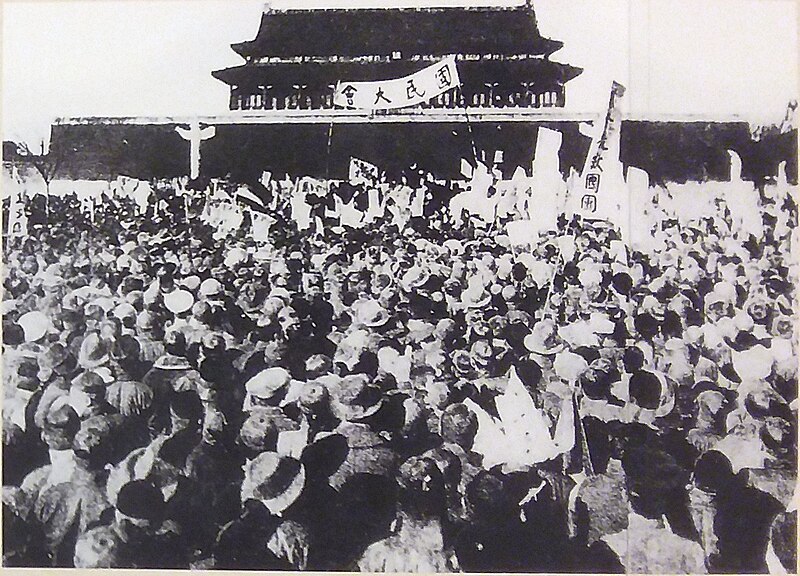
May Fourth Movement
Chinese cultural and political movement beginning with protests on 4 May 1919 in Beijing
Japanese Instrument of Surrender
1945 agreement ending hostilities in WWII
Twenty-One Demands
Set of concessionary demands made by imperial Japan to China during World War I
China–Japan relations
bilateral relations between China and Japan
Kwantung Leased Territory
Japanese possession in Northeastern China until the end of World War II
Greater East Asia Conference
conference held in 1943
Battle of Baekgang
7th-century battle in Korea
Gapsin Coup
1884 coup d'état attempt in Joseon Korea
Lansing–Ishii Agreement
1917 agreement between Japan and the United States
G8+5
The Group of Eight + Five (G8+5) was an international group that consisted of the leaders of the heads of government from the G8 nations (Canada, France, Germany, Italy, Japan, Russia, the United Kingdom, and the United States), plus the heads of government of the five leading emerging economies (Brazil, China, India, Mexico, and South Africa). In March 2014, Russia was removed from the Group of 8 for annexing Crimea, so the G8+5 in its original form is unlikely to reconvene with Russia present.
Jinan Incident
1928 conflict between Chinese Nationalist troops and Japanese soldiers in Jinan, Shandong, China
Racial Equality Proposal
1919 proposal by Japan to the Paris Peace Conference
Imo Incident
mutiny of the Joseon military against the government of Joseon in Seoul in 1882
Shandong Problem
dispute over Shandong Peninsula after Treaty of Versailles
Japanese missions to Imperial China
diplomatic missions or embassies intermittently sent from Japan to the Imperial Chinese court
2015 China Victory Day Parade
military parade in Beijing, China
Japanese history textbook controversies
controversy over historiography in Japan
King Outside, Emperor Inside
diplomatic policy of East Asian countries (Korea, Vietnam, etc.), according to which their monarchs would be titled “king” (王 wang) when dealing with China, but would be referred to as “emperor” (帝 di) internally
Japan–China Joint Communiqué
1972 treaty between Japan and China
anti-Japanese sentiment in China
overview of anti-Japanese sentiment in China
Hua–Yi distinction
ancient distinction between Chinese people and foreigners
Nagasaki incident
1883 riot of Chinese sailors in Japan
Ningbo Turmoil
1523 brawl in Ningbo, China
María Luz Incident
1872 Japan-Peru diplomatic incident
Ryūkyū Disposition
Japanese annexation of the Ryukyu Kingdom
Nishihara Loans
interwar Chinese loans from Japan
The Most Recent Biographies of Chinese Dignitaries
guide to prominent individuals in China compiled in Japan by the Asahi Shimbun during the Second Sino-Japanese War
anti-Chinese sentiment in Japan
description and history of anti-Chinese sentiments in Japan
2012 anti-Japanese demonstrations in China
ABCD line
series of embargoes against Japan beginning in 1940
China-Japan Friendship Hospital
hospital in China
Ling Ling
male giant panda
exclusive economic zone of Japan
economic zone exclusive to Japan
The Silk Road
1980 television programme
2010 Senkaku boat collision incident
international incident
Nobukatsu Fujioka
Japanese academic
Embassy of Japan, Beijing
building in Chaoyang District, China
Embassy of the People's Republic of China, Tokyo
diplomatic mission of the People's Republic of China in Japan
Zhapu Town
Zhapu, alternately romanized as Chapoo or Chapu, is a town under the administration of Pinghu, in the north of Zhejiang Province, China. It is located along the northern shore of Hangzhou Bay in the southeastern part of Pinghu and borders Haiyan County to its south and southeast. The town covers an area of 54.4 square kilometers and has a population of 54,000.

history of China–Japan relations
aspect of history
Yang Shoujing
Chinese diplomat, geographer and historian (1839–1915)
2025–2026 China–Japan diplomatic crisis
Diplomatic row caused by a dispute regarding Taiwan
Fukunaga Kosei
Manchu-Japanese noblewoman
Jiajing wokou raids
by Chinese-led international merchant-pirates (including the Japanese) on Ming dynasty China

Satoru Mizushima
Japanese film director
Fukushūen
right|300px|thumb
'''''' is a traditional Chinese garden in the Kume area of Naha, Okinawa.
Baodiao movement
1971–1972 protest movement
North China Buffer State Strategy
series of political manueverings in North China undertaken by Japan
Template:China–Japan relations
Wikimedia template
TPE
submarine telecommunications cable
Chankoro
thumb|A picture of courtesans playing a chankoro game in Okinawa prefecture ([[Iha Fuyū, 1893). The slur is used to stress the subjugated position of Okinawan women]]
Chankoro (, etymology is unclear, Ogata suggests "pigtailed fellow" while Shih states that it means "Qing slave") is a Sinophobic ethnic slur used by the Japanese since the end of the Qing dynasty and it was also an expression of insult to the Chinese people.
boycotts of Japanese products
movements when Chinese or Korean consumers have stopped buying from Japan
Yokohama Specie Bank Building
building in Yokohama Specie Bank Building, China
controversies surrounding Yasukuni Shrine
controversies of a Shinto shrine in Japan
xiao Riben
Chinese language ethnic slur for people of Japanese descent
2005 anti-Japanese demonstrations
series of protests in East Asia