Category
page 1Chlamydiota

chlamydia infection
Chlamydia, or more specifically a chlamydia infection, is a sexually transmitted infection caused by the bacterium Chlamydia trachomatis. Most people who are infected have no symptoms. When symptoms do appear, they may occur only several weeks after infection; the incubation period between exposure and being able to infect others is thought to be on the order of two to six weeks. Symptoms in women may include vaginal discharge or burning with urination. Symptoms in men may include discharge from the penis, burning with urination, or pain and swelling of one or both testicles. The infection can

Chlamydia trachomatis
species of bacterium

Chlamydia
genus of bacteria
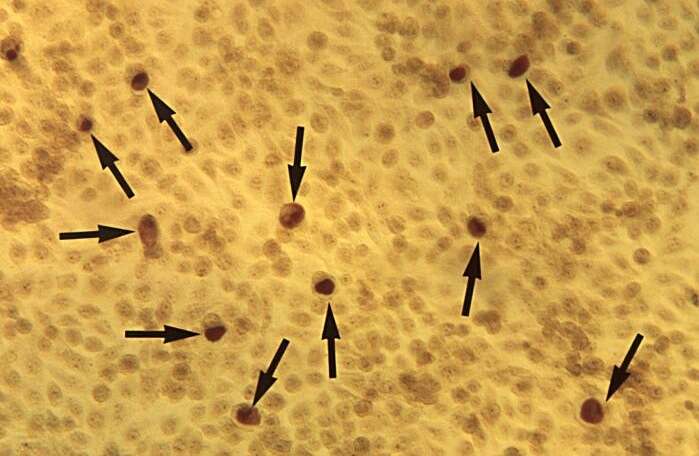
Chlamydiaceae
The Chlamydiaceae are a family of gram-negative bacteria that belongs to the phylum Chlamydiota, order Chlamydiales. Chlamydiaceae species express the family-specific lipopolysaccharide epitope αKdo-(2→8)-αKdo-(2→4)-αKdo (previously called the genus-specific epitope). Chlamydiaceae ribosomal RNA genes all have at least 90% DNA sequence identity. Chlamydiaceae species have varying inclusion morphology, varying extrachromosomal plasmid content, and varying sulfadiazine resistance.
Chlamydiales
The bacterial order Chlamydiales includes only obligately intracellular bacteria that have a chlamydia-like developmental cycle of replication and at least 80% 16S rRNA or 23S rRNA gene sequence identity with other members of Chlamydiales. Chlamydiales live in animals, insects, and protozoa.
Chlamydia muridarum
species of bacteria

Chlamydia psittaci
species of bacterium
Chlamydia pneumoniae
species of bacterium
Chlamydia felis
species of bacterium
Chlamydiota
The Chlamydiota (synonym Chlamydiae) are a bacterial phylum and class whose members are remarkably diverse, including pathogens of humans and animals, symbionts of ubiquitous protozoa, and marine sediment forms not yet well understood. All of the Chlamydiota that humans have known about for many decades are obligate intracellular bacteria; in 2020 many additional Chlamydiota were discovered in ocean-floor environments, and it is not yet known whether they all have hosts.
Parachlamydiaceae
Parachlamydiaceae is a family of bacteria in the order Chlamydiales. Species in this family have a Chlamydia–like cycle of replication and their ribosomal RNA genes are 80–90% identical to ribosomal genes in the Chlamydiaceae. The Parachlamydiaceae naturally infect amoebae and can be grown in cultured Vero cells. The Parachlamydiaceae are not recognized by monoclonal antibodies that detect Chlamydiaceae lipopolysaccharide.