Encyclopedia of Life · EOL (see source)
Chlamydiaceae
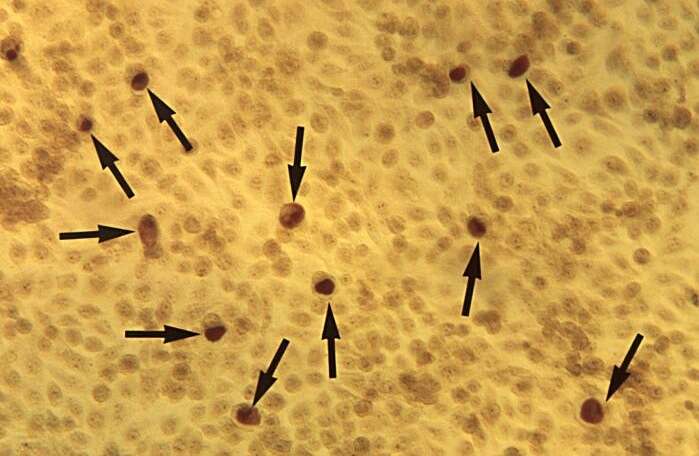
Sign in to saveThe Chlamydiaceae are a family of gram-negative bacteria that belongs to the phylum Chlamydiota, order Chlamydiales. Chlamydiaceae species express the family-specific lipopolysaccharide epitope αKdo-(2→8)-αKdo-(2→4)-αKdo (previously called the genus-specific epitope). Chlamydiaceae ribosomal RNA genes all have at least 90% DNA sequence identity. Chlamydiaceae species have varying inclusion morphology, varying extrachromosomal plasmid content, and varying sulfadiazine resistance.
Species
FAMILY
- KingdomBacteria
- PhylumChlamydiota
- ClassChlamydiia
- OrderChlamydiales
- FamilyChlamydiaceae
Chlamydien ist eine in der Alltagssprache gebräuchliche Bezeichnung für Arten innerhalb der Familie Chlamydiaceae. Es handelt sich um sehr kleine, gramnegative Bakterien, die sich als Parasiten nur innerhalb einer Wirtszelle vermehren können. Sie können eine Vielzahl von Lebewesen infizieren, auch den Menschen. Eine Infektion mit Chlamydien wird als Chlamydiose bezeichnet. Die Erkrankungen betreffen u. a. die Schleimhäute im Augen-, Atemwegs- und Genitalbereich. Die Vertreter der Chlamydiaceae durchlaufen in ihrem Entwicklungszyklus zwei Formen, als infektiöse Elementarkörperchen und als Retikularkörperchen, die die vegetative Form darstellen. Auf üblichen Nährmedien können sie nicht angezüchtet werden. Früher wurden alle bekannten Arten der Gattung Chlamydia zugerechnet, als Ergebnis genetischer Untersuchungen wurde 1999 die Systematik der Ordnung Chlamydiales, der Familie, der Gattungen und der Arten aktualisiert. Seitdem sind der Familie Chlamydiaceae zwei Gattungen – Chlamydia und Chlamydophila – zugehörig. Diese Systematik ist jedoch umstritten.
via GBIF
Research
23,009 papers- Chlamydiaceae infections in pig.Veterinary research · 2011
- Chlamydiaceae and chlamydial infections in sheep or goats.Veterinary microbiology · 2015
- Chlamydiaceae in cattle: commensals, trigger organisms, or pathogens?Veterinary journal (London, England : 1997) · 2011
- Inclusion proteins of Chlamydiaceae.Drugs of today (Barcelona, Spain : 1998) · 2006
- [Chlamydiaceae and cancer].Duodecim; laaketieteellinen aikakauskirja · 1999
via PubMed
Wikidata facts
- Instance of
- taxon
- Parent taxon
- Chlamydiales
- Image
- ChlamydiaTrachomatisEinschlusskörperchen.jpg
Show 7 more facts
- topic's main category
- Category:Chlamydiaceae
- taxon name
- Chlamydiaceae
- taxon rank
- family
- Commons category
- Chlamydiaceae
- Gram staining
- gram-negative bacteria
- taxonomic type
- Chlamydia
Sources (2)
via Wikidata · CC0
~2 min read
Encyclopedic overview
4 sectionsContents
- ''Chlamydia''
- Phylogeny
- See also
- References
The Chlamydiaceae are a family of gram-negative bacteria that belongs to the phylum Chlamydiota, order Chlamydiales. Chlamydiaceae species express the family-specific lipopolysaccharide epitope αKdo-(2→8)-αKdo-(2→4)-αKdo (previously called the genus-specific epitope). Chlamydiaceae ribosomal RNA genes all have at least 90% DNA sequence identity. Chlamydiaceae species have varying inclusion morphology, varying extrachromosomal plasmid content, and varying sulfadiazine resistance.
The family Chlamydiaceae currently includes one genus and one candidate genus: Chlamydia and candidatus Clavochlamydia.
Excerpted from Wikipedia’s “Chlamydiaceae” article, available under the CC BY-SA 4.0 licence.