Category
page 1Chlamydomonadales

Volvox
Volvox is a polyphyletic genus of chlorophyte green algae in the family Volvocaceae. Volvox species form spherical colonies of up to 50,000 cells, and for this reason they are sometimes called globe algae. First reported by Antonie van Leeuwenhoek in 1700, it is distinctive and easily identified in the microscope. It occurs in a variety of freshwater habitats and has a widespread, cosmopolitan distribution.

Dunaliella salina
species of alga

Pandorina
Pandorina is a genus of green algae in the family Volvocaceae. It is a common freshwater genus, and has a cosmopolitan distribution. Along with other algae such as Volvox, Eudorina and Chlamydomonas, it is a model organism for studying the origins and evolution of multicellularity.

Volvocaceae
Volvocaceae are a family of unicellular or colonial biflagellate algae, including the typical genus Volvox, and are collectively known as the volvocine algae. The family was named by Ehrenberg in 1834, and it is known in older classifications as the Volvocidae. All species are colonial and typically inhabit freshwater environments. They are particularly useful as model organisms for studying the evolution of multicellularity, the evolution of sex, and cellular motion and mechanics.
Dunaliella
Dunaliella is a single-celled, photosynthetic green alga, that is characteristic for its ability to outcompete other organisms and thrive in hypersaline environments. It is mostly a marine organism, though there are a few freshwater species that tend to be more rare. It is a genus in which certain species can accumulate relatively large amounts of β-carotenoids and glycerol in very harsh growth conditions consisting of high light intensities, high salt concentrations, and limited oxygen and nitrogen levels, yet is still very abundant in lakes and lagoons all around the world.

Chlamydomonadales
Chlamydomonadales, also known as Volvocales, are an order of flagellated or pseudociliated green algae, specifically of the Chlorophyceae. Chlamydomonadales can form planar or spherical colonies. These vary from Gonium (four to 32 cells) up to Volvox (500 cells or more). Each cell has two flagella, and is similar in appearance to Chlamydomonas, with the flagella throughout the colony moving in coordination.

Gonium
thumb|right|240px|Gonium colony of 16 cells at nominal magnification of 450x.

Eudorina
Eudorina is a genus of green algae in the family Volvocaceae, containing about seven species. It has a cosmopolitan distribution in freshwater habitats.

Haematococcus pluvialis
species of green algae
Haematococcaceae
Haematococcaceae is a family of green algae in the order Chlamydomonadales. It consists of freshwater algae such as Chlorogonium, Haematococcus and Stephanosphaera.
Dunaliellaceae
Dunaliellaceae is a family of algae in the order Chlamydomonadales. It is widespread in freshwater and saline environments worldwide, less so in marine waters.

Volvox globator
species of alga
Pleodorina
Pleodorina is a genus of colonial green algae in the family Volvocaceae. It occurs in freshwater habitats and has a cosmopolitan distribution.

Tetrasporaceae
The Tetrasporaceae are a family of green algae, specifically of the Chlamydomonadales. They are found in freshwater habitats.
Actinochloridaceae
thumb | right | Deasonia sp. NAMSU 934/2, light microscopy.
Actinochloridaceae is a family of green algae, in the order Chlamydomonadales.
Spondylomoraceae
Spondylomoraceae is a family of algae in the order Chlamydomonadales. It consists of various freshwater, microscopic algae.
Chlorangiellaceae
Chlorangiellaceae is a green algae family in the order Chlamydomonadales.

Volvox aureus
species of alga

Palmellopsidaceae
Palmellopsidaceae is a green algae family in the order Chlamydomonadales.

Haematococcus
Haematococcus is a genus of algae in the family Haematococcaceae. It is a freshwater alga with a nearly cosmopolitan distribution, found from every continent except Antarctica.
Tetrabaenaceae
Tetrabaenaceae is a family of green algae in the order Chlamydomonadales. It is widespread but occasional, and found in freshwater habitats.

Volvox carteri
species of alga

Chlorosarcinaceae
Chlorosarcinaceae is a family of chlorophyte green algae, in the order Chlamydomonadales. Members of this genus are found in soils.
Platydorina
Platydorina is a genus of microscopic green algae in the family Volvocaceae. It contains only one species, Platydorina caudata. It was described by Charles Atwood Kofoid in 1899.
Asteromonadaceae
Asteromonadaceae are a family of algae in the order Chlamydomonadales.
Protosiphonaceae
Protosiphonaceae is a family of chlorophyte green algae, in the order Chlamydomonadales.
Goniaceae
Goniaceae is a family of algae in the order Chlamydomonadales, that includes the genera Astrephomene and Gonium. Members of the Goniaceae are distinguished from those of the Volvocaceae by having each cell surrounded by a tripartite boundary of the extracellular matrix, as opposed to the entire colony being surrounded by the tripartite boundary in Volvocaceae. Goniaceae is the sister group to Volvocaceae.
Hypnomonadaceae
Hypnomonadaceae is a family of green algae, in the order Chlamydomonadales.
Phacotaceae
Phacotaceae is a family of green algae in the order Chlamydomonadales. Members of this family are found in freshwater habitats worldwide.

Palmellaceae
The Palmellaceae are a family of green algae, specifically of the Chlamydomonadales. Members of this group are typically found in atmophytic or terrestrial habitats, or as phycobionts associated with lichens; a few are found in fresh water.
Chlorochytriaceae
Chlorochytriaceae is a family of algae within the order Chlamydomonadales. Alternatively, it shows some morphological similarity to Characiosiphonaceae and closely related to it.
It contains a number of parasitic taxa endophytic within vascular plants, mosses, or other algae.
Volvulina
Volvulina is a genus of colonial green algae in the family Volvocaceae. It is cosmopolitan, but rare.
Sphaerocystidaceae
Sphaerocystidaceae is a family of chlorophyte green algae, in the order Chlamydomonadales.
Characiochloridaceae
Characiochloridaceae is a family of green algae in the order Chlamydomonadales.
Chlorogonium
Chlorogonium is a genus of green algae in the family Haematococcaceae. It was first described by Christian Gottfried Ehrenberg in 1837, with the type species Chlorogonium euchlorum; currently, around 30 species are accepted. They are found in freshwater habitats worldwide.
Characiosiphonaceae
The Characiosiphonaceae are a family of algae in the order Chlamydomonadales. Two genera are included in this family, Characiosiphon and Lobocharacium, each containing a single species. The genus Characiochloris may eventually be placed in this family pending future revisions, as it is phylogenetically closely related to the twose genera.
Sphaerodictyaceae
Sphaerodictyaceae is a family of green algae, in the order Chlamydomonadales.

Protosiphon
Protosiphon is a genus of green algae in the class Chlorophyceae.
Apiocystis
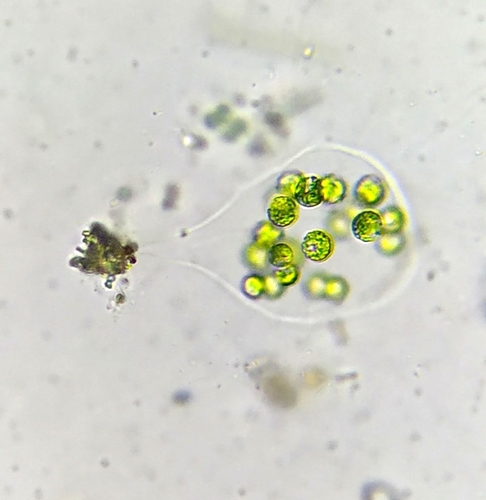
Apiocystis is a genus of algae belonging to the family Tetrasporaceae. It is found attached to freshwater aquatic algae or plants. The species of this genus are found in Europe and Northern America, and are widespread but generally uncommon.
Astrephomene
Astrephomene is a genus of green algae in the family Goniaceae, order Chlamydomonadales. The genus was first discovered in 1937 by Mary Pocock and later named by Pocock in 1953. The name comes from the Classical Greek roots a- (meaning "not") and strephomene (meaning "turning itself"), referring to its mode of reproduction. To date, the genus contains two species.
Rhodochytrium
Rhodochytrium is a genus of green algae in the family Chlorochytriaceae.
Pyrobotrys
Pyrobotrys is a genus of green algae in the family Spondylomoraceae. It has a cosmopolitan distribution, found in fresh water rich in organic matter.

Pleurastrum
Pleurastrum is a genus of green algae, specifically of the Chlorophyceae. , it was the only genus in the family Pleurastraceae.
Tetrabaena
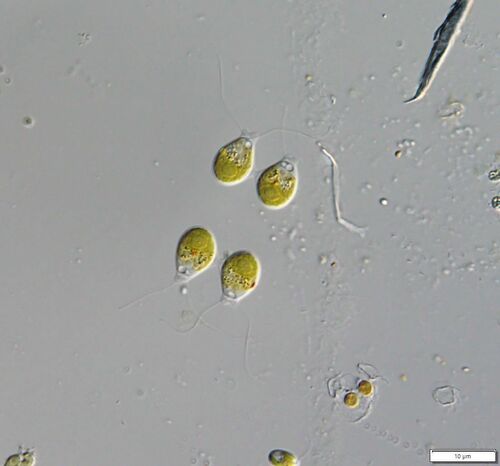
Tetrabaena is a monotypic genus of green algae containing the species Tetrabaena socialis. It primarily occurs in freshwater, although it has been found in saltwater on at least one occasion. Although rare, it has a cosmopolitan distribution and has even been found from Antarctica.
Basichlamys
Basichlamys is a monotypic genus of colonial green algae in the family Tetrabaenaceae. The sole species is Basichlamys sacculifera. It is rare, but cosmopolitan in freshwaters.
Polytomella
Polytomella is a genus of green algae in the family Dunaliellaceae. It is widespread in freshwater habitats worldwide. The algae is actually colourless. It has discarded the ability of photosynthesis, and lives by consuming compounds like acetate, butyrate, and alcohols. Thus, it's one of the rare examples of non-photosynthetic algae.
Pteromonas
Pteromonas is a genus of green algae in the family Phacotaceae. It has a cosmopolitan distribution, and mainly occurs in nutrient-rich freshwaters.
Paulschulzia
Paulschulzia is a genus of green algae, specifically of the family Tetrasporaceae.
Golenkinia
Golenkinia is a genus of green algae first described in 1894 by Robert Chodat. The genus is named for the Russian phycologist Mikhail Iljitsch Golenkin. Golenkinia species live in fresh water (including bodies of black water such as Winyah Bay) and are found around the world.
Yamagishiella
Yamagishiella is a genus of colonial green algae in the family Volvocaceae. It contains the single species Yamagishiella unicocca. It was first described in 1974 as Pandorina unicocca, and then transferred to a new genus in 1992. It is a freshwater species.

Asterococcus
Asterococcus is a genus of green algae in the order Chlamydomonadales. It is planktonic in freshwater ponds and lakes, or benthic within mires and swamps. It is a common and widespread genus, but is rarely abundant.