File:Mikrofoto.de-volvox-4.jpg · Wikimedia Commons · See Wikimedia Commons
Volvox
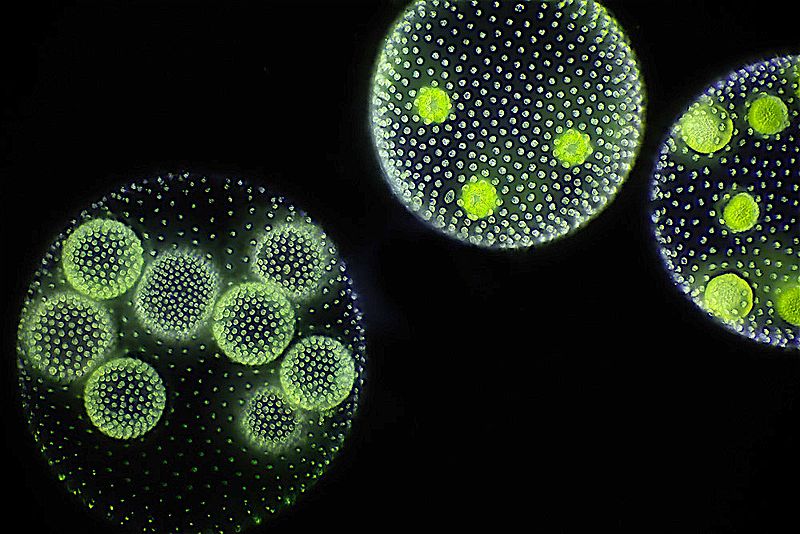
Sign in to saveVolvox is a polyphyletic genus of chlorophyte green algae in the family Volvocaceae. Volvox species form spherical colonies of up to 50,000 cells, and for this reason they are sometimes called globe algae. First reported by Antonie van Leeuwenhoek in 1700, it is distinctive and easily identified in the microscope. It occurs in a variety of freshwater habitats and has a widespread, cosmopolitan distribution.
OverviewAI-generated
Volvox is a genus within the family Volvocaceae. It belongs to the kingdom Plantae, phylum Chlorophyta, and class Chlorophyceae. The order is listed as Volvocales in some records and Chlamydomonadales in others. The genus was described by Linnaeus in 1758 and holds an accepted taxonomic status. Its common names include ボルボックス属 and オオヒゲマワリ属.
This freshwater organism is distributed in small, still pools, where it is most abundant in spring and often forms pure groups. Occurrence records have been documented in the United States, South Africa, Mozambique, France, and Sweden. Scientific literature includes 558 PubMed entries, while 1,664 occurrence records are available through GBIF.
Synthesized by Vinony from 32 facts across 8 sources: Wikidata, GBIF, PubMed, Gbif Occ, Encyclopedia of Life, WoRMS, iDigBio, Vinony graph. Generated from structured data (not the Wikipedia text) and checked against those facts — may still contain errors.
Species
GENUS
- KingdomPlantae
- PhylumChlorophyta
- ClassChlorophyceae
- OrderVolvocales
- FamilyVolvocaceae
团藻(Volvox)为绿藻门团藻科一种藻体,分布于静止的小型池滨内,春季较盛,并常成纯群。
via GBIF
Museum specimens
- Specimen records
- 47
- With media
- 27
- Family
- Volvocaceae
- Collections
- US, AM, UTEX, UPS, NHMUK, YPM
- Recorded in
- United States, South Africa, Mozambique, France, Sweden
Research
558 papers- Volvox and volvocine green algae.EvoDevo · 2020
- Volvox: simple steps to developmental complexity?Current opinion in plant biology · 2010
- Volvox: A simple algal model for embryogenesis, morphogenesis and cellular differentiation.Developmental biology · 2016
- Volvox.Current biology : CB · 2004
- Major ontogenetic transitions during Volvox (Chlorophyta) evolution: when and where might they have occurred?Development genes and evolution · 2016
via PubMed
Wikidata facts
- Instance of
- taxon
- Parent taxon
- Volvocaceae
- Image
- 202004 Volvox.svg
Show 5 more facts
- taxon name
- Volvox
- Commons category
- Volvox
- taxon rank
- genus
- taxon common name
- オオヒゲマワリ属
Sources (2)
via Wikidata · CC0
~12 min read
Encyclopedic overview
11 sectionsContents
- History of knowledge
- Description
- Reproduction
- Colony inversion
- Habitats
- Taxonomy
- Species
- Evolution
- References
- Notes
- External links
Volvox is a polyphyletic genus of chlorophyte green algae in the family Volvocaceae. Volvox species form spherical colonies of up to 50,000 cells, and for this reason they are sometimes called globe algae. First reported by Antonie van Leeuwenhoek in 1700, it is distinctive and easily identified in the microscope. It occurs in a variety of freshwater habitats and has a widespread, cosmopolitan distribution.
Volvox diverged from unicellular ancestors approximately . Colonies of Volvox are differentiated into somatic and reproductive cells, and are capable of both sexual and asexual reproduction. Additionally, its close relatives are diverse in body plan and reproductive strategy, ranging from unicellular organisms such as Chlamydomonas to simple colonial organisms such as Pandorina and Eudorina. Because of this, Volvox and its relatives are used as model organisms in the classroom and laboratory to study biological processes such as cellular movement, sexual reproduction, and evolution of multicellularity.
Excerpted from Wikipedia’s “Volvox” article, available under the CC BY-SA 4.0 licence.