Category
page 1Christian prayer
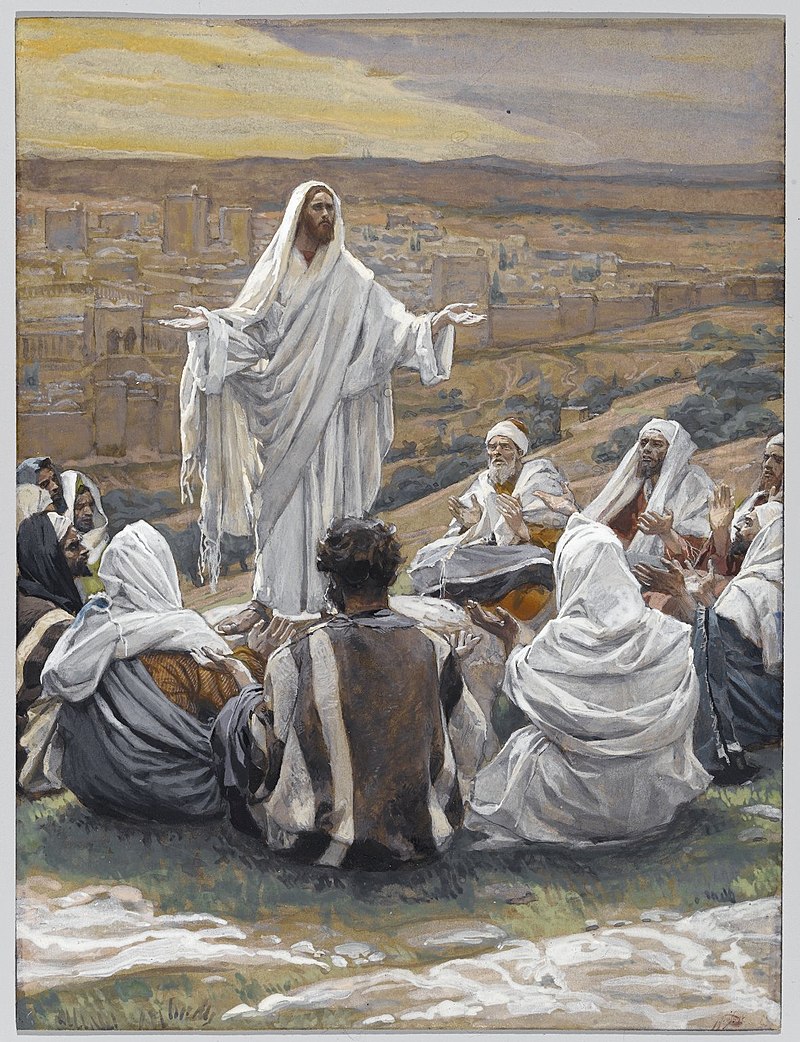
Lord's Prayer
central Christian prayer, taught by Jesus Christ to his disciples

amen
thumb|upright=0.9|A man in Jewish hat says "Amen" to ' in the margin of ' f. 86v. Abraham, c. 1300.
Amen is an Abrahamic declaration of affirmation which is first found in the Hebrew Bible, and subsequently found in the New Testament. It is used in Jewish, Christian, and Islamic practices as a concluding word, or as a response to a prayer. Common English translations of the word amen include "verily", "truly", "it is true", and "let it be so". It is also used colloquially to express strong agreement.

hallelujah
thumb|900px|Hallelujah written in Modern Hebrew
Hallelujah (; , Modern ) is an interjection from the Hebrew language, used as an expression of gratitude to God. The term is used 24 times in the Tanakh (in the book of Psalms), twice in deuterocanonical books, and four times in the Christian Book of Revelation.

stations of the Cross
series of artistic representations, depicting Christ carrying the Cross to his crucifixion

Magnificat
thumb|Visitation (Ghirlandaio)|Visitation, by [[Domenico Ghirlandaio (1491), depicts Mary visiting her elderly cousin Elizabeth.]]

mass for the dead
thumb|Requiem for Cirilo Almario|Bishop Cirilo Almario, in the [[Mass of Paul VI at Minor Basilica and Cathedral of the Immaculate Conception, Malolos, Bulacan, 2016]]
thumb|The Requiem, in the Tridentine Mass, celebrated annually for [[Louis XVI and victims of the French Revolution, in the crypt of Strasbourg Cathedral, 2013]]
thumb|270px|Requiem Mass for Archduke Franz Ferdinand of Austria at St. Catherine's Cathedral, [[St. Petersburg, published in a Russian newspaper, 1914]]

Gloria Patri
Trinitarian doxology

contemplation
thumb|Kamppi Chapel in Helsinki City Centre is a [[community centre, assigned for contemplation.]]
thumb|Nature contemplation

Gloria in excelsis Deo
Liturgical Christian hymn
Salve Regina
Medieval Catholic hymn to Mary, mother of Jesus
prayer rug
piece of fabric, sometimes a pile carpet, used by Muslims and some Christians during prayer

Kyrie
thumb| XI ("orbis factor")—a fairly ornamented setting of the '' in Gregorian chant—from the [[Liber Usualis'']]

hesychasm
Hesychasm () is a contemplative monastic tradition in the Eastern Christian traditions of the Eastern Orthodox Church and Eastern Catholic Churches in which stillness (hēsychia) is sought through uninterrupted Jesus prayer. While rooted in early Christian monasticism, it took its definitive form in the 14th century at Mount Athos.
Jesus Prayer
short prayer, popular in Eastern Christianity: "Lord Jesus Christ, Son of God, have mercy on me, a sinner."
Nunc dimittis
passage from the Gospel of Luke

novena
thumb|Novena to Our Lady of Perpetual Help in Brazil
thumb|A booklet of the novena to Most Holy Name of the Blessed Virgin Mary|Sweetest Name of Mary, in Bikol and printed in [[Binondo, Manila dated 1867]]

Trisagion
thumb|Trinity (Andrei Rublev)|Old Testament Trinity [[icon by Andrei Rublev, (Tretyakov Gallery, Moscow)]]
The Trisagion (; 'Thrice Holy'), sometimes called by its incipit Agios O Theos, is a standard hymn of ancient origin of the Divine Liturgy in most of the Eastern Orthodox, Western Orthodox, Oriental Orthodox, and Eastern Catholic churches.
Christian mysticism
development of mystical practices and theory within Christianity

Kontakion
A kontakion (Greek , kondákion, plural κοντάκια, kondákia) is a form of hymn in the Byzantine liturgical tradition.
The kontakion form originated in Syriac hymnography and gained prominence in Byzantium during the 6th century, particularly through the work of St. Romanos the Melodist of Emesa.
Kontakia have a number of strophes (oikoi or ikoi, stanzas; singular oikos or ikos) and begin with a prologue (the prooimoion or koukoulion). A kontakion sometimes has a biblical theme and may feature a dialogue between biblical characters. The only kontakion that is used in full length today is the Ak

vigil
thumb|Vigil, tacuinum sanitatis casanatensis (14th century)right|thumb|''A Knight's Vigil'' by John Pettie
A vigil is a period of purposeful sleeplessness, an occasion for devotional watching, or an observance.
Lectio Divina
traditional monastic practice of scriptural reading, meditation and prayer intended to promote communion with God and to increase the knowledge of God's word
prayer rope
Item used in Christianity to assist prayer
canonical hours
Christian concept of periods of prayer throughout the day
Marian devotion
external pious practices directed to the person of Mary by members of certain Christian traditions
The Prayer of Russians
national anthem with lyrics by Vasily Zhukovsky
Christian prayer
activity in Christianity
Holy door
Special church door during Jubilee years in the catholic church
collect
The collect ( ) is a short general prayer of a particular structure used in Christian liturgy.

orans
thumb|An early Christian painting of Noah praying in the gesture of orant
right|thumb|Fresco in the Catacomb of Priscilla showing a Christian woman wearing a headcovering and praying in the orant posture
thumb|Christian man praying in the gesture of orant, Catacombs of Rome#Catacombs of Domitilla|Catacombs of Domitilla, [[Rome]]
Orans, a loanword from Medieval Latin orans () translated as "one who is praying or pleading", also orant or orante, as well as lifting up holy hands, is a posture or bodily attitude of prayer, usually standing, with the elbows close to the sides of the body and with t
%2C%20poi%20domenico%20atticciati%20(1589-91)%2C%20coro%20della%20certosa%20di%20firenze%2C%20misericordie%2015%2C0.jpg)
misericord
thumb|upright=1.2|Misericord from the Florence Charterhouse|Charterhouse of Florence (Tuscany, Italy), depicting a mascaron (a decorative face)
thumb|upright=1.2|With the seat lifted (as at left), the misericord provides a ledge to support the user.A misericord (sometimes named mercy seat, like the biblical object, sometimes misericordia) is a small wooden structure (a sort of shelf) on the underside of a hinged folding seat in a church which, when the seat (or 'stall') is folded up, is intended to act as a ledge to support a person leaning against it in a partially standing position during lo

Memorare
thumb|Refugium Peccatorum Madonna, an example of Marian art
Wessobrunn Prayer
literary work
canon
structured hymn used in a number of Eastern Orthodox services
Examination of conscience
concept in Catholic theology
National Prayer Breakfast
annual event held in Washington, D.C.
Eternal Rest
Introit, Western Christian prayer for the dead
votive candle
type of votive offering in Christianity
Christian headcovering
religious head covering for women in Christianity

prie-dieu
thumb|upright=0.9|A fairly large, elaborately carved prie-dieu with a built-in altar that can be closed
thumb|upright=0.9|Prie-dieu facing the casket of the President of the United States|US President [[John F. Kennedy in the East Room of the White House in 1963. The priests Robert Mohan and Gilbert Hartke are praying on two more to the right.]]
Prayer to Saint Michael
prayer

Paraklesis
thumb|250px|Receiving a blessing at the end of a Molieben at the Trinity-St. Sergius Lavra (Siege of Troise-Sergieva Lavra, by [[Vasily Petrovich Vereshchagin, 1891).]]
A Paraklesis () or Supplicatory Canon in the Byzantine Rite, is a service of supplication for the welfare of the living. It is addressed to a specific Saint or to the Most Holy Theotokos whose intercessions are sought through the chanting of the supplicatory canon together with psalms, hymns, and litanies.
Phos Hilaron
one of the well known ancient hymn in Christianity

benediction
thumb|200px|Icon of Christ Pantokrator|Jesus Christ Pantokrator by [[Theophanes the Cretan. His right hand is raised in benediction.]]
A benediction (, 'well' + , 'to speak') is a short invocation for divine help, blessing and guidance, usually at the end of worship service. It can also refer to a specific Christian religious service including the exposition of the eucharistic host in the monstrance and the blessing of the people with it.

Lestovka
thumb|Lestovka with the names of the Apostles the work of the master Jelisaveta Gornitskaya
Lestovka () is a special type of prayer rope made of leather, once in general use in old Russia, and is still used by Russian Old Believers today, such as the Russian Orthodox Christians and Russian Orthodox Oldritualist Church, Pomorian Old-Orthodox Church and Edinoverians, whether Orthodox or Greek Catholic.
Words of Institution
Eucharist liturgies sometimes using the phase
Christian meditation
form of prayer
ecphonesis
Ecphonesis () is an emotional, exclamatory phrase (exclamation) used in poetry, drama, or song. It is a rhetorical device that originated in ancient literature.
Anglican prayer beads
used by Anglicans and other Protestants, such as Methodists
Prayer in the Catholic Church
Roman Catholic beliefs on Christian prayer
ejaculation
very short prayer

How Glorious Is Our Lord in Zion
1794 hymn composed by Dmytro Bortniansky with lyrics by Mikhail Kheraskov
Prayer of Saint Ephrem
eastern Christian text with variants
Usual beginning
Absolution of the dead
prayer for or a declaration of absolution of a dead person's sins that takes place at the person's religious funeral
Prayer to Saint Joseph
Prayers in Roman Catholicism
Basílica del Sagrado Corazón de Jesús, Bogotá
church building in Bogotá, Colombia
Lity
festive religious procession
World Day of Prayer
international ecumenical Christian laywomen's initiative
Sinner's prayer
evangelical Christian term referring to any prayer of repentance

Spiritual Communion
Christian practice related to Holy Communion