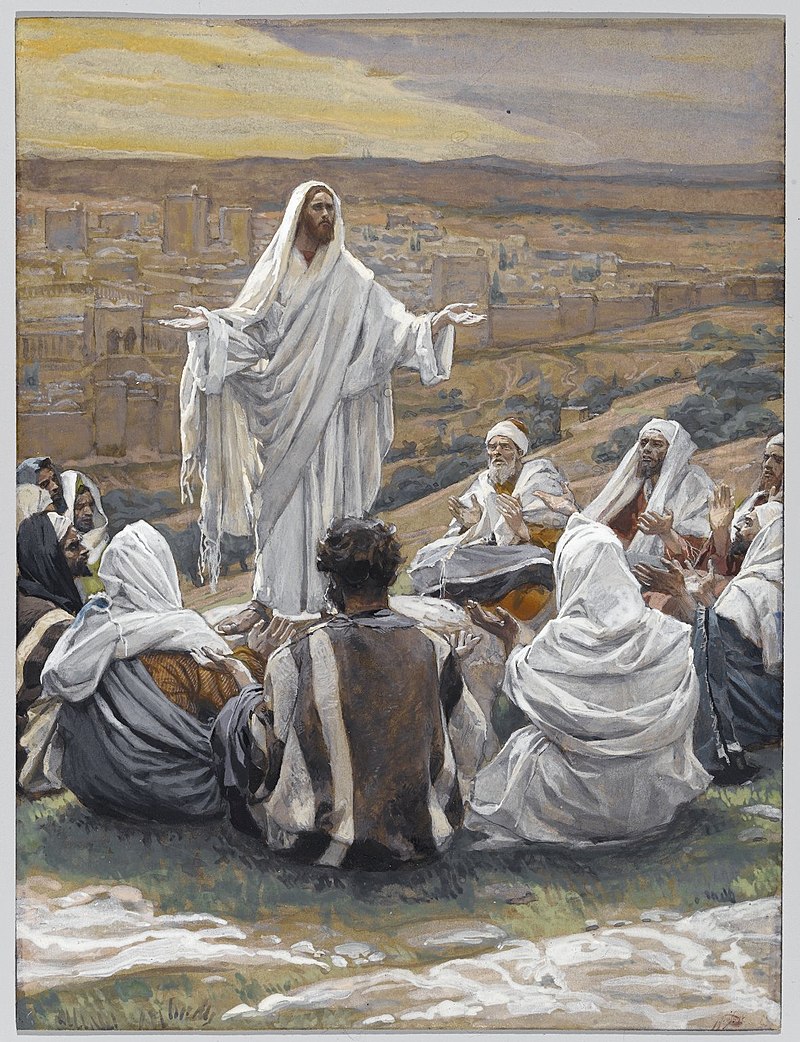
File:Brooklyn_Museum_-_The_Lord's_Prayer_(Le_Pater_Noster)_-_James_Tissot.jpg · Wikimedia Commons · See Wikimedia Commons
Lord's Prayer
Sign in to saveAlso known as Our Father, Pater noster, Model Prayer, Our father who art in Heaven, Lords prayer, Lord’s Prayer, Pater Hemon, Prayer
central Christian prayer, taught by Jesus Christ to his disciples
The Lord's Prayer is a central prayer in Christianity that Jesus Christ taught to his disciples. It remains one of the most important and widely recited prayers in the Christian faith.
AI-generated from the Wikipedia summary — may contain errors.
Wikidata facts
- Instance of
- logion
- Religion
- Christianity
- Creator
- Jesus
- Image
- TissotLordsPrayer.JPG
Show 11 more facts
- Commons category
- Lord's Prayer
- topic's main category
- Category:Lord's Prayer
- time of earliest written record
- 0100-00-00
- Commons gallery
- Lord's Prayer
- language of work or name
- Czech
- first line
- Otče náš, jenž jsi na nebesích, posvěť se jméno tvé, přijď království tvé, buď vůle tvá jako v nebi, tak i na zemi.
- last line
- ἀλλὰ ῥῦσαι ἡμᾶς ἀπὸ τοῦ πονηροῦ.
- subtitle
- Modlitba Páně
- title
- Otče náš
- form of creative work
- poem
- Stack Exchange tag
- christianity.stackexchange.com/tags/lords-prayer
via Wikidata · CC0
~40 min read
Encyclopedic overview
The Lord's Prayer (Le Pater Noster), by James Tissot
The Lord's Prayer, also known by its incipit Our Father (Greek: Πάτερ ἡμῶν, romanized: Páter hēmôn; Latin: Pater Noster), is a central Christian prayer attributed to Jesus. It contains petitions to God focused on God's holiness, will, and kingdom, as well as human needs, with variations across manuscripts and Christian traditions.
Excerpted from Wikipedia’s “Lord's Prayer” article, available under the CC BY-SA 4.0 licence.
Gallery (11)
Available in 184 languages
- Español
- Français
- Deutsch
- 中文
- 日本語
- Русский
- Português
- Italiano
- العربية
- हिन्दी
- Afrikaans
- Albanian
- Albanian
- Amharic
- Aragonese
- Aramaic
- Armenian
- Arpitan
Show 165 more
- Asturian
- Aymara
- Azerbaijani
- Bahasa Indonesia
- Bangla
- Basque
- bat_smg
- Bavarian
- be_x_old
- Belarusian
- Betawi
- Bikol
- Bislama
- Bosnian
- Breton
- Bulgarian
- Burmese
- Catalan
- Cebuano
- Central Dusun
- Cherokee
- Choctaw
- Church Slavic
- Colognian
- Cornish
- Corsican
- Croatian
- Czech
- Danish
- Egyptian Arabic
- eml
- Erzya
- Esperanto
- Estonian
- Faroese
- Fiji Hindi
- Fijian
- Filipino
- Finnish
- fiu_vro
- Fon
- Friulian
- Galician
- Georgian
- Goan Konkani
- Greek
- Guarani
- Hakka Chinese
- Hawaiian
- Hebrew
- Hiri Motu
- Hungarian
- hyw
- Iban
- Icelandic
- Ido
- Interlingua
- Interlingue
- Inupiaq
- Irish
- Javanese
- Kashubian
- Komi
- Komi-Permyak
- Kurdish
- Latin
- Latvian
- Ligurian
- Limburgish
- Lingala
- Lingua Franca Nova
- Lithuanian
- lld
- Lombard
- Low German
- Lower Sorbian
- Luxembourgish
- Macedonian
- Malagasy
- Malay
- Malayalam
- Manx
- Māori
- Marshallese
- Mingrelian
- Moksha
- nah
- Navajo
- nds_nl
- Neapolitan
- Nederlands
- Nias
- Northern Sami
- Northern Sotho
- Norwegian
- Norwegian Nynorsk
- Novial
- nrm
- Occitan
- Old English
- Pampanga
- Pennsylvania German
- Picard
- Piedmontese
- Polski
- Pontic
- ppl
- pwn
- Quechua
- roa_rup
- roa_tara
- Romanian
- Romansh
- Romany
- Rusyn
- Samoan
- Sardinian
- Scots
- Scottish Gaelic
- Serbian
- Serbian (Latin)
- Shona
- Sicilian
- Silesian
- simple
- Sinhala
- Slovak
- Slovenian
- Somali
- Southern Sotho
- Sundanese
- Svenska
- Swahili
- Swati
- Tamil
- Taroko
- Tatar
- Tiếng Việt
- Toki Pona
- Tsonga
- Tulu
- Tumbuka
- Türkçe
- Ukrainian
- Upper Sorbian
- Urdu
- Uyghur
- Venetian
- Veps
- Volapük
- Walloon
- Waray
- Welsh
- West Flemish
- Western Frisian
- Wu Chinese
- Xhosa
- Zaza
- Zeelandic
- zh_classical
- zh_min_nan
- zh_yue
- فارسی
- ไทย
- 한국어
via Wikidata sitelinks · CC0