Category
page 1Christmas traditions

Santa Claus
Santa Claus is a legendary figure originating in Western Christian culture who is said to bring gifts during the late evening and overnight hours on Christmas Eve. Christmas elves are said to make the gifts in Santa's workshop, while flying reindeer pull his sleigh through the air.

Rovaniemi
Rovaniemi ( , ; ; ; ) is a city in Finland and the regional capital of Lapland. It is located near the Arctic Circle in the northern interior of the country. The population of Rovaniemi is approximately , while the sub-region has a population of approximately . It is the most populous municipality in Finland, and the 11th most populous urban area in the country.
alt=Electronic departure board inside a Finnish railway station showing long-distance and overnight sleeper trains to Rovaniemi in Lapland.|thumb|320x320px|Departure board for Santa Express sleeper train to Rovaniemi
Rovaniemi is the a

nativity scene
representation of the birth of Christ

Christmas market
market, usually outdoor, associated with the celebration of Christmas
Christmas card
a greeting card sent for Christmas

Christmas pudding
steamed pudding
Christmas gift
gift given in celebration of Christmas
snow globe
transparent sphere enclosing a miniaturized scene, filled with water with unattached objects resembling snowflakes
Christmas and holiday season
Christmas period with related and unrelated holidays between the end of November until the first days of January
Christmas stocking
receptacle for Christmas gifts
Korvatunturi
Korvatunturi is a fell in Lapland, on the border between Finland and Russia. Its Finnish part is within Urho Kekkonen National Park in the municipality of Savukoski. In Finnish the name Korvatunturi means "Ear Fell", referring to the mountain's distinctive profile.
Christmas cracker
table decorations that make a snapping sound when pulled
Christmas stamp
stamp issued during the Christmas season
Christmas sweater
pullover decorated with Christmas imagery
Secret Santa
Western Christmas tradition
Christmas seal
labels (not stamps) placed on mail during Christmas; issued by private organisations

Chrismukkah
thumb|A Hanukkah bush that some Jewish families display in their homes for the duration of Hanukkah and Christmas. Unlike a Christmas tree it would be without any Christianity-themed ornaments and use the colour blue.
Chrismukkah is a pop-culture portmanteau neologism referring to the merging of the holidays of Christianity's Christmas and Judaism's Hanukkah. It first arose in the German-speaking countries within middle-class Jews of the 19th century. After World War II, Chrismukkah became particularly popular in the United States, but is also celebrated in other countries.
Christmas tradition
traditions of celebrating Christmas around the world
santon
painted terracotta figurine, basic element of Provençal Nativity scenes

Turoń
alt=A kind of costume-effigy, that represents aurochs-like creature. It's massive, coated with black fur, and with a flopping jaw.|thumb|Turons, 1926
thumb|Kolęda walkers with a Turoń|alt=|324x324px
Christmas on the International Space Station
Christmas traditions and celebration in the International Space Station
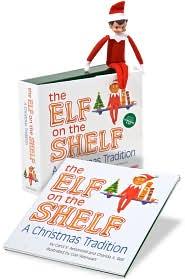
The Elf on the Shelf
2005 picture book by Carol Aebersold and Chanda Bell
observance of Christmas by country
overview about Christmas traditions
Christmas Kettle
fundraising campaign by The Salvation Army
Operation Christmas Drop
Annual humanitarian airlift
Teddy bear toss
Christmas tradition
aguinaldo
folk genre of Christmas music
J-day
thumb|250x250px|An advertising display for Tuborg Julebryg
In Danish culture, J-dag (short for "julebryg dag", meaning Christmas beer day) is the name given to the day on which Tuborg Brewery releases its christmas beer, Tuborg Julebryg. The concept was launched in 1990, though it had reportedly been celebrated in the mid-1980s. In 2008, the noun j-dag was included in Retskrivningsordbogen, the Danish spelling dictionary.
Bear guiding
Russian folk ritual
polaznik
thumb|320x320px|Carlton Alfred Smith, Christmas Eve
In Slavic traditions, a Polaznik is the first guest (sometimes called the "divine guest") who comes to a house at Christmas or on some holiday between St. Demetrius day and Epiphany to bring luck, prosperity, health, and wealth for the coming year. Less frequently, the role of the polaznik is taken over by an animal, which is brought into the house, which is also supposed to bring luck. The ritual is known mainly to Ukrainians, Poles, Slovaks, Slovenes, Serbs, Croats, and Bulgarians. It is believed that the polaznik is a messenger of the ance
podłaźniczka
thumb|upright|A drawing of a podłaźniczka from the Lesser Poland region
Podłaźniczka, polazňička is a traditional Polish and Slovak Christmas decoration. It was usually made from branches or the top of a conifer tree turned upside down, which was then decorated with colored paper cutouts (wycinanki), candies, apples, nuts, typical Polish świats, or stars and crosses made of straw. The podłaźniczka was then hung from the ceiling rafters over the Wigilia dinner table on Christmas Eve.
Pancho Claus
Hispanic version of Santa Claus popular in parts of the United States, sometimes referred to as a "Tex-Mex" version of Santa
Boro Din
Christmas in Bangladesh
snapdragon
game played in winter
Boxing Day Test
annual cricket Test match in Australia