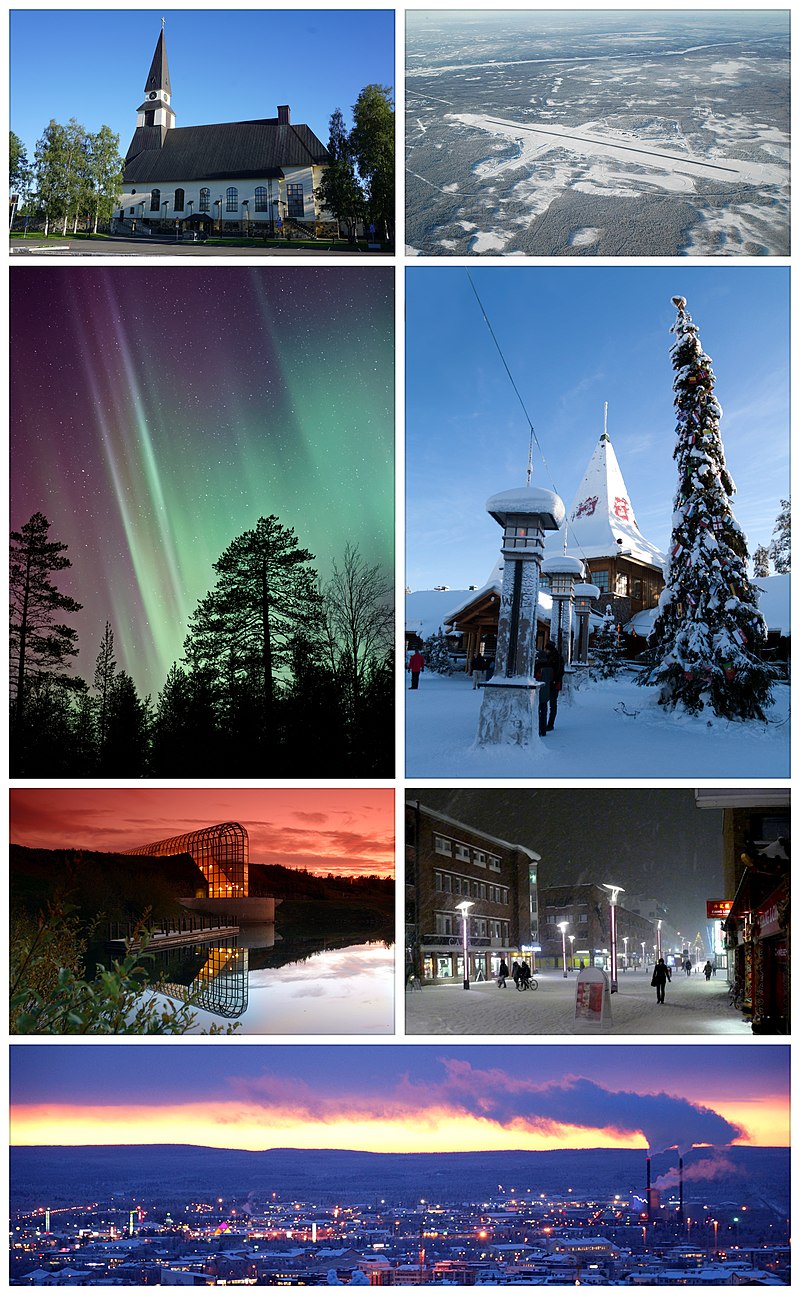
File:Rovaniemi_Montage.jpg · Wikimedia Commons · See Wikimedia Commons
Rovaniemi
Sign in to saveAlso known as Roavvenjárga, Roavenjárga, Ruávinjargâ, Roavvenjarga, Roavenjarga, Ruavinjarga, Ruäʹvnjargg
Rovaniemi ( , ; ; ; ) is a city in Finland and the regional capital of Lapland. It is located near the Arctic Circle in the northern interior of the country. The population of Rovaniemi is approximately , while the sub-region has a population of approximately . It is the most populous municipality in Finland, and the 11th most populous urban area in the country. alt=Electronic departure board inside a Finnish railway station showing long-distance and overnight sleeper trains to Rovaniemi in Lapland.|thumb|320x320px|Departure board for Santa Express sleeper train to Rovaniemi Rovaniemi is the a
OverviewAI-generated
Rovaniemi is a city and municipality in Finland, serving as the capital of Lapland. It is located in the Lapland region, specifically within the Rovaniemi sub-region and Oulu Province. The municipality shares borders with Kolari, Kittilä, Sodankylä, and Kemijärvi. It is situated near the Kemijoki river and follows the former Rovaniemen maalaiskunta. The area has an elevation of 88 meters above sea level, with a total area of 8016.62.
The city has a population of 65329 and uses Finnish as its official language. It operates in the UTC+02:00 and UTC+03:00 time zones, corresponding to Europe/Helsinki. Rovaniemi is twinned with Neustrelitz, Kassel, St. Johann in Tirol, and Kiruna Municipality. It owns the Rovaniemen keskuskenttä. The subject is referenced by 911 other encyclopedia articles.
Synthesized by Vinony from 46 facts across 6 sources: Wikidata, Open Meteo, Openweathermap, OpenStreetMap, Vinony graph, Geo. Generated from structured data (not the Wikipedia text) and checked against those facts — may still contain errors.
Weather now
cached 10h ago7-day forecast
via Open-Meteo
Key facts
- Settlement.name
- Rovaniemi
- Settlement.nicknames
- Arctic Capital; Hometown of Santa Claus
- Settlement.settlement_type
- Municipality
- Settlement.image_skyline
- Rovaniemi Montage.jpg
- Settlement.image_caption
- Clockwise from top: the Rovaniemi Church, the Rovaniemi Airport, the Santa Claus Village, downtown Rovaniemi, a view of the city from Ounasvaara, the Arktikum Science Museum, and aurora borealis in Someroharju.
- Settlement.image_flag
- Rovaniemi.lippu.svg
- Settlement.image_shield
- Rovaniemi.vaakuna.svg
- Settlement.shield_size
- 120x80px
- Settlement.image_map
- Rovaniemi sijainti Suomi.svg
- Settlement.map_caption
- Location of Rovaniemi in Finland
- Settlement.map_caption1
- Interactive map outlining Rovaniemi.
- Settlement.mapframe
- yes
- Settlement.mapframe marker
- city
- Settlement.subdivision_type
- Country
- Settlement.subdivision_name
- Finland
- Settlement.subdivision_type1
- Region
- Settlement.subdivision_name1
- Lapland
- Settlement.subdivision_type2
- Sub-region
via Wikipedia infobox
Wikidata facts
- Instance of
- municipality of Finland
- Official name
- Rovaniemen kaupunki
- Country
- Finland
- Located in
- Oulu Province
- Official language
- Finnish
- Population
- 65286
- Area
- 434.99
- Elevation
- 88
- Time zone
- UTC+03:00
- Body of water
- Kemijoki
- Capital of
- Lapland
- Shares border with
- Pelkosenniemi
- Legal form
- municipality of Finland
- Follows
- Rovaniemen maalaiskunta
- Official website
- international.rovaniemi.fi/en
- Image
- Rovaniemi -The ”Lumberjack's Candle Bridge.jpg
- Dialing code
- 16
Show 15 more facts
- category for people who died here
- Category:Deaths in Rovaniemi
- twinned administrative body
- Harbin
- Commons category
- Rovaniemi
- topic's main category
- Category:Rovaniemi
- category for people born here
- Category:Births in Rovaniemi
- category of associated people
- Category:People from Rovaniemi
- native label
- Rovaniemi
- owner of
- Rovaniemen keskuskenttä
- time of earliest written record
- 1453-00-00
- P8168
- Roger Willemsen
- associated electoral district
- Lapland
- located in the statistical territorial entity
- Rovaniemi sub-region
- different from
- Rovaniemi sub-region
- citizens' initiative URL
- www.kuntalaisaloite.fi/sv/sok?municipalities=698
- postal code
- 96100
Sources (14)
via Wikidata · CC0
Travel guide
Understand
thumb|350px|Santa's Village at the Arctic Circle in the winter
Rovaniemi is a transport and tourist hub for Finnish Lapland. Sitting on the Arctic Circle does not harm the latter role, and Joulupukki, presenting himself as Santa Claus to foreigners, has understood that this is the place to meet people. Tourist businesses have also flocked here. Easily reachable, Rovaniemi still has rivers, a fell, mires, vast forests, Midnight Sun and Northern Lights: much of what Lapland means to most people.
As the capital of Finnish Lapland, the city has several important museums, cultural venues and educational institutions. It has the feel of a university town when you get to the right venues. The University of Lapland and Lapland University of Applied Sciences have about 10,000 students in total.
In 1960, Rovaniemi became a city, and in 2006, it merged with the surrounding municipality. With the resulting area of , nearly the size of all Cyprus, it became the largest city in Europe. With 63,500 inhabitants it is also among the ten most populous cities this north, globally. Some 52,000 live in urban areas. The population is Finnish-speaking (96%). The original Sámi population has integrated with the Finns and disappeared; there are some Sámi here, but not significant numbers. The first Sámi village is 175 km to the north.
The Finnish Air Force maintains a base (Lapland Air Command) which is situated at the city's airport. Therefore spotting some military aircraft above the town is da…
Get in
thumb|Rovaniemi railway station
Get around
Being not too big of a town, the best way to get around the city quickly is on foot. However, some of the main attractions are far away and buses are sparse; most households have a car.
See
thumb|Santa Claus Village, the most popular tourist attraction. thumb|The Science Centre Arktikum has more than 100 000 visitors each year.
Most tourists come to Rovaniemi for precisely one thing: Santa.
The famous midnight sun, when the sun doesn't set at all, is seen between June 6th and July 7th (even though the city centre is south of the Arctic Circle). There are white nights from May until mid-August. In winter auroras are seen on most nights if the sky is clear.
Buy
thumb|Main entrance of Sampokeskus on the Lordi's Square
There are some souvenirs and fur products for sale at the , on the pedestrian street, and — of course — at the Santa Claus Village. At the once famous there are mostly berries for sale in the summer and Christmas trees before Christmas.
There is a fancy and popular event Rovaniemi old-style market fair (Rovaniemen Wanhat Markkinat) during the weekend in mid-August with lots of local products and delicacies for sale. These are arranged at the , near the Jätkänkynttilä bridge.
Eat
Considering the size of the city, Rovaniemi has a remarkably wide range of restaurants. You will find anything from sushi to bear meat and from hamburgers to traditional delicacies.
As elsewhere in Lapland, the traditional restaurant meal is sautéed reindeer (poronkäristys), consisting of slices of reindeer meat stewed in a frying pan with butter and water. A "bowl" of mashed potatoes is placed to the dish and the hole is filled with stewed meat. This is garnished with lingonberry jam and sometimes slices of pickled cucumber. It's worth trying once at least – you should be able to find this dish in most better restaurants around town. Salmon (lohi) and lavaret (siika) are other common ingredients.
You can find the light greyish flatbread called rieska from any grocery store. Those are usually made of barley (ohrarieska), sometimes potato (perunarieska). A comb-shaped, slightly sweet pastry kampanisu is eaten with a cup of coffee. It is a true speciality of this area but much harder to find.
If you are about to buy some reindeer cold cuts from the market, make sure there is a word poro on the package. Horse meat looks the same but is much cheaper.
Sleep
There are many apartments available on short-term rental sites. There is also an abundance of conventional lodging options, although in peak season availability may be scarce. If you intend to work here in season, check housing arrangements before accepting, as rents may be high on anything that is available.
Stay safe
Rovaniemi is a safe city. You're unlikely to face any major dangers. For hiking or off-the-beaten-path destinations, follow common advice: tell somebody about your plans and a hard deadline, and know what you are doing.
Respect
thumb|upright|"Private area – no trespassing"
Note the limits to the right to access: do respect people's privacy and don't disturb farm animals, reindeer or wildlife. If you see a sign which says yksityisalue, it makes clear that somebody here has had issues with people trespassing.
Go next
Downhill (and cross-country) skiing from November to April in Levi (near Kittilä), Luosto (near Sodankylä) and Pyhä (near Pelkosenniemi). Ranua with an Arctic wildlife park Inari, the Finnish capital for the Sámi, 315 km farther north
Travel guide from Wikivoyage (CC BY-SA 4.0)
~19 min read
Encyclopedic overview
24 sectionsContents
- Name
- History
- World War II
- Geography
- Climate
- Populated places
- Demographics
- Population
- Languages
- Immigration
- Religion
- Economy
- Tourism
- Attractions
- Sports
- Transport
- Notable inhabitants
- Twin towns – sister cities
- In popular culture
- See also
- Notes
- References
- Further reading
- External links
Rovaniemi ( , ; ; ; ) is a city in Finland and the regional capital of Lapland. It is located near the Arctic Circle in the northern interior of the country. The population of Rovaniemi is approximately , while the sub-region has a population of approximately . It is the most populous municipality in Finland, and the 11th most populous urban area in the country. alt=Electronic departure board inside a Finnish railway station showing long-distance and overnight sleeper trains to Rovaniemi in Lapland.|thumb|320x320px|Departure board for Santa Express sleeper train to Rovaniemi Rovaniemi is the administrative capital and commercial centre of Finland's northernmost province, Lapland, and its southern part Peräpohjola. The city centre is situated about south of the Arctic Circle and is between the hills of Ounasvaara and Korkalovaara, at the confluence of the river Kemijoki and its tributary, the Ounasjoki. It is the second-largest city of Northern Finland after Oulu, and, together with the capital city Helsinki, it is one of Finland's most significant tourist cities in terms of foreign tourism. In 2024, CNN listed Rovaniemi as "one of the best places in the world to celebrate Christmas."
The city and the surrounding (Rural municipality of Rovaniemi) were consolidated into a single entity on 1 January 2006. Rovaniemi municipality has an approximate population of . The urban area of Rovaniemi has a population of 53,361, in an area of about . Rovaniemi is a monolingual Finnish-speaking municipality, and unusually for larger Finnish towns, it is also known by its Finnish name and spelling in the Swedish language.
Excerpted from Wikipedia’s “Rovaniemi” article, available under the CC BY-SA 4.0 licence.
Gallery (36)
On the map
3 mapped locations
Available in 95 languages
- Español
- Français
- Deutsch
- 中文
- 日本語
- Русский
- Português
- Italiano
- العربية
- Afrikaans
- Albanian
- Aragonese
- Armenian
- Asturian
- Aymara
- Bahasa Indonesia
- Bangla
- Basque
Show 76 more
- Bavarian
- be_x_old
- Belarusian
- Breton
- Bulgarian
- Catalan
- Cebuano
- Cornish
- Croatian
- Czech
- Danish
- Egyptian Arabic
- Esperanto
- Estonian
- Extremaduran
- Finnish
- Galician
- Georgian
- Greek
- Hausa
- Hebrew
- Hungarian
- Icelandic
- Inari Sami
- Interlingue
- Irish
- Komi
- Komi-Permyak
- Kongo
- Latin
- Latvian
- Lithuanian
- Lombard
- Low German
- Luxembourgish
- Malay
- Māori
- map_bms
- Mari
- Mazanderani
- Moksha
- Moroccan Arabic
- Nederlands
- Northern Frisian
- Northern Sami
- Norwegian
- Norwegian Nynorsk
- Occitan
- olo
- Ossetic
- Polski
- Romanian
- Serbian
- Serbian (Latin)
- Silesian
- simple
- Slovak
- Slovenian
- Svenska
- Tatar
- Tiếng Việt
- Tumbuka
- Türkçe
- Ukrainian
- Urdu
- Veps
- Waray
- Western Panjabi
- Wu Chinese
- Yakut
- Zaza
- zh_min_nan
- zh_yue
- فارسی
- ไทย
- 한국어
via Wikidata sitelinks · CC0