Category
page 1Chromosomes

chromosome
thumb|Different representations of chromosomes
thumb|Main parts of a condensed chromosome
thumb|212x212px|Condensed chromosome (purple rod) inside a bone marrow erythrokaryocyte undergoing mitosis

Y chromosome
sex chromosome in the XY sex-determination system

telomere
thumb|right|300px|Human chromosomes (grey) capped by telomeres (white)

autosome
An autosome is any chromosome that is not a sex chromosome. The members of an autosome pair in a diploid cell have the same morphology, unlike those in allosomal (sex chromosome) pairs, which may have different structures. The DNA in autosomes is collectively known as atDNA or auDNA.
locus
location of a gene at a chromosome

karyotype
A karyotype is the general appearance of the complete set of chromosomes in the cells of a species or in an individual organism, mainly including their sizes, numbers, and shapes. Karyotyping is the process by which a karyotype is discerned by determining the chromosome complement of an individual, including the number of chromosomes and any abnormalities.
thumb|Micrographic karyogram of human male using [[Giemsa staining]]
thumb|Schematic karyogram demonstrating the basic knowledge needed to read a karyotype
A karyogram or idiogram is a graphical depiction of a karyotype, wherein chromosomes

chromosome, centromeric region
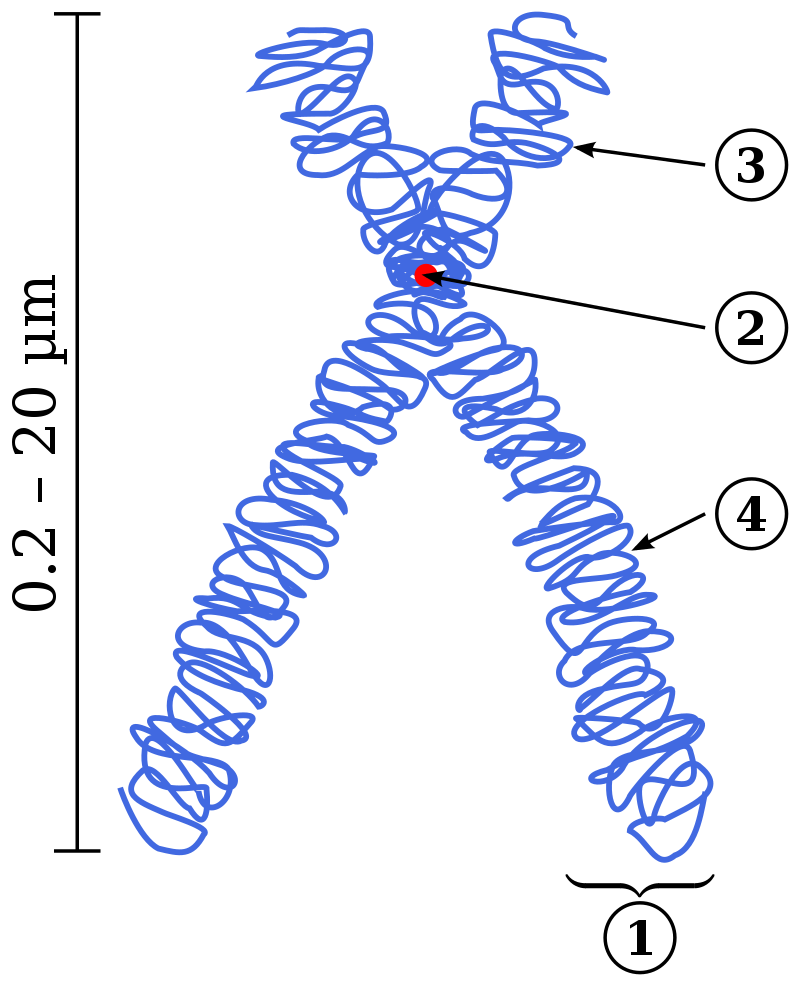
thumb|In this diagram of a duplicated chromosome, (2) identifies the centromere—the region that joins the two sister chromatids, or each half of the chromosome. In prophase of mitosis, specialized regions on centromeres called [[kinetochores attach chromosomes to spindle fibers.]]

sex chromosome
chromosome involved in sex determination

X chromosome
sex chromosome present in both sexes, of species in which the male is the heterogametic sex
chromatid
thumb|In the diagram, (1) refers to a chromatid: 1-half of two identical threadlike strands of a replicated chromosome. During cell division, the identical copies (called a "sister chromatid pair") are joined at the region called the [[centromere (2). Once the paired sister chromatids have separated from one another (in the anaphase of mitosis) each is known as a daughter chromosome. The short arm of the right chromatid (3), and the long arm of the right chromatid (4), are also marked.]]
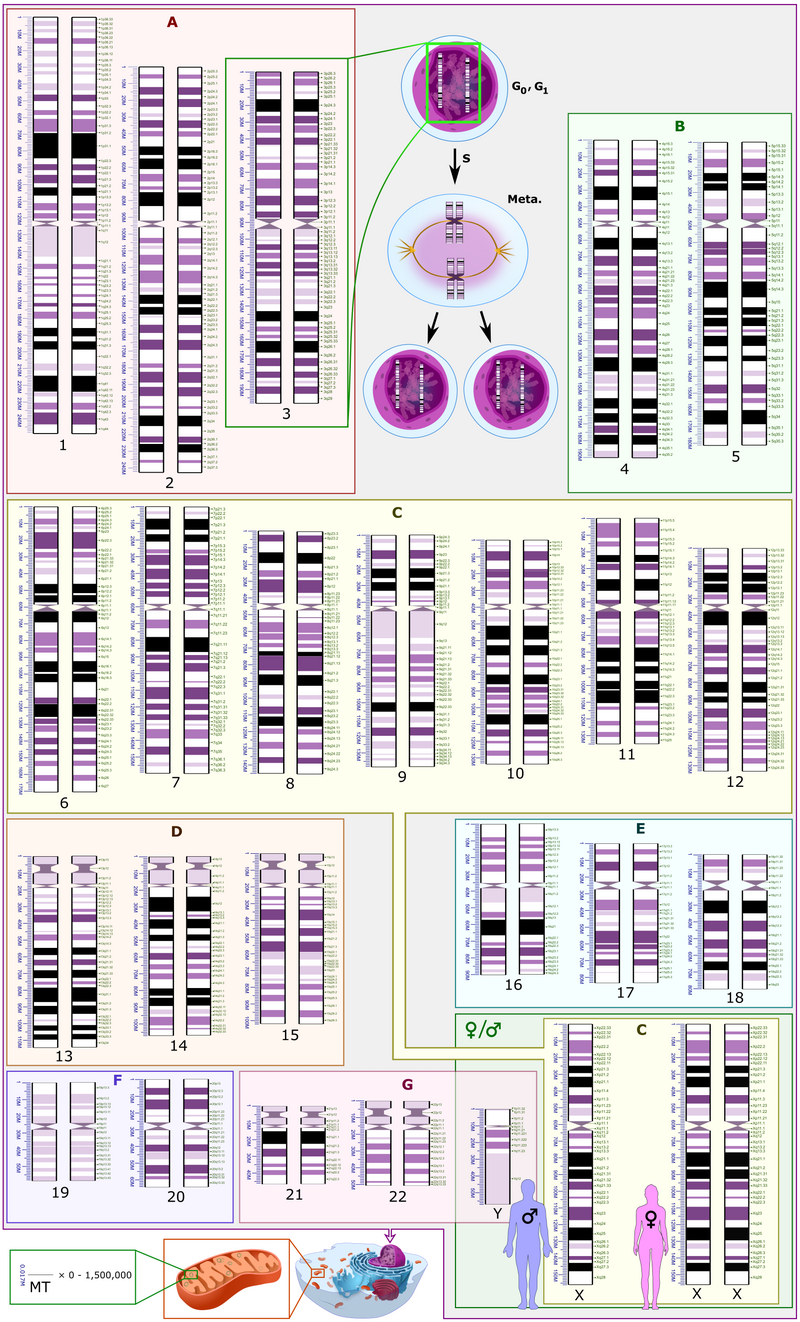
thumb|220px|Schematic karyogram of the human chromosomes, showing their usual state in the G0 and G1 phase
homologous chromosome
set of one maternal and one paternal chromosome that pair up with each other inside a cell during meiosis. Homologs have the same genes in the same loci
Barr body
structure found in a female mammalian cell containing an unpaired X chromosome that has become densely heterochromatic, silenced and localized at the nuclear periphery

vaginoplasty
Vaginoplasty is any surgical procedure that results in the construction or reconstruction of the vagina. It is a type of genitoplasty. Pelvic organ prolapse is often treated with one or more surgeries to repair the vagina. Sometimes a vaginoplasty is needed following the treatment or removal of malignant growths or abscesses to restore a normal vaginal structure and function. Surgery to the vagina is done to correct congenital defects to the vagina, urethra and rectum. It may correct protrusion of the urinary bladder into the vagina (cystocele) and protrusion of the rectum (rectocele) into the
chromosomal inversion
reordering of genes in a DNA-sequence
plastome
DNA located in cellular organelles called plastids
Holliday junction
Branched nucleic acid structure containing four double-stranded arms
polytene chromosome
large chromosome that provides a high level of function in tissues such as salivary glands
Template:Chromosome genetics
Wikimedia template
clitoridectomy
Clitoridectomy or clitorectomy is the surgical removal, reduction, or partial removal of the clitoris. It is rarely used as a therapeutic medical procedure, such as when cancer has developed in or spread to the clitoris. Commonly, non-medical removal of the clitoris is performed during female genital mutilation.
G banding
genetic technique

isochromosome
thumb|Isochromosome in which the arms are mirror copies of each other.
lampbrush chromosome
Chromosome appearance found in growing oocytes

neuroacanthocytosis
Neuroacanthocytosis is a label applied to several genetic neurological conditions in which the blood contains misshapen, spiculated red blood cells called acanthocytes.
B chromosome
type of chromosome
chromosome conformation capture
set of molecular biology methods used to analyze the spatial organization of chromatin in a cell
chromosome segregation
process in which genetic material, in the form of chromosomes, is organized into specific structures
list of organisms by chromosome count
Wikimedia list article
bivalent
pair of homologous chromosomes during meiotic synapsis
genome instability
high frequency of mutations within the genome of a cellular lineage
genomic structural variation
contiguous large-scale differences in the genomic DNA between individuals
microchromosome
right|thumb|200px|Image of chicken chromosomes featuring the many microchromosomes (appearing as dots). The arrows indicate a stained gene locus on homologous macrochromosomes.
Chromomere
A chromomere, also known as an idiomere, is one of the serially aligned beads or granules of a eukaryotic chromosome, resulting from local coiling of a continuous DNA thread. Chromomeres are regions of chromatin that have been compacted through localized contraction. In areas of chromatin with the absence of transcription, condensing of DNA and protein complexes will result in the formation of chromomeres. It is visible on a chromosome during the prophase of meiosis and mitosis. Giant banded (Polytene) chromosomes resulting from the replication of the chromosomes and the synapsis of homologs w
satellite chromosome
Type of chromosome containing one or more secondary constrictions besides the centromere
chromothripsis
350px|thumb| alt=massive gene rearrangement event leading as a result of chromothripsis leading to cancer|Chromothripsis: Single catastrophic event in a cell's history
Chromothripsis is a mutational process by which up to thousands of clustered chromosomal rearrangements occur in a single event in localised and confined genomic regions in one or a few chromosomes, and is known to be involved in both cancer and congenital diseases. It occurs through one massive genomic rearrangement during a single catastrophic event in the cell's history. It is believed that for the cell to be able to withstan
chromosome 17q12 deletion syndrome
rare human disease caused by partial deletion of the long arm of chromosome 17
ZO sex-determination system
Biological system in certain moths
chromosome instability
type of genomic instability
Circular bacterial chromosome
type of chromosome
Balancer chromosome
type of genetically engineered chromosome