File:Chromosome.svg · Wikimedia Commons · See Wikimedia Commons
chromatid
Sign in to saveAlso known as chromatids
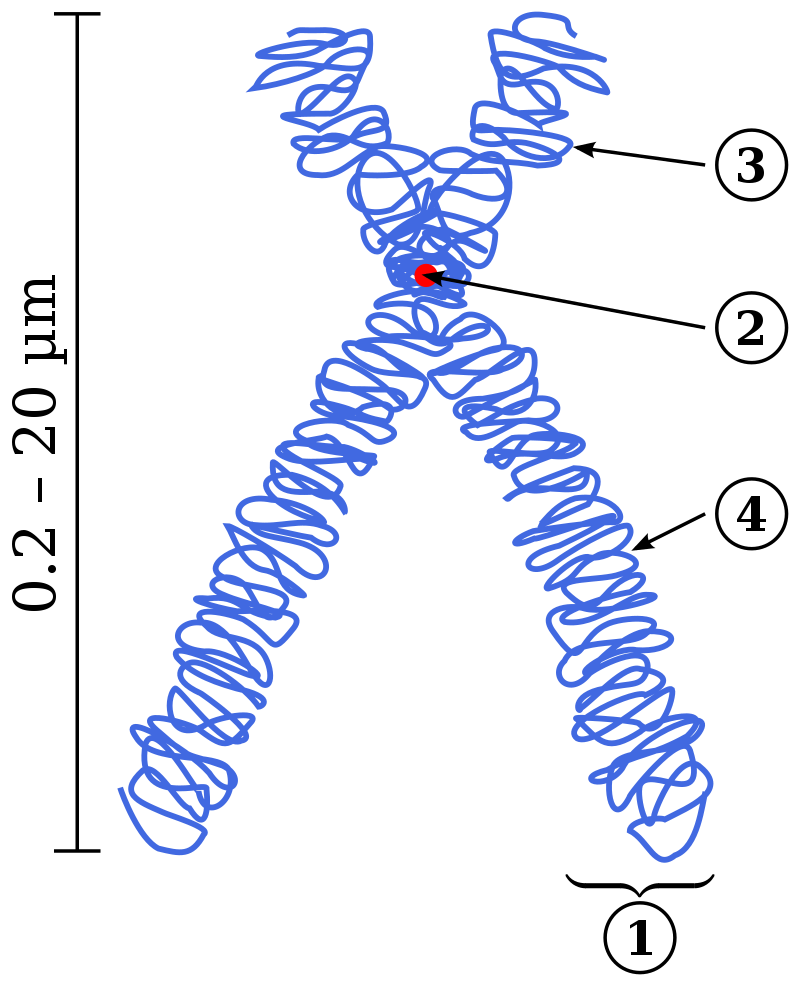
thumb|In the diagram, (1) refers to a chromatid: 1-half of two identical threadlike strands of a replicated chromosome. During cell division, the identical copies (called a "sister chromatid pair") are joined at the region called the [[centromere (2). Once the paired sister chromatids have separated from one another (in the anaphase of mitosis) each is known as a daughter chromosome. The short arm of the right chromatid (3), and the long arm of the right chromatid (4), are also marked.]] thumb|220px|Schematic karyogram of the human chromosomes, showing their usual state in the G0 and G1 phase
Research
16,293 papers- Sister chromatid cohesion establishment during DNA replication termination.Science (New York, N.Y.) · 2024
- Sister chromatid-sensitive Hi-C to map the conformation of replicated genomes.Nature protocols · 2022
- Sister chromatid cohesion through the lens of biochemical experiments.Current opinion in cell biology · 2025
- Biochemical reconstitution of sister chromatid cohesion establishment during DNA replication.Molecular cell · 2025
- Condensin in Chromatid Cohesion and Segregation.Cytogenetic and genome research · 2015
via PubMed
Wikidata facts
- Part of
- chromosome
Show 1 more fact
- described by source
- Armenian Soviet Encyclopedia
Sources (2)
via Wikidata · CC0
~3 min read
Encyclopedic overview
3 sectionsContents
- Sister chromatids
- See also
- References
thumb|In the diagram, (1) refers to a chromatid: 1-half of two identical threadlike strands of a replicated chromosome. During cell division, the identical copies (called a "sister chromatid pair") are joined at the region called the [[centromere (2). Once the paired sister chromatids have separated from one another (in the anaphase of mitosis) each is known as a daughter chromosome. The short arm of the right chromatid (3), and the long arm of the right chromatid (4), are also marked.]] thumb|220px|Schematic karyogram of the human chromosomes, showing their usual state in the G0 and G1 phase of the cell cycle. At top center it also shows the chromosome 3 pair in [[metaphase (annotated as "Meta."), which takes place after having undergone DNA synthesis which occurs in the S phase (annotated as S) of the cell cycle. During metaphase, each chromosome is duplicated into sister chromatids.]]
A chromatid (Greek khrōmat- 'color' + -id) is one half of a duplicated chromosome. Before replication, one chromosome is composed of one DNA molecule. In replication, the DNA molecule is copied, and the two molecules are known as chromatids. During the later stages of cell division these chromatids separate longitudinally to become individual chromosomes.
Excerpted from Wikipedia’s “chromatid” article, available under the CC BY-SA 4.0 licence.