Category
page 1Church architecture

dome
A dome () is an architectural element similar to the hollow upper half of a sphere. There is significant overlap with the term cupola, which may also refer to a dome or a structure on top of a dome. The precise definition of a dome has been a matter of controversy and there are a wide variety of forms and specialized terms to describe them.

apse
thumb|Typical early Christian Byzantine apse with a hemispherical semi-dome in the [[Basilica of Sant'Apollinare in Classe]]
thumb|Typical floor plan of a cathedral, with the apse shaded
In architecture, an apse (: apses; from Latin , 'arch, vault'; from Ancient Greek , , 'arch'; sometimes written apsis; : apsides) is a semicircular recess covered with a hemispherical vault or semi-dome, also known as an exedra. In Byzantine, Romanesque, and Gothic Christian church (including cathedral and abbey) architecture, the term is applied to a semi-circular or polygonal termination of the main building

nave
thumbnail|The nave of the Church of Saint-Sulpice, Paris|Saint-Sulpice Church in Paris
thumb|The nave of the Santa Monica Parish Church (Sarrat)|Santa Monica Parish Church in [[Sarrat, Philippines]]

royal coat of arms of the United Kingdom
national coat of arms of the United Kingdom

crypt
thumb|Visigoths|Visigothic crypt of Saint Antoninus [[Palencia Cathedral in Spain]]
thumb|A crypt in Wola Gułowska in [[Lublin Province, Poland]]
A crypt () is a stone chamber beneath the floor of a church, above ground within a cemetery’s mausoleum or a free-standing outdoor memorial tomb. It typically contains coffins, sarcophagi, or religious relics and sometimes cremation urns.
.jpg)
triptych
thumb|330px|Triptych of the The Elevation of the Cross (Rubens)|Raising of the Cross, Rubens, 1610–11, Antwerp Cathedral
A triptych ( ) is a work of art (usually a panel painting) that is divided into three sections, or three carved panels that are hinged together and can be folded shut or displayed open. It is therefore a type of polyptych, the term for all multi-panel works. The middle panel is typically the largest and flanked by two smaller related works, although there are triptychs of equal-sized panels. The form can also be used for pendant jewelry.

cloister
300px|thumb|upright= 1.5|The cloister at Salisbury Cathedral, England

rose window
circular window

sacristy
thumb|Sacristy with a sacristy credens (a cabinet with wide and very shallow drawers in which vestments and hangings are stored). A chasuble and stole are laid out on top of it, ready to be put on.
A sacristy, also known as a vestry or preparation room, is a room in Christian churches for the keeping of vestments (such as the alb and chasuble) and other church furnishings, sacred vessels, and parish records.
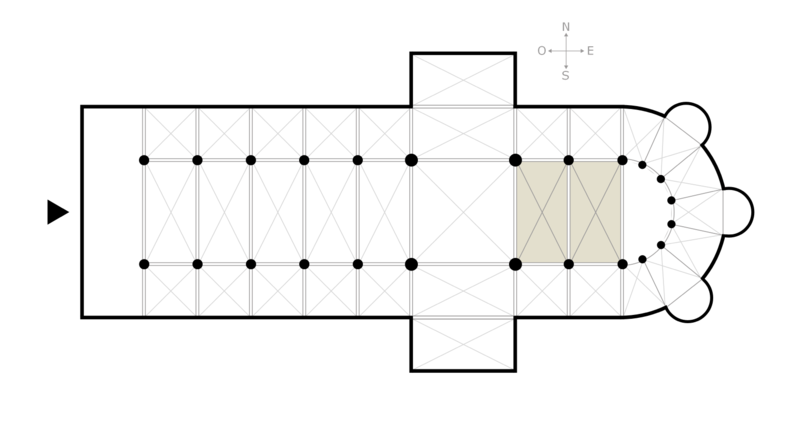
choir
area of a church or cathedral

iconostasis
thumb|Five-panel Deesis row (center), iconostasis in the Cathedral of the Annunciation in the [[Moscow Kremlin by Theophanes the Greek, 1405|328x328px]]

baptistery
thumb|upright|Pisa Baptistery, begun 1152, completed 1363
In Christian architecture the baptistery or baptistry (Old French baptisterie; Latin baptisterium; Greek , 'bathing-place, baptistery', from , baptízein, 'to baptize') is the separate centrally planned structure surrounding the baptismal font. The baptistery may be incorporated within the body of a church or cathedral, and provided with an altar as a chapel. In the early Church, the catechumens were instructed and the sacrament of baptism was administered in the baptistery.

transept
thumb|300x300px|Cathedral ground plan. The shaded area is the transept; the darker shading at the centre represents the Crossing (architecture)|crossing.
thumb|South transept at Kilcooly Abbey, [[County Tipperary, Ireland]]

narthex
thumb|Plan of a Western cathedral, with the narthex in the shaded area at the Liturgical east and west|western end.
The narthex is an architectural element typical of early Christian and Byzantine basilicas and churches consisting of the entrance or vestibule, located at the west end of the nave, opposite the church's main altar. Traditionally the narthex was a part of the church building, but was not considered part of the church proper.
church tabernacle
locked box in which, in some Christian churches, the Eucharist is stored

pulpit
thumb|The pulpit of the Notre-Dame de Revel in Revel, Haute-Garonne|Revel, [[Haute-Garonne, France]]
thumb|upright|Pulpit at Blenduk Church in [[Semarang, Indonesia, with large sounding board and cloth antependium ]]
thumb|"Two-decker" pulpit in an abandoned Welsh chapel, with reading desk below
thumb|upright|1870 Gothic Revival oak pulpit, [[Church of St Thomas, Thurstonland]]
upright|thumb|Ambo, in the modern Catholic sense, in Austria
thumb|upright|19th-century wooden pulpit in Canterbury Cathedral
A pulpit is an elevated stand for preachers in a Christian church. The origin of the word is

baptismal font
large basins or other vessels set in or on the ground or fixed on a pedestal and intended for use in the baptismal rite
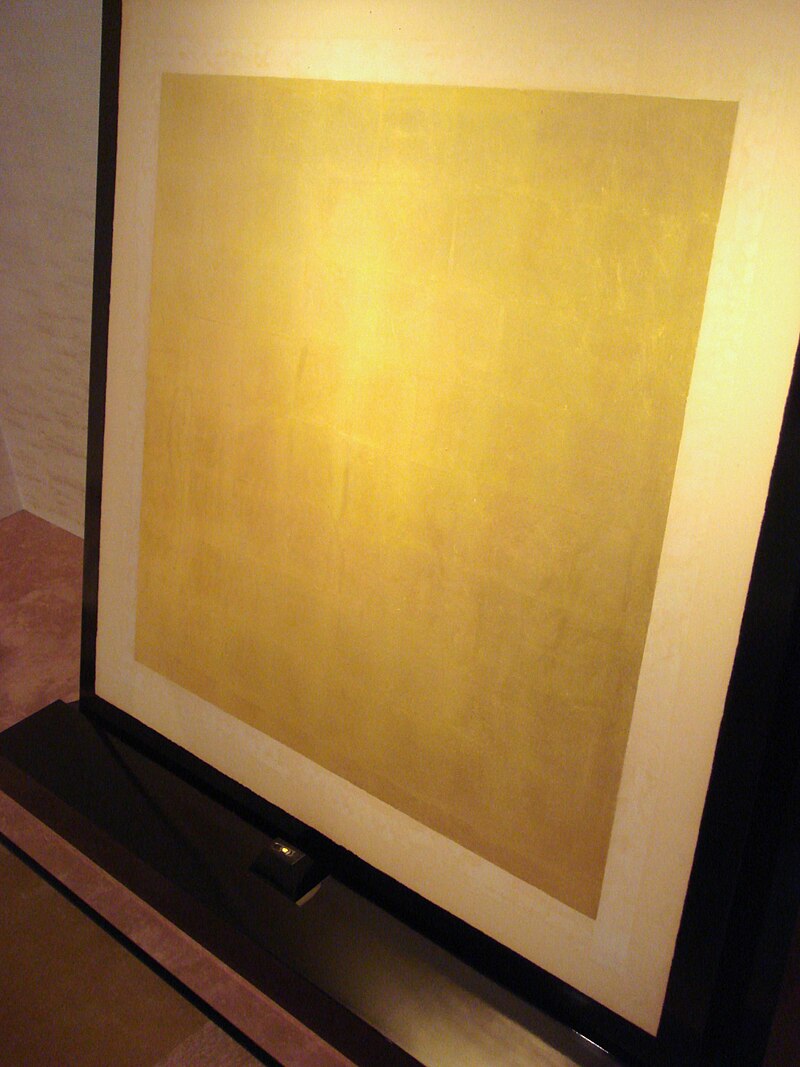
gold leaf
very thin gold used in art

refectory
300px|thumb|right|The refectory of the Convent of Christ (Tomar)|Convent of Christ in [[Tomar, Portugal]]

ambulatory
thumb|right|The placement of the ambulatory within a standard cathedral.
The ambulatory ( 'walking place') is the covered passage around a cloister or the processional way around the east end of a cathedral or large church and behind the high altar. The first ambulatory was in France in the 11th century but by the 13th century ambulatories had been introduced in England and many English cathedrals were extended to provide an ambulatory.
crossing
junction of the four arms of a cross-shaped church
.jpg)
spire
thumb|250px|Before the Burj Khalifa, the [[Taipei 101 had the former tallest spire in the world.]]
thumb|360x360px|The Burj Khalifa holds the record of the tallest spire in the world, with the height of
thumb|360x360px|The Chrysler Building was the world-first skyscraper with a spire
thumb|Spire of Salisbury Cathedral (completed 1320) (, with tower and spire)
rood screen
partition between the chancel and nave found in medieval church architecture

cathedra
thumb|The cathedra of the Pope in the [[apse of St. John Lateran, the cathedral church of Rome]]
thumb|Modern cathedra at the Cathedral of Our Lady of the Angels in [[Los Angeles]]
thumb|19th-century cathedra in Lichfield Cathedral
hall church
type of church building

lavra
A lavra or laura (; Cyrillic: ла́вра) is a type of monastery consisting of a cluster of cells or caves for hermits, with a church and sometimes a refectory at the center. Lavra monasteries operate within the Orthodox and other Eastern Christian traditions; the name is also used by some Catholic communities.
The term in Greek initially meant a narrow lane or an alley in a city. In a later Eastern Orthodox context, the term took on the new meaning of a large and important monastery.
ambon
liturgical furniture

hexagram
[[File:Regular_hexagon_as_intersection_of_two_triangles.png|thumb|A regular hexagram, [[List_of_regular_polytopes_and_compounds#Two_dimensional_compounds|{6}[2{3}]{6}]], can be seen as a compound composed of an upwards (blue here) and downwards (pink) facing equilateral triangle, with their intersection as a regular hexagon (in green).]]
stave church
a Northern European style of wooden church typical in early medieval Scandinavia

clerestory
thumb|upright|Interior elevation of a Gothic cathedral, with clerestory highlighted
thumb|The church of St. Nicholas' Church (Stralsund)|St Nicholas, Stralsund in Germany – the clerestory is the level between the two green roofs, reinforced here by [[flying buttresses]]

Triforium
thumb|A Romanesque architecture|Romanesque triforium gallery, Cathedral of Saint Mary Major, Lisbon
thumb|Interior elevation view of a Gothic cathedral, with triforium highlighted
ciborium
canopy or covering that covers the altar in a church

altarpiece
thumb|300px|The Ghent Altarpiece (1432) by Hubert and [[Jan van Eyck, with its wings open. Considered one of the masterpieces of Early Netherlandish painting, a complex polyptych panel winged altarpiece, which lost its elaborate framework in the Reformation.]]
An altarpiece is a painting or sculpture, including relief, of religious subject matter made for placing at the back of or behind the altar of a Christian church. Though most commonly used for a single work of art such as a painting or sculpture, or a set of them, the word can also be used of the whole ensemble behind an altar, otherwise

confessional
thumb|Confessional at the Toulouse Cathedral
thumb|300px|A confessional in Luther Church, Helsinki|Luther Church ([[Helsinki, Finland)]]

tracery
Tracery is an architectural device by which windows (or screens, panels, and vaults) are divided into sections of various proportions by stone bars or ribs of moulding. Most commonly, it refers to the stonework elements that support the glass in a window. The purpose of the device is practical as well as decorative, because the increasingly large windows of Gothic buildings needed maximum support against the wind. The term probably derives from the tracing floors on which the complex patterns of windows were laid out in late Gothic architecture. Tracery can be found on the exterior of building
.jpg)
westwork
thumb|upright|Westwork of Corvey Abbey
A westwork (), forepart, avant-corps or avancorpo is the monumental, west-facing entrance section ("west front") of a Carolingian, Ottonian, or Romanesque church. The exterior consists of multiple stories between two towers. The interior includes an entrance vestibule, a chapel, and a series of galleries overlooking the nave. A westwork is usually broader than the width of the nave and aisles. It is sometimes used synonymously with narthex. The structural purpose of the massive westwork is to resolve the horizontal thrust of the east-to-west arcades of th
Green Man
sculpture or other representation of a face surrounded by or made from leaves
Armenian architecture
architectural works connected to the Armenian people
matroneum
REDIRECT Triforium#Matroneum
apse chapel
chapel radiating tangentially from one of the bays of the apse of a church

triquetra
right|thumb|Interlaced triquetra which is a trefoil knot
The triquetra ( ; from the Latin adjective triquetrus "three-cornered") is a triangular figure composed of three interlaced arcs, or (equivalently) three overlapping vesicae piscis lens shapes. It is used as an ornamental design in architecture, and in medieval manuscript illumination (particularly in the Insular tradition). Its depiction as interlaced is common in Insular ornaments from about the 7th century. In this interpretation, the triquetra represents the topologically simplest possible knot.
thumb|Comparison of associated Reuleau

piscina
thumb|16th-century double piscina at the Franciscan friary in Kilconnell, Ireland
A piscina is a shallow basin placed near the altar of a church, or else in the vestry or sacristy, used for washing the communion vessels. The sacrarium is the drain itself. Lutherans and Anglicans usually refer to the basin, calling it a piscina. For Catholics and Lutherans, a sacrarium is "special sink used for the reverent disposal of sacred substances. This sink has a cover, a basin, and a special pipe and drain that empty directly into the earth, rather than into the sewer system" (USCCB, Built of Living Sto

diaconicon
thumb|The triple apse of an Orthodox Church. The altar is in the larger central apse, the prothesis in the apse to the right, and the diaconicon in the one to the left.
The diaconicon (; Slavonic: diakonik) is, in Eastern Orthodox and Eastern Catholic Churches, the name given to a chamber on the south side of the central apse of the church, where the vestments, books, etc., that are used in the Divine Services of the church are kept (the sacred vessels are kept in the prothesis, which is on the north side of the sanctuary). Diaconicon and prothesis are collectively known as pastophoria.
prothesis
recess used for preparation of the Eucharist in Orthodox churches
%20%C3%89glise%20Notre-Dame%20Fa%C3%A7ade%20sud%2001.JPG)
crocket
thumb|upright|Crocketed spire of the Notre-Dame Church in Vitré, Ille-et-Vilaine|Vitré, France

cross-in-square
A cross-in-square, crossed-dome, tetrastyle, or quincunx floor plan was the dominant form of church architecture in the middle and late Byzantine Empire. It featured a square centre with an internal structure shaped like a cross, topped by a dome.

bell-gable
thumb|Simple bell gable at the St. James' Church of Entença, town|Entença ([[Spain), near the Pyrenees.]]
The bell gable (, , ) is an architectural element crowning the upper end of the wall of church buildings, usually in lieu of a church tower. It consists of a gable end in stone, with small hollow semi-circular arches where the church bells are placed. It is a characteristic example of the simplicity of Romanesque architecture.
%2C%20poi%20domenico%20atticciati%20(1589-91)%2C%20coro%20della%20certosa%20di%20firenze%2C%20misericordie%2015%2C0.jpg)
misericord
thumb|upright=1.2|Misericord from the Florence Charterhouse|Charterhouse of Florence (Tuscany, Italy), depicting a mascaron (a decorative face)
thumb|upright=1.2|With the seat lifted (as at left), the misericord provides a ledge to support the user.A misericord (sometimes named mercy seat, like the biblical object, sometimes misericordia) is a small wooden structure (a sort of shelf) on the underside of a hinged folding seat in a church which, when the seat (or 'stall') is folded up, is intended to act as a ledge to support a person leaning against it in a partially standing position during lo
.jpg)
gavit
thumb|Gavit of Geghard Monastery in Armenia, a UNESCO World Heritage Site. Dated 1215–1225, it has a [[muqarnas vault at the center.]]
In a medieval Armenian monastery, a gavit (; gawit’) or zhamatun (Armenian: ) is a congressional room or mausoleum added to the entrance of a church, and therefore often contiguous to its west side. It served as narthex (entrance to the church), mausoleum and assembly room, somewhat like the narthex or lite of a Byzantine church. As an architectural element, the gavit was distinct from the church, and built afterwards. Its first known instance is at the Horomos

Rayonnant
Rayonnant was a very refined style of Gothic Architecture which appeared in France in the 13th century. It was the defining style of the High Gothic period, and is often described as the high point of French Gothic architecture.
French architects turned their attention from building cathedrals of greater size and height towards bringing greater light into the cathedral interiors and adding more extensive decoration. The architects made the vertical columns and supports thinner, made extensive use of pinnacles and moldings. They combined the triforium gallery and the clerestory into single spa
Eastern Orthodox church building
type of church building

Tetraconch
thumb|The plan of Zvartnots Cathedral, [[Armenia, 7th-century]]
royal doors
central doors of the iconostasis in an Eastern Orthodox or Eastern Catholic church
church architecture
branch of architecture focused on church buildings
altar rails
barrier or low rails in front of the altar of a church

lavabo
thumb|A 14th-century lavabo as a niche (architecture)|niche recessed into the side wall of a sanctuary in [[Amblie, Normandy]]
A lavabo is a device used to provide water for the washing of hands. It consists normally of a ewer or container of some kind to pour water, and a bowl to catch the water as it falls off the hands. In ecclesiastical usage it refers to all of: the basin in which the priest washes their hands; the ritual that surrounds this action in the Catholic Mass; and the architectural feature or fitting where a basin or place for one is recessed into the side wall of the sanctuary,
lancet window
very narrow pointed window
Pastophories
Pastophorion (; ) is one of two chambers within an early Christian and Eastern Christian church building used as sacristies—the diaconicon and the prothesis.
aisleless church
church building with a single nave and no side-aisles

kliros
thumb|250px|Chanters singing on the kliros at the Church of St. George, Istanbul|Church of St. George, [[Patriarchate of Constantinople]]