File:Narthex.svg · Wikimedia Commons · See Wikimedia Commons
narthex
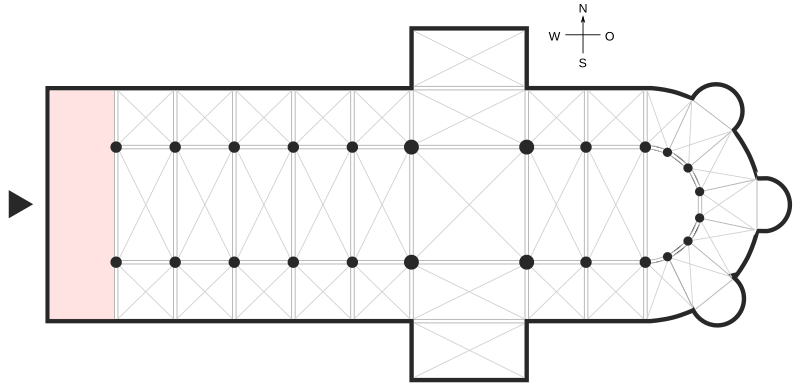
Sign in to savethumb|Plan of a Western cathedral, with the narthex in the shaded area at the Liturgical east and west|western end. The narthex is an architectural element typical of early Christian and Byzantine basilicas and churches consisting of the entrance or vestibule, located at the west end of the nave, opposite the church's main altar. Traditionally the narthex was a part of the church building, but was not considered part of the church proper.
Wikidata facts
- Image
- HSX Millingen 1912 fig 105.jpg
Show 3 more facts
- described by source
- New International Encyclopedia
- Commons category
- Narthexes
- described at URL
- www.nplg.gov.ge/gwdict/index.php?a=term&d=3&t=26888
via Wikidata · CC0
~5 min read
Encyclopedic overview
6 sectionsContents
- Etymology
- Purpose
- See also
- References
- Further reading
- External links
thumb|Plan of a Western cathedral, with the narthex in the shaded area at the Liturgical east and west|western end. The narthex is an architectural element typical of early Christian and Byzantine basilicas and churches consisting of the entrance or vestibule, located at the west end of the nave, opposite the church's main altar. Traditionally the narthex was a part of the church building, but was not considered part of the church proper.
In early Christian churches the narthex was often divided into two distinct parts: an esonarthex (inner narthex) between the west wall and the body of the church proper, separated from the nave and aisles by a wall, arcade, colonnade, screen, or rail, and an external closed space, the exonarthex (outer narthex), a court in front of the church façade delimited on all sides by a colonnade as in the first St. Peter's Basilica in Rome or in the Basilica of Sant'Ambrogio in Milan. The exonarthex may have been either open or enclosed with a door leading to the outside, as in the Byzantine Chora Church.
Excerpted from Wikipedia’s “narthex” article, available under the CC BY-SA 4.0 licence.