Category
page 1Circadian rhythm

pineal gland
small endocrine gland found in most vertebrates, which produces melatonin; in humans, located in the epithalamus, in a groove where the two halves of the thalamus join; its shape and size resembles a pine nut, after which it is named
circadian rhythm
natural internal process that regulates the sleep-wake cycle

jet lag
physiological condition caused by travel across time zones

chronobiology
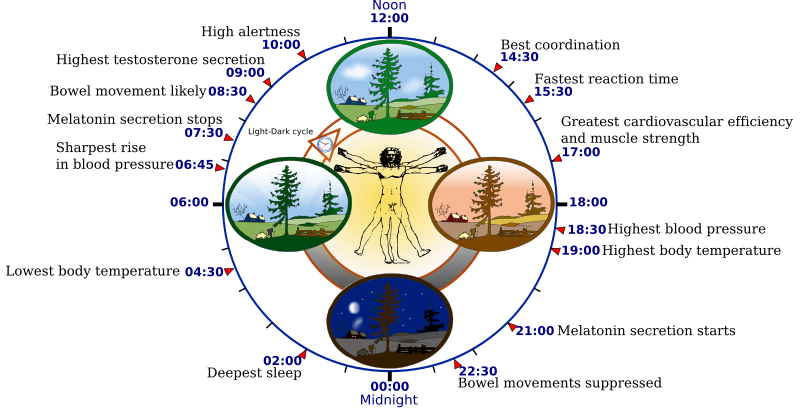
upright=1.8|thumb|Overview, including some Physiology|physiological parameters, of the human circadian rhythm ("biological clock")

photoperiodism
Photoperiod is the change of day length over the seasons. Earth's rotation around its axis produces 24-hour changes in light (daytime) and dark (night) cycles on Earth. The length of the light and dark in each phase varies across the seasons due to the axial tilt of Earth. The photoperiod defines the length of the light. For example, in summer the length of light could be 16 hours while the dark is 8 hours, whereas in winter the length of day could be 8 hours, while the dark is 16 hours. Importantly, the axial tilt of the Earth causes the opposing seasons in the Northern and Southern Hemispher
light therapy
therapy consisting of exposure to daylight or to specific wavelengths of light, for a prescribed amount of time or at a specific time of day.

nocturnality
thumb|right|Owl|Owls are well known for being nocturnal, but some owls are active during the day.

seasonal affective disorder
mental depression that involves presentation of depressive symptoms only during a specific season of the year

diurnality
thumb|right|Steppe eagles are diurnal, and hunt during the day.
thumb|right|Humans are diurnal, and organize their work and [[business mainly in the day.]]
Diurnality is a form of plant and animal behavior characterized by activity during daytime, with a period of sleeping or other inactivity at night. The common adjective used for daytime activity is "diurnal". The timing of activity by an animal depends on a variety of environmental factors such as the temperature, the ability to gather food by sight, the risk of predation, and the time of year. Diurnality is a cycle of activity within a 24-
shift work
employment practice designed to make use of, or provide service across, part of or all 24 hours of each day of the week
suprachiasmatic nucleus
part of the brain's hypothalamus
polyphasic sleep
any sleep pattern with multiple periods of sleep in a 24-hour period
night owl
a person who tends to stay up until late at night

Opsin 4
Melanopsin is a type of photopigment belonging to a larger family of light-sensitive retinal proteins called opsins and encoded by the gene Opn4. In the mammalian retina, there are two additional categories of opsins, both involved in the formation of visual images: rhodopsin and photopsin (types I, II, and III) in the rod and cone photoreceptor cells, respectively.
circadian clock
biological mechanism that controls circadian rhythm
N-acetylserotonin
'''N-Acetylserotonin (NAS), also known as normelatonin''', is a naturally occurring chemical intermediate in the endogenous production of melatonin from serotonin. It also has biological activity in its own right, including acting as a melatonin receptor agonist, an agonist of the TrkB, and having antioxidant effects.
chronotype
A chronotype is the behavioral manifestation of an underlying circadian rhythm's myriad physical processes. A person's chronotype is the propensity for the individual to sleep at a particular time during a 24-hour period. Eveningness (delayed sleep period; most active and alert in the evening) and morningness (advanced sleep period; most active and alert in the morning) are the two extremes with most individuals having some flexibility in the timing of their sleep period. However, across development there are changes in the propensity of the sleep period with pre-pubescent children preferring
Zeitgeber
A zeitgeber ( , ) is any external or environmental cue that entrains or synchronizes an organism's biological rhythms, usually naturally occurring and serving to entrain to the Earth's 24-hour light/dark and 12-month cycles.
intrinsically photosensitive retinal ganglion cell
neuron in the retina of the mammalian eye
early bird
person who usually gets up early in the morning and goes to bed early in the evening

photoreceptor protein
Molecular photoreceptors
shift work sleep disorder
medical condition
serotonin N-acetyltransferase
class of enzymes
high-energy visible light
effects of blue light
sundowning
Sundowning, or sundown syndrome, prevalent among people with some form of dementia, is characterized by increased confusion and restlessness beginning in the late afternoon and early evening. The term sundowning was coined by nurse Lois K. Evans in 1987 due to the association between the person's increased confusion and the setting of the sun.
sleep phase chronotherapy
treatment for sleep disorder
actigraphy
Actigraphy is a non-invasive method of monitoring human rest/activity cycles. A small actigraph unit, also called an actimetry sensor, is worn for a week or more to measure gross motor activity. The unit is usually in a wristwatch-like package worn on the wrist. The movements the actigraph unit undergoes are continually recorded and some units also measure light exposure. The data can be later read to a computer and analysed offline; in some brands of sensors the data are transmitted and analysed in real time.
sleep inertia
drowsiness just after waking up
witching hour
time of day when the devil, demons or ghosts are supposed to come out
chronotherapy
use of circadian or other rhythmic cycles of a condition's symptoms in applying therapy
sleep diary
data sheet
entrainment
alignment of a circadian system's period and phase to the period and phase of an external rhythm
Dark therapy
use of darkness to treat psychological conditions
6-hydroxymelatonin
6-Hydroxymelatonin (6-OHM) is a naturally occurring, endogenous, major active metabolite of melatonin. 6-Hydroxymelatonin is produced as a result of the enzymatic conversion of melatonin through hydroxylation. Similar to melatonin, 6-OHM is a full agonist of the MT1 and MT2 receptors. It is also an antioxidant and neuroprotective, and is even more potent in this regard relative to melatonin.
free-running sleep
rare sleep pattern whereby the sleep schedule of a person shifts later every day
Winter-over syndrome
psychological condition related to the Antarctic winter