Category
page 1Cities in Hebei

Shijiazhuang
Shijiazhuang is the capital and most populous city of China's Hebei Province, located southwest of Beijing. It administers eight districts, three county-level cities and eleven counties, and is east of the Taihang Mountains, which extend over from north to south with an average elevation of .

Tangshan
thumb|left|Huimin Yuan Apartments, Zhengtai Li, in Lunan District
thumb|Jianshe South Road in Tangshan

Baoding
Baoding is a prefecture-level city in central Hebei province, approximately southwest of Beijing. As of the 2020 census, Baoding City had 11,544,036 inhabitants, of which 2,549,787 lived in the metropolitan area made of 4 out of 5 urban districts: Lianchi, Jingxiu, Qingyuan, and Mancheng all of which are largely conurbated. Accounting for about one-sixth of the population of Hebei Province. At the end of 2024, the city's resident population is 9,046,200, of which the urban resident population is 5,527,200. Baoding is among 13 Chinese cities with a population of over 10 million, ranking seventh

Handan
Handan is a prefecture-level city located in the southwest of Hebei province, China. The southernmost prefecture-level city of the province, it borders Xingtai on the north, and the provinces of Shanxi on the west, Henan on the south and Shandong on the east. At the 2010 census, its population was 9,174,683 inhabitants of whom 2,845,790 lived in the built-up (or metro) area made of 5 urban districts.By the end of 2024, the total resident population of the city is 9,182,100, and the urbanization rate of the resident population is 62.10%. Yongnian District in Handan and Shahe City in Xingtai hav

Qinhuangdao

Chengde
Chengde, formerly known as Jehol and Rehe, is a prefecture-level city in Hebei province, situated about northeast of Beijing. It is best known as the site of the Mountain Resort, a vast imperial garden and palace formerly used by the Qing emperors as summer residence. Its local dialect is also known for being the closest to Standard Chinese, which took several inspirations from the Chengde dialect. The permanent resident population is approximately 3,473,200 in 2017. At the end of 2024, the total resident population of the city was 3,285,700, a decrease of 16,500 from the end of the previous y
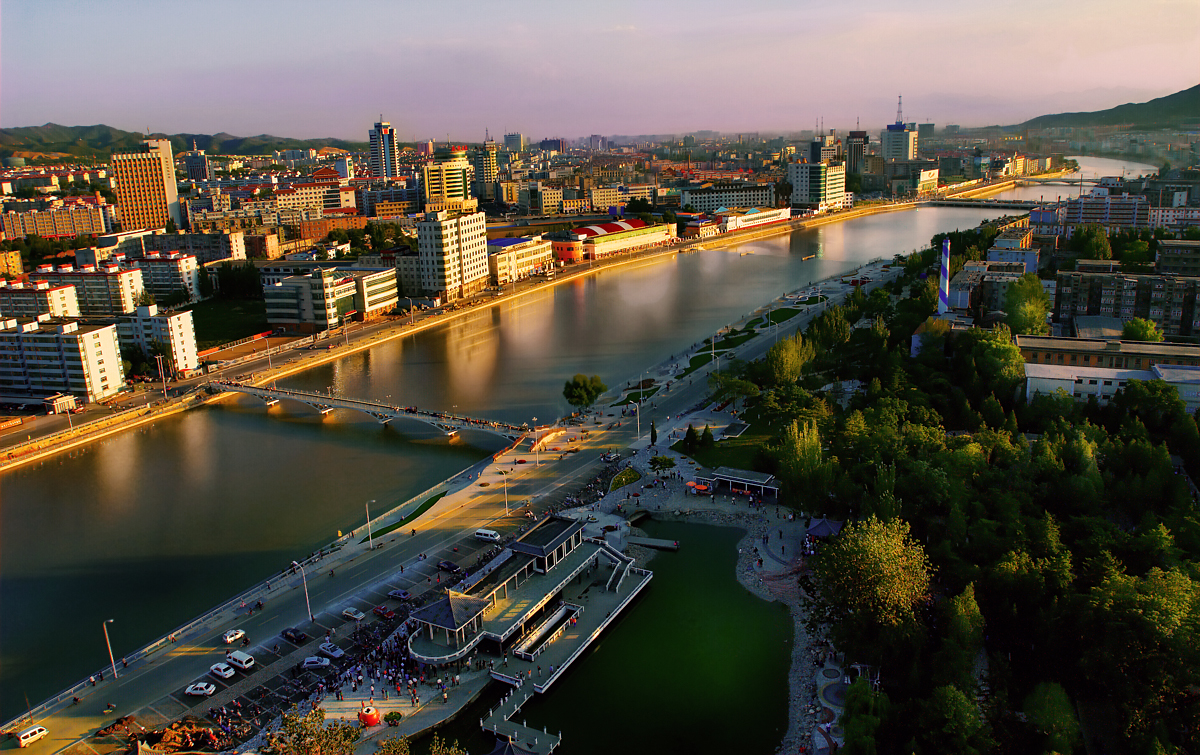
Zhangjiakou
Zhangjiakou (), also known as Kalgan and by several other names, is a prefecture-level city in northwestern Hebei province in Northern China, bordering Beijing to the southeast, Inner Mongolia to the north and west, and Shanxi to the southwest. In 2020, its population was 4,118,908 inhabitants, with an area of , divided into 17 counties and districts. The built-up (or metro) area, made of Qiaoxi, Qiaodong, Chongli, Xuanhua, Xiahuayuan Districts, is largely conurbated, with 1,413,861 inhabitants in 2020 in an area of . In 2024, the registered population of the whole region is 208.896 million.

Cangzhou
Cangzhou is a prefecture-level city in China forming the southeastern extension of Hebei Province to the coast of the Bohai Sea between Tianjin and Shandong. At the 2020 census, Cangzhou's built-up (or metro) area made of Yunhe district, Xinhua district, and Cang County is largely conurbated with a population of 1,421,843 inhabitants, while the prefecture-level administrative unit in total has a population of 7,300,783. The resident population at the end of 2024 was 7,227,700, a decrease of 36,900 from the end of the previous year. It lies approximately from the major port city of Tianjin, and

Langfang
Langfang is a prefecture-level city of Hebei Province, China, and was known as Tianjin Prefecture until 1973. It was renamed Langfang Prefecture after Tianjin became a municipality and finally upgraded into a prefecture-level city in 1988. Langfang is located approximately midway between Beijing and Tianjin. At the 2020 census, the population of Langfang was 5,464,087, of whom 1,147,591 lived in the built-up (or metro) area made of Guangyang and Anci districts; its total area is around . At the end of 2024, the registered population of the city was 4.972 million, and the resident population of

Xingtai
Xingtai (), formerly known as Xingzhou or Shunde, is a prefecture-level city in southern Hebei province, People's Republic of China. It has a total area of and administers 4 districts, 2 county-level cities and 12 counties. At the 2020 census, its population was 7,111,106 inhabitants. By the end of 2024, the total resident population of the city will be 6.877,800. Among them, the resident population of urban areas is 3,921,700. It borders Shijiazhuang and Hengshui in the north, Handan in the south, and the provinces of Shandong and Shanxi in the east and west respectively.

Hengshui
Hengshui () is a prefecture-level city in southern Hebei province, People's Republic of China, bordering Shandong to the southeast. It borders the cities of Shijiazhuang, the capital of Hebei, to the west, Xingtai to the south, and Baoding and Cangzhou to the north. As of the 2020 census, its population was 4,212,933 inhabitants, out of whom 805,000 lived in the built-up (or metro) area made of Taocheng urban district. At the end of 2024, the city's resident population was 4.1299 million, down 27,700 from the end of the previous year. The urbanization rate of the resident population is 58.17%.