Category
page 1Comparative politics

political party
organization that seeks to influence government policy and actions and be elected to directly take part on government or legislation

public election
thumb|right|A ballot box used in France

revolution
thumb|Eugène Delacroix's romantic painting, La liberté guidant le peuple – "Liberty Guiding the People". An example of a revolution in the political sense thereof.
In political science, a revolution (, 'a turn around') is a rapid, fundamental transformation of a society's class, state, ethnic or religious structures. According to sociologist Jack Goldstone, all revolutions contain "a common set of elements at their core: (a) efforts to change the political regime that draw on a competing vision (or visions) of a just order, (b) a notable degree of informal or formal mass mobilization, and (c)
.jpg)
populism
Populism is a contested concept for a variety of political stances that emphasise the idea of the "common people", often in opposition to a perceived elite. It is frequently associated with anti-establishment and anti-political sentiment. The term developed in the late 19th century and has been applied to various politicians, parties, and movements since that time, often assuming a pejorative tone. Within political science and other social sciences, different definitions of populism have been employed.

institution
An institution is a humanly devised structure of rules and norms that shape and constrain social behavior. All definitions of institutions generally entail that there is a level of persistence and continuity. Laws, rules, social conventions and norms are all examples of institutions. Institutions vary in their level of formality and informality. Institutions embody a great deal of knowledge of how to do things in society and have been described as the social science equivalent of theories in the natural sciences.
social movement
loosely organized effort by a large group of people to achieve a particular set of goals

welfare state
form of government that protects and promotes the economic and social well-being of its citizens

political repression
persecution of an individual or group within society for political reasons, for the purpose of restricting or preventing their ability to take part in the political life of a society

social capital
sociology concept
.jpg)
constitutionalism
Constitutionalism is "a compound of ideas, attitudes, and patterns of behavior elaborating the principle that the authority of government derives from and is limited by a body of fundamental law".

social policy
measures by governments or institutions which aim to improve or reform society

democratization
thumb|upright=1.3|Since 1900, the number of countries democratizing (yellow) has been higher than those autocratizing (blue), except in the late 1920s through 1940s and since 2010.
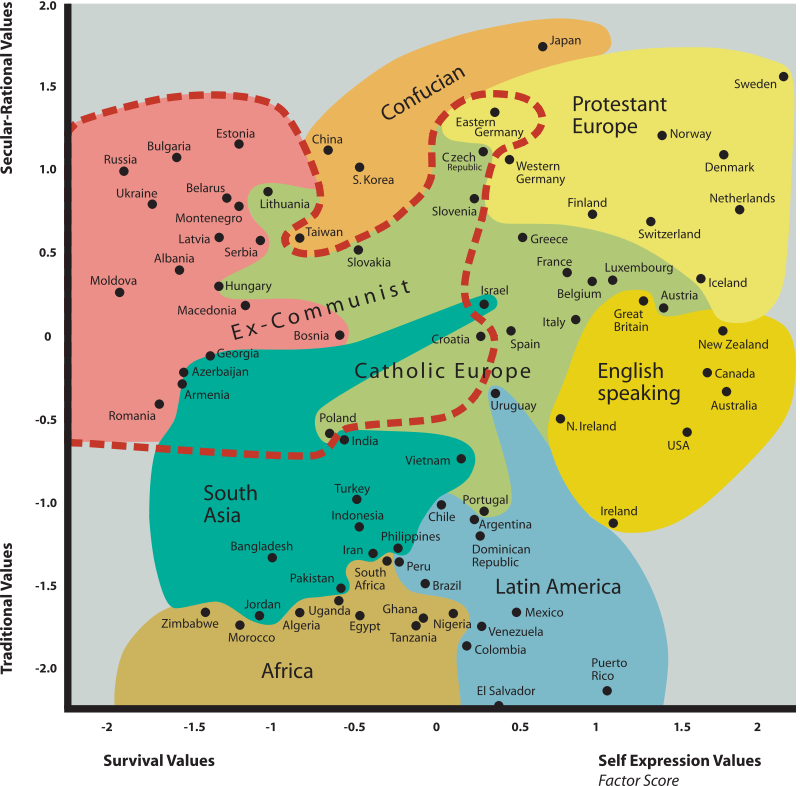
political culture
set of attitudes and beliefs that give order and meaning to a political process
American exceptionalism
ideology holding the United States as unique among nations; facet of nationalism in the United States
comparative politics
field and a method used in political science
dependency theory
notion that resources flow from a periphery of poor underdeveloped states to a core of wealthy states; contends that poor states are impoverished and rich ones enriched by the way poor states are integrated into the world system
polyarchy
In political science, the term polyarchy, literally ”rule by many” ( "many", arkhe "rule") was used by Robert Dahl to describe a form of government in which power is invested in multiple people. It takes the form of neither a dictatorship nor a democracy. This form of government was first implemented in the United States and France and gradually adopted by other countries. Polyarchy is different from democracy, according to Dahl, because the fundamental democratic principle is "the continuing responsiveness of the government to the preferences of its citizens, considered as political equals" w
structural functionalism
a sociological theory arguing that the stability of society is determined by functional institutions and individuals having a specific role
Why Nations Fail: The Origins of Power, Prosperity, and Poverty
2012 book by Daron Acemoglu and James Robinson
elite theory
theory of the state
modernization theory
explanation for the process of modernization within societies
consociationalism
Consociationalism ( ) is a form of democratic power sharing. Political scientists define a consociational state as one which has major internal divisions along ethnic, religious, or linguistic lines, but which remains stable due to consultation among the elites of these groups. Consociational states are often contrasted with states with majoritarian electoral systems.
party system
type of organization of a democracy in terms of the number of parties and their relative power
behavioralism
Behavioralism is an approach in the philosophy of science, describing the scope of the fields now collectively called the behavioral sciences; this approach dominated the field until the late 20th century. Behavioralism attempts to explain human behavior from an unbiased, neutral point of view, focusing only on what can be verified by direct observation, preferably using statistical and quantitative methods. In doing so, it rejects attempts to study internal human phenomena such as thoughts, subjective experiences, or human well-being. The rejection of this paradigm as overly-restrictive would
consensus democracy
form of government
exceptionalism
Exceptionalism is the perception or belief that a species, country, society, institution, movement, individual, or time period is "exceptional" (i.e., unusual or extraordinary). The term carries the implication, whether or not specified, that the referent is superior in some way.
political representation
political actors acting on behalf of citizens in public-policy-making processes
voting behavior
form of political behavior
state formation
development of a centralized government structure
pluralism
view that politics and decision making are located mostly in the framework of government, but that many non-governmental groups use their resources to exert influence
political linguistics
The study of the relations between language and politics
developmental state
phenomenon of state-led macroeconomic planning in East Asia in the late 20th century
majoritarian democracy
form of government
politicisation
Politicisation (also politicization; see English spelling differences) is a concept in political science and theory used to explain how ideas, entities or collections of facts are given a political tone or character, and are consequently assigned to the ideas and strategies of a particular group or party, thus becoming the subject of contestation. Politicisation has been described as compromising objectivity, and is linked with political polarisation. Conversely, it can have a democratising effect and enhance political choice, and has been shown to improve the responsiveness of supranational i
state collapse
the catastrophic failure and downfall of a government
Selectorate theory
Systems theory in political science
holistic view of politics, developed by David Easton
Contentious politics
disruptive action oriented to change