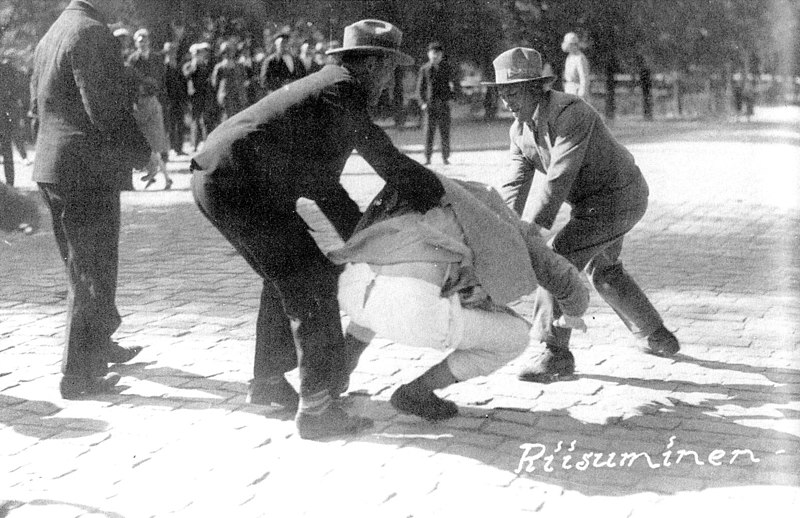
File:Eino_Niemisen_pahoinpitely.jpg · Wikimedia Commons · See Wikimedia Commons
political repression
Sign in to saveAlso known as political persecution, repression, repressive, politically repressive
persecution of an individual or group within society for political reasons, for the purpose of restricting or preventing their ability to take part in the political life of a society
Political repression is when a government or powerful group punishes people because of their political beliefs or activities, making it harder for them to participate in politics. It matters because it undermines democracy and free society by silencing dissent and preventing people from having a voice in decisions that affect them.
AI-generated from the Wikipedia summary — may contain errors.
Wikidata facts
Show 7 more facts
- topic's main category
- Category:Political repression
- Commons category
- Political repression
- on focus list of Wikimedia project
- WikiProject Human rights
- has characteristic
- crime against humanity
- facet of
- totalitarianism
- uses
- force
- used by
- state
via Wikidata · CC0
~19 min read
Encyclopedic overview
v t e
Political repression is the act of a state entity controlling a citizenry by force for political reasons, particularly for the purpose of restricting or preventing the citizenry's ability to take part in the political life of a society, thereby reducing their standing among their fellow citizens. Repression tactics target the citizenry who are most likely to challenge the political ideology of the state in order for the government to remain in control. In autocracies, the use of political repression is to prevent anti-regime support and mobilization. It is often manifested through policies such as human rights violations, surveillance abuse, police brutality, kangaroo courts, imprisonment, involuntary settlement, stripping of citizen's rights, lustration, and violent action or terror such as murder, summary executions, torture, forced disappearance, and other extrajudicial punishment of political activists, dissidents, or the general population. Direct repression tactics are those targeting specific actors who become aware of the harm done to them while covert tactics rely on the threat of citizenry being caught (wiretapping and monitoring). The effectiveness of the tactics differs: covert repression tactics cause dissidents to use less detectable opposition tactics while direct repression allows the citizenry to witness and react to the repression. Political repression can also be reinforced by means outside of written policy, such as by public and private media ownership and by self-censorship within the public.
Excerpted from Wikipedia’s “political repression” article, available under the CC BY-SA 4.0 licence.