Category
page 1Computability theory
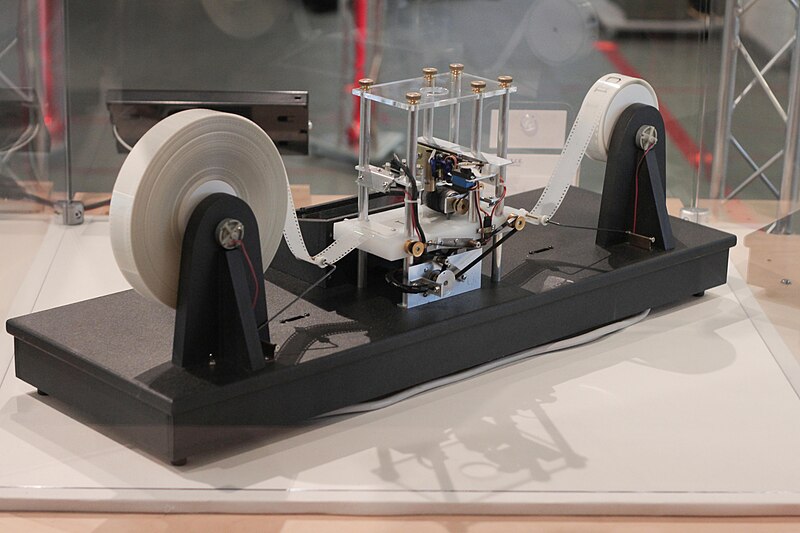
Turing machine
abstract computation model; mathematical model of computation that defines an abstract machine which manipulates symbols on a strip of tape according to a table of rules

lambda calculus
formal system in mathematical logic
computability theory
study of computable functions and Turing degrees
Church–Turing thesis
thesis about the nature of computable functions
halting problem
problem of determining whether a given program will finish running or continue forever
recursion
algorithmic technique in computer science of solving a problem by reducing it to a smaller instance of the same problem
computation
A computation is any type of arithmetic or non-arithmetic calculation that is well-defined. Common examples of computation are mathematical equation solving and the execution of computer algorithms.
decision problem
yes/no problem in computer science
Ackermann function
total non-primitive-recursive computable function
computable function
function whose values can be computed by an algorithm
Kolmogorov complexity
measure of algorithmic complexity
recursive set
Set where an algorithm can take a number as an input and can decide whether the number belongs to the set
model of computation
mathematical model describing how an output of a function is computed given an input
μ-recursive function
one of several equivalent definitions of a computable function
recursive language
recursive subset of the set of all possible finite sequences over the alphabet of the language
Entscheidungsproblem
In mathematics and computer science, the ; ) is a challenge posed by David Hilbert and Wilhelm Ackermann in 1928. It asks for an algorithm that considers an inputted statement and answers "yes" or "no" according to whether it is universally valid, i.e., valid in every structure. Such an algorithm was proven to be impossible by Alonzo Church and Alan Turing in 1936.
computable number
real number that can be computed to within any desired precision by a finite, terminating algorithm
oracle machine
abstract machine used to study decision problems
computability
Computability is the ability to solve a problem by an effective procedure. It is a key topic of the field of computability theory within mathematical logic and the theory of computation within computer science. The computability of a problem is closely linked to the existence of an algorithm to solve the problem.
busy beaver
a halting, binary-alphabet Turing machine which writes the most 1s on the tape, using only a limited set of states
Post correspondence problem
undecidable decision problem
primitive recursive function
function that can be computed with loops of bounded length
mathematical universe hypothesis
theory stating that external physical reality is a mathematical structure
undecidable problem
decision problem for which it is impossible to construct an algorithm that always leads to a correct yes-or-no answer
König's lemma
lemma in infinite graph theory
recursively enumerable set
a set that can be output (enumerated) by an algorithm (mathematical logic, computability theory)
arithmetical hierarchy
hierarchy which classifies certain sets based on the complexity of formulas that define them
Kleene's recursion theorem
Theorem in computability theory
effective method
problem-solving procedures with certain characteristics
Turing degree
measurement for the level of algorithmic unsolvability of a set
R
set of all total computable functions
Post's theorem
Theorem in computability theory
fast-growing hierarchy
ordinal-indexed family of rapidly increasing functions: ℕ→ℕ
numbering
in computability theory, the assignment of natural numbers to a set of objects
reverse mathematics
Branch of mathematical logic
ELEMENTARY
complexity class, algebra
sₘₙ theorem
theorem
arithmetical set
mathematical concept
μ operator
concept in computability theory
Grzegorczyk hierarchy
hierarchy of primitive recursive functions used in computability theory
Church–Turing–Deutsch principle
stronger, physical form of the Church–Turing thesis, that a universal Turing machine can simulate every physical process
analytical hierarchy
extension of the arithmetical hierarchy
Slow-growing hierarchy
LOOP
programming language
Lempel-Ziv complexity
Complexity measure in computer science
normal form
an object that cannot be rewritten further
Trakhtenbrot's theorem