Category
page 1Computational biology

Protein Data Bank
international open access database of protein and nucleic acid structures

Folding@home
Folding@home (FAH or F@h) is a distributed computing project aimed to help scientists develop new therapeutics for a variety of diseases by the means of simulating protein dynamics. This includes the process of protein folding and the movements of proteins, and is reliant on simulations run on volunteers' personal computers. Folding@home is currently based at the University of Pennsylvania and led by Greg Bowman, a former student of Vijay Pande.
UniProt
UniProt is a freely accessible database of protein sequence and functional information, many entries being derived from genome sequencing projects. It contains a large amount of information about the biological function of proteins derived from the research literature. It is maintained by the UniProt consortium, which consists of several European bioinformatics organisations and a foundation from Washington, DC, US.
computational biology
data-analytical and theoretical methods, mathematical modeling and computational simulation techniques to the study of biological, behavioral, and social systems
Ensembl genome database project
gene sequence database

Pfam
Pfam is a database of protein families that includes their annotations and multiple sequence alignments generated using hidden Markov models. The latest version of Pfam, 37.0, was released in June 2024 and contains 21,979 families. It is currently provided through InterPro website.
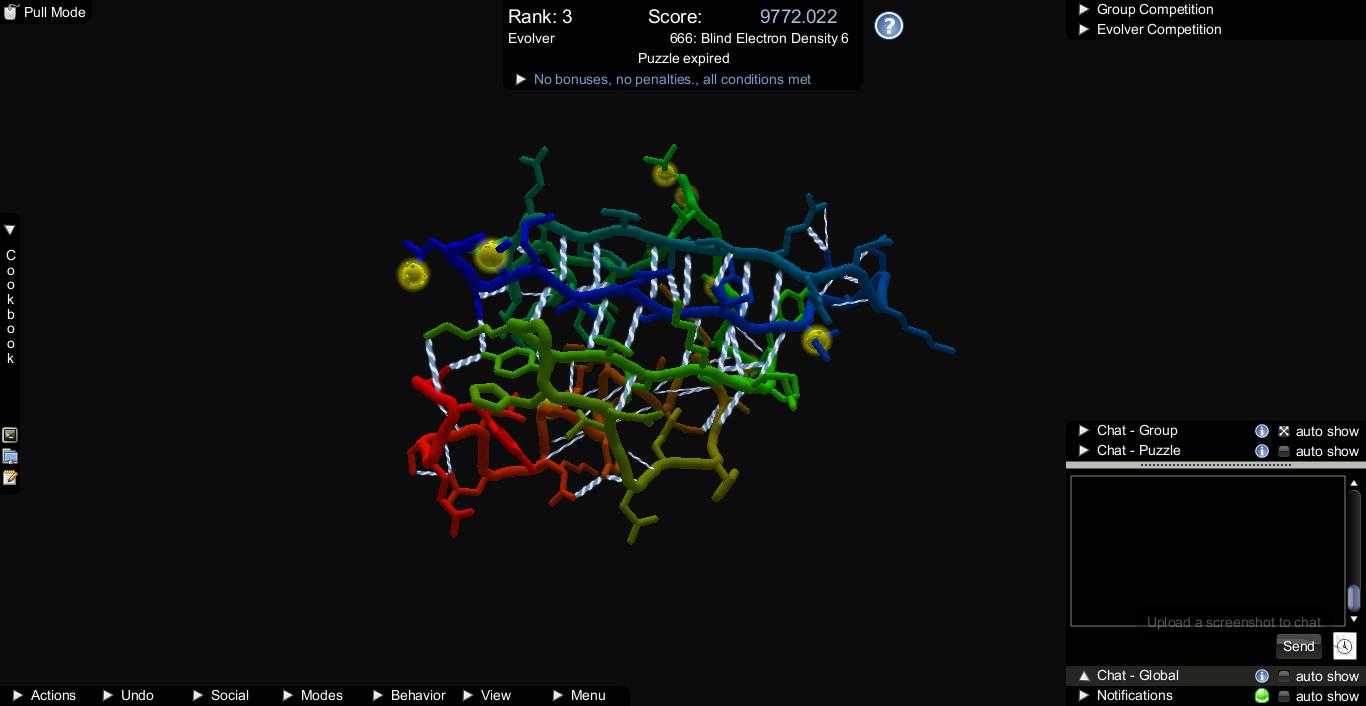
Foldit
Foldit is an online puzzle video game about protein folding. It is part of an experimental research project developed by the University of Washington, Center for Game Science, in collaboration with the UW Department of Biochemistry. The objective of Foldit is to fold the structures of selected proteins as perfectly as possible, using tools provided in the game. The highest scoring solutions are analyzed by researchers, who determine whether or not there is a native structural configuration (native state) that can be applied to relevant proteins in the real world. Scientists can then use these
Human Microbiome Project
former research initiative

DNA digital data storage
Process of encoding and decoding binary data to and from synthesized strands of DNA
Bette Korber
American computational biologist
UCSC Genome Browser
online and downloadable genome browser hosted by the University of California, Santa Cruz
International Society for Computational Biology
learned society for computational biology
K-mer
thumb|The sequence ATGG has two 3-mers: ATG and TGG.
In bioinformatics, '''k-mers' are substrings of length k contained within a biological sequence. Primarily used within the context of computational genomics and sequence analysis, in which k-mers are composed of nucleotides (i.e. A, T, G, and C), k-mers are capitalized upon to assemble DNA sequences, improve heterologous gene expression, identify species in metagenomic samples, and create attenuated vaccines. Usually, the term k''-mer refers to all of a sequence's subsequences of length k, such that the sequence AGAT would have four monomers

Gene co-expression network
Graph measuring gene relationships
Darwin Core
standard for biodiversity information
Flux balance analysis
in chemical engineering/systems biology