Category
page 1Computer architecture statements
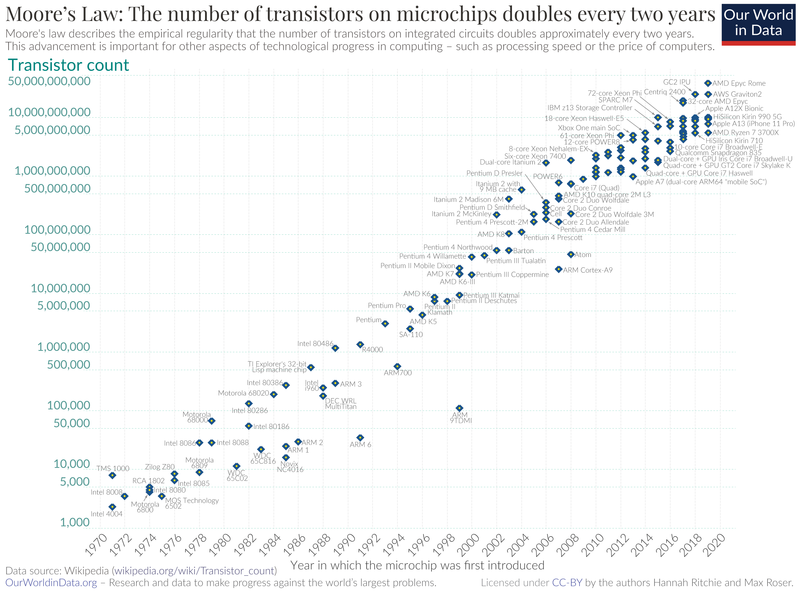
Moore's law
observation on the growth of integrated circuit capacity
Metcalfe's law
empirical rule that the value of a telecommunications network is proportional to the square of its number of users
Amdahl's law
formula in computer architecture
Kerckhoffs’s principle
cryptographic principle
Linus's Law
claim about software development that given a large developer base, bugs will be fixed quickly
Gustafson's law
law
Wirth's law
computing adage popularized by Niklaus Wirth that that software gets slower more rapidly than hardware becomes faster
Conway's law
observation that organizations design systems mirroring their communication structures (Melvin Conway, 1968)
Brooks' law
principle in software development that, past some point, assigning more people to a software project ends up delaying it
Reed's law
Value of a network is 2^n. Based on expoentual increase in sub groups formable
Grosch's law
Observation on computer performance
Dennard scaling
scaling law based on a 1974 paper co-authored by Robert H. Dennard, above
noisy intermediate-scale quantum era
era of technology characterized by quantum processors with <1000 qubits sensitive to noise, prone to quantum decoherence, and incapable of continuous quantum error correction
robustness principle
design guideline for software that states: "be conservative in what you do, be liberal in what you accept from others"
Haitz's law
Observation of LED production efficiency
Koomey's law
trend in the history of computing that the number of computations per unit energy dissipated doubles every 1.57 years
quantum computing scaling laws
observations predicting exponential progress in quantum computing, including qubit count, computational power, and decoherence time
Greenspun's tenth rule
Computing aphorism
Rock's law
Observation on semiconductor fab prices
Huang's law
observation by the head of Nvidia Jensen Huang about the advancement of artificial intelligence technology