File:Moore's_Law_Transistor_Count_1970-2020.png · Wikimedia Commons · See Wikimedia Commons
Moore's law
Sign in to saveobservation on the growth of integrated circuit capacity
Moore's law is the observation that the number of transistors on integrated circuits tends to double roughly every two years, allowing chips to become more powerful and capable over time. This matters because it has helped predict and drive progress in computing technology for decades, making devices faster and more advanced.
AI-generated from the Wikipedia summary — may contain errors.
Wikidata facts
- Instance of
- principle
- Named after
- Gordon Moore
- Image
- Закон на Мур 1.png
Show 2 more facts
- inception
- 1975-00-00
- Commons category
- Moore's law
Sources (3)
via Wikidata · CC0
~37 min read
Encyclopedic overview
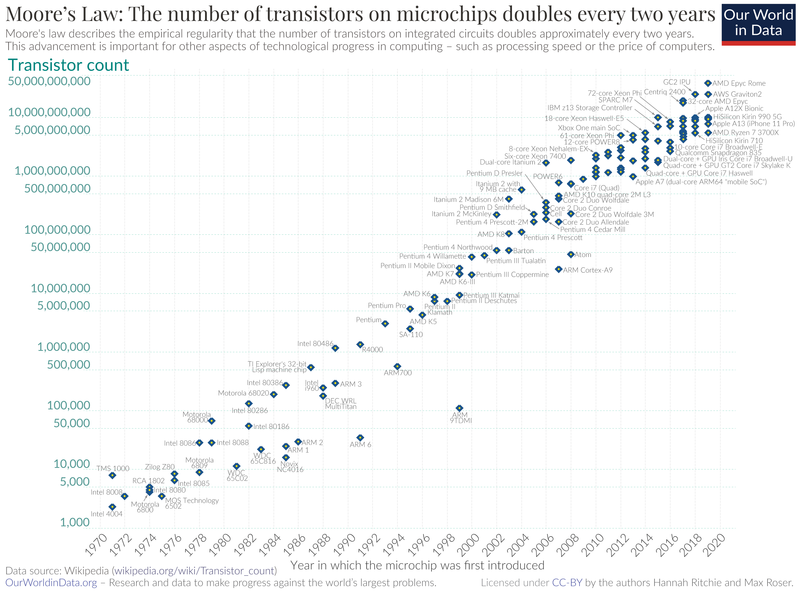
A semi-log plot of transistor counts for microprocessors against dates of introduction, nearly doubling every two years
Moore's law is the observation that the number of transistors in an integrated circuit (IC) doubles about every two years, with minimal increase in cost. Despite the name, Moore's law describes an empirical relationship, not a scientific law. This type of observation, the experience curve effect, quantifies efficiency gains from learned experience in production.
Excerpted from Wikipedia’s “Moore's law” article, available under the CC BY-SA 4.0 licence.
Gallery (9)
Available in 62 languages
- Español
- Français
- Deutsch
- 中文
- 日本語
- Русский
- Português
- Italiano
- العربية
- Afrikaans
- Armenian
- Asturian
- Azerbaijani
- Bahasa Indonesia
- Bangla
- Basque
- Belarusian
- Bosnian
Show 43 more
- Bulgarian
- Catalan
- Croatian
- Czech
- Danish
- Esperanto
- Estonian
- Finnish
- Galician
- Greek
- Hausa
- Hebrew
- Hungarian
- Icelandic
- Irish
- Latin
- Latvian
- Lombard
- Macedonian
- Malayalam
- Mongolian
- Nederlands
- Norwegian
- Pashto
- Polski
- Romanian
- Serbian
- simple
- Slovak
- Slovenian
- Svenska
- Tiếng Việt
- Türkçe
- Turkmen
- Ukrainian
- Urdu
- Uzbek
- West Flemish
- Wu Chinese
- zh_yue
- فارسی
- ไทย
- 한국어
via Wikidata sitelinks · CC0