Category
page 1Computer memory

random-access memory
form of computer data storage

byte
The byte is a unit of digital information that most commonly consists of eight bits. Historically, the byte was the number of bits used to encode a single character of text in a computer and for this reason it is the smallest addressable unit of memory in many computer architectures. To disambiguate arbitrarily sized bytes from the common 8-bit definition, network protocol documents such as the Internet Protocol () refer to an 8-bit byte as an octet.

read-only memory
non-volatile memory used in computers and other electronic devices; class of storage medium used in computers and other electronic devices
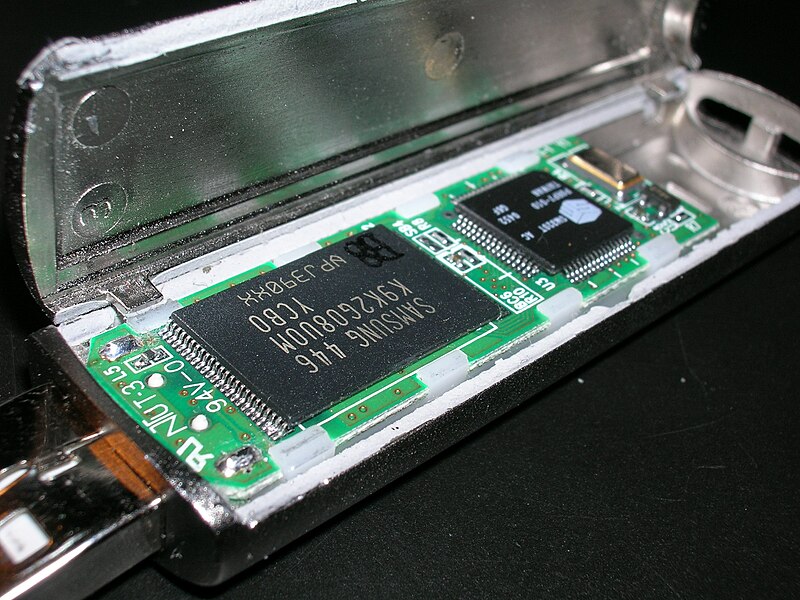
flash memory
electronic non-volatile computer storage device

flip-flop
circuit that has two stable states and can be used to store state information

computer memory
physical device used to store information for immediate use in a digital electronic device

EEPROM
thumb|A cross section of legacy EPROM structure.Upper insulator: Lower insulator: tunnel oxide
thumbnail|[[STMicroelectronics|STMicro M24C02 I²C serial type EEPROM]]
thumbnail|[[Atmel AT93C46A die]]
[[File:Atmel-avr-atusb162-HD.jpg|thumbnail| AT90USB162 MCU integrates 512 Byte EEPROM]]

programmable read-only memory
form of digital memory that can be written once by blowing fuses/antifuses to set bits

static random-access memory
semiconductor memory that uses flip-flops to store each bit
.jpg)
erasable programmable read-only memory
thumb|An EPROM: the Texas Instruments TMS27C040, a CMOS chip with 4 megabits of storage and 8-bit output (shown here in a 600-mil ceramic dual-in-line package). The TMS27C040 operates at 5 volts, but must be programmed at 13 volts.
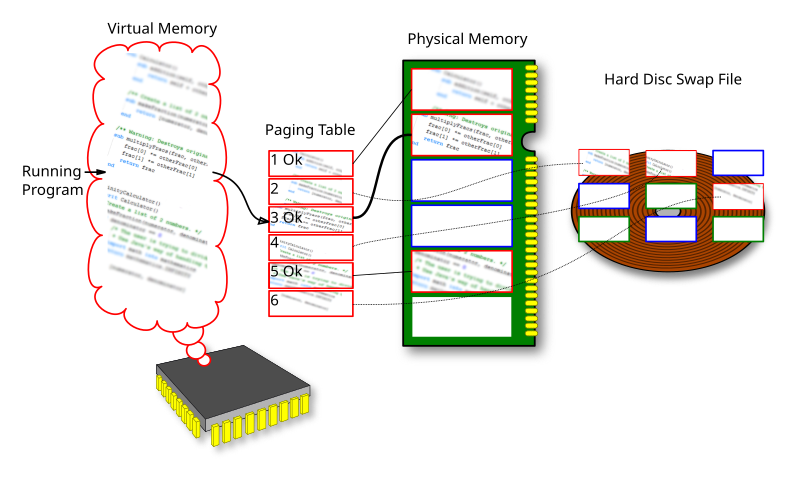
memory address
reference to a specific location in a computer's physical or virtual memory

direct memory access
feature of computer systems
data buffer
region of a physical memory storage used to temporarily store data while it is being moved from one place to another
buffer overflow
anomaly in computer security and programming that could be exploited as a security vulnerability
CPU cache
dynamically managed local memory that mirrors main memory in a microprocessor to reduce the cost of access

CompactFlash
non-volatile memory
computer memory that can retain stored information even when not powered

endianness
thumb|upright=2|Diagram demonstrating big- versus little-endianness
shift register
cascade of flip-flops sharing the same clock, in which the output of each flip-flop is connected to the input of the next flip-flop in the chain, resulting in a circuit that shifts by one position the bit array stored in it
drum memory
magnetic data storage device
non-volatile random-access memory
random-access memory that retains its information when power is turned off (non-volatile),in contrast to dynamic random-access memory (DRAM) and static random-access memory (SRAM), which both maintain data only for as long as power is applied

framebuffer
thumb|Sun TGX Framebuffer
thumb|320x320px|Sets 1, 2 and 3 represent the operation of single, double and triple frame-buffering, respectively, with Screen tearing#Vertical synchronization|vertical synchronization (vsync) enabled. In each graph, time flows from left to right. For details, see the page on [[multiple buffering.]]
A framebuffer (frame buffer, or sometimes framestore) is a portion of random-access memory (RAM) containing a bitmap that drives a video display. It is a memory buffer containing data representing all the pixels in a complete video frame. Modern video cards contain frameb
volatile memory
computer memory that requires power to maintain the stored information; needs constant power in order to prevent data from being erased
non-uniform memory access
computer memory design used in multiprocessing
bubble memory
type of non-volatile computer memory
Williams tube
random access
ability to access an arbitrary element of a sequence in equal time
sequential access
method of retrieving and processing information in the order stored
circular buffer
data structure
translation lookaside buffer
memory cache that is used to reduce the time taken to access a user memory location; part of the chip’s memory-management unit
High Bandwidth Memory
high-performance RAM interface for 3D-stacked DRAM from AMD and Hynix
offset
integer indicating the distance (displacement) between the beginning of an array or data structure and a given element or point
content-addressable memory
special type of computer memory used in certain very-high-speed searching applications
ECC memory
computer memory which detects and corrects errors
semiconductor memory
data storage device
phase-change memory
type of non-volatile random-access memory
page table
data structure that maps virtual addresses with physical addresses
delay line memory
sequential-access refreshable memory, in which amplifier and a pulse shaper are connected between the output of the delay line and the input, creating a loop that maintains the signal
in-memory database system
database management system that primarily relies on main memory for computer data storage
locality of reference
principle describing a tendency to repetitively accessing similar memory location sets momentaneously
Bank switching
a technique to increase the amount of usable memory

MemTest86
MemTest86 and Memtest86+ are memory test software programs designed to test and stress test an x86 architecture computer's random-access memory (RAM) for errors, by writing test patterns to most memory addresses, reading back the data, and comparing for errors. Each tries to verify that the RAM will accept and correctly retain arbitrary patterns of data written to it, that there are no errors where different bits of memory interact, and that there are no conflicts between memory addresses.
resistive random-access memory
non-volatile memory type
racetrack memory
experimental memory device
selectron tube
trademark
memory controller
digital circuit that manages the flow of data going to and from the computer's main memory
3D XPoint
non-volatile memory technology
ROM image
data dump from a ROM chip
Intel Turbo Memory
technology introduced by Intel
SxS
SxS (S-by-S) is a flash memory standard compliant to the Sony and SanDisk-created ExpressCard standard. According to Sandisk and Sony, the cards have transfer rates of 800 Mbit/s and burst transfer rate of up to 2.5 Gbit/s over the ExpressCard's PCI Express interface. Sony uses these cards as the storage medium for their XDCAM EX line of professional video cameras.
memory cell
elementary data-storing circuit within an electronically addressed computer memory/storage device
XQD card
memory card format
physical address
representation of memory address
multi-level cell
memory cell/element capable of storing more than a single bit of information

registered memory
computer memory module containing a hardware buffer between the DRAM chips and the system's memory controller
uniform memory access
shared memory architecture used in parallel computers, where all processors share the physical memory uniformly

remote direct memory access
hardware direct memory access over computer networks
Fully Buffered DIMM
memory technology
memory module
discrete printed circuit board on which memory chips are mounted
multi-channel memory architecture
computer memory architecture that increases bandwidth by attaching multiple memory channels to the DRAM controller