Category
page 1Concepts in logic

truth
Truth is conformity to reality or fact. It contrasts with falsity or misrepresentation that fails to align with the world. Truth is typically treated as a property of truthbearers, such as sentences, propositions, or beliefs that describe things as they are. It is closely related to truthfulness, a virtue associated with honesty, and to truthlikeness, a characteristic of theories that approximate the truth.

reality
Reality is the state of everything that exists, not how they might be imagined. Different cultures and academic disciplines conceptualize it in various ways.

infinity
thumb|The Sierpiński triangle contains infinitely many (scaled-down) copies of itself.
Infinity is something which is boundless, limitless, endless. It is denoted by , called the infinity symbol.

name
thumb|Names of the 2002 Bali bombings victims in [[Indonesia]]
A name is a term used for identification by an external observer. A name can identify a class or category of things, or a single thing, either uniquely, or within a given context. The entity identified by a name is called its referent. A personal name identifies, not necessarily uniquely, a specific individual human. The name of a specific entity is sometimes called a proper name (although that term has a philosophical meaning as well) and is, when consisting of only one word, a proper noun. Other nouns are sometimes called "common

reason
Reason is the capacity to consciously apply logic by drawing valid conclusions from new or existing information, with the aim of seeking truth. It is associated with activities considered characteristic of humans, including philosophy, religion, science, language, and mathematics, and is generally considered a distinguishing ability possessed by humans. The term "reason" is sometimes used to refer to rationality, although the latter is more about its application.
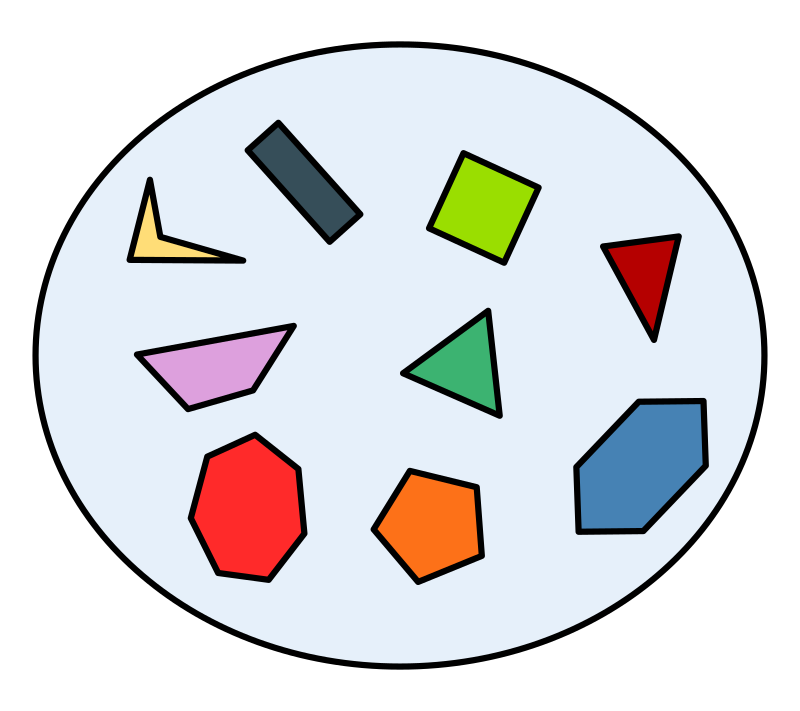
set
well-defined mathematical collection of distinct objects

axiom
thumb|The parallel postulate which states if the sum of the interior angles of two lines is less than 180°, the two straight lines meet on that side. The postulate is correct on a flat plane in [[Euclidean geometry but breaks on curved geometries such as spheres.]]
An axiom, postulate, or assumption is a statement that is taken to be true, to serve as a premise or starting point for further reasoning and arguments. The word comes from the Ancient Greek word (), meaning 'that which is thought worthy or fit' or 'that which commends itself as evident'.
.PNG)
theorem
thumb|The Pythagorean theorem has at least 370 known proofs.

paradox
A paradox is a logically self-contradictory statement or a statement that runs contrary to one's expectation. It is a statement that, despite apparently valid reasoning from true or apparently true premises, leads to a seemingly self-contradictory or a logically unacceptable conclusion. A paradox usually involves contradictory-yet-interrelated elements that exist simultaneously and persist over time. They result in "persistent contradiction between interdependent elements" leading to a lasting "unity of opposites".

semantics
thumb|alt=Diagram of the relation between word, object, and thought|A central topic in semantics concerns the relation between language, world, and mental concepts.|class=skin-invert-image
Semantics is the study of linguistic meaning. It examines what meaning is, how words get their meaning, and how the meaning of a complex expression depends on its parts. Part of this process involves the distinction between sense and reference. Sense is given by the ideas and concepts associated with an expression while reference is the object to which an expression points. Semantics contrasts with syntax, w

definition
thumb|A definition states the meaning of a word using other words. This is sometimes challenging. Common dictionaries contain lexical descriptive definitions, but there are various types of definition – all with different purposes and focuses.

fact
A fact is a true datum about one or more aspects of a circumstance, or an occurrence in the real world. Standard reference works are often used to check facts. Scientific facts are verified by careful, repeatable observation or measurement by experiments or other means. Generally speaking, facts are independent of belief, knowledge and opinion.
Facts are different from inferences, theories, values, and objects.

Occam's razor
philosophical principle used to judge credibility of statements
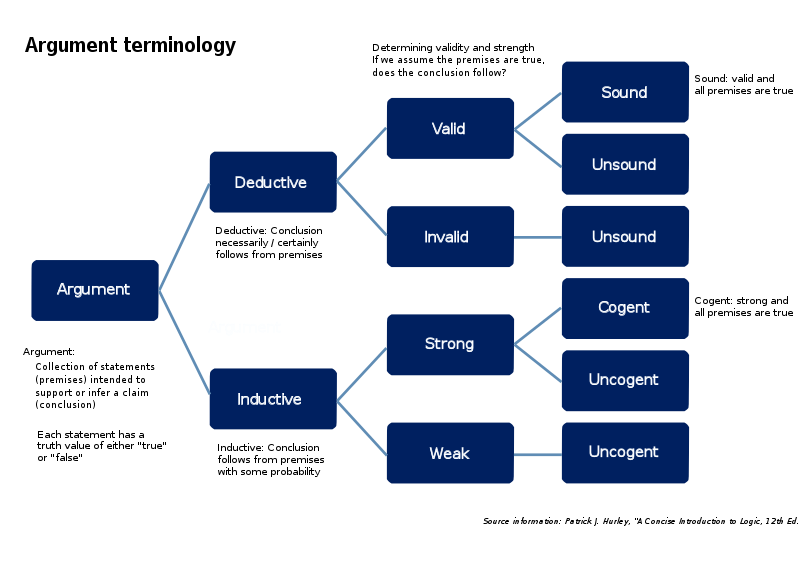
inductive reasoning
method of reasoning in which a body of observations is synthesized to hypothesize a general principle
inference
Inferences are steps in logical reasoning, moving from premises to logical consequences; etymologically, the word infer means to "carry forward". Inference is theoretically traditionally divided into deduction and induction, a distinction that dates at least to Aristotle (300s BC). Deduction is inference deriving logical conclusions from premises known or assumed to be true, with the laws of valid inference being studied in logic. Induction is inference from particular evidence to a universal conclusion. A third type of inference is sometimes distinguished, notably by Charles Sanders Peirce, c

essence
Essence () has various meanings and uses for different thinkers and in different contexts. It is used in philosophy and theology as a designation for the property or set of properties or attributes that make an entity the entity it is or, expressed negatively, without which it would lose its identity. Essence is contrasted with accident, which is a property or attribute the entity has accidentally or contingently, but upon which its identity does not depend.

premise
A premise or premiss is a proposition—a true or false declarative statement—used in an argument to prove the truth of another proposition called the conclusion. Arguments consist of a set of premises and a conclusion.
.jpg)
dilemma
thumb|Cartoon showing William Ewart Gladstone in a dilemma: If he climbs to escape the guard dog he will face the man's wrath, but if he drops to avoid the man, the dog will attack him.
explanation
An explanation is a set of statements usually constructed to describe a set of facts that clarifies the causes, context, and consequences of those facts. It may establish rules or laws, and clarifies the existing rules or laws in relation to any objects or phenomena examined.

rationality
Rationality is the quality of being guided by or based on reason. In this regard, a person acts rationally if they have a good reason for what they do, or a belief is rational if it is based on strong evidence. This quality can apply to an ability, as in a rational animal, to a psychological process, like reasoning, to mental states, such as beliefs and intentions, or to persons who possess these other forms of rationality. A thing that lacks rationality is either arational, if it is outside the domain of rational evaluation, or irrational, if it belongs to this domain but does not fulfill its
antinomy
In philosophy, an antinomy (; Ancient Greek: 'against' + 'law') is a real or apparent contradiction between two conclusions, both of which seem justified. It is a term used in logic and epistemology, particularly in the philosophy of Immanuel Kant.

connotation
A connotation is a commonly understood cultural or emotional association that any given word or phrase carries, in addition to its explicit or literal meaning, which is its denotation.
identity
relation each thing bears to itself alone
a priori and a posteriori
two types of knowledge, justification, or argument

reference
In logic, a reference is a relationship between objects in which one object designates, or acts as a means by which to connect to or link to, another object. The first object in this relation is said to refer to the second object. It is called a name for the second object. The next object, the one to which the first object refers, is called the referent of the first object. A name is usually a phrase or expression, or some other symbolic representation. Its referent may be anything – a material object, a person, an event, an activity, or an abstract concept.
property
predominant feature that characterizes a being, a thing, a phenomenon, etc. and which differentiates one being from another, one thing from another
truth value
value indicating the relation of a proposition to truth
contingency
status of propositions that are neither always true nor always false
necessity and sufficiency
conditional or implicational relationship between two statements: a necessary condition is one which must be present in order for another condition to occur, while a sufficient condition is one which produces the said condition
logical consequence
fundamental concept in logic
accident
in metaphysics, a property that the entity or substance has contingently, without which the substance can still retain its identity
validity
logical correctness of an argument's steps, regardless of the truth of the premises
principle of sufficient reason
principle that everything must have a reason or a cause
mutatis mutandis
Medieval Latin phrase
possible world
in philosophy, a complete and consistent way the world is or could have been
presupposition
In linguistics and philosophy, a presupposition is an implicit assumption about the world or background belief relating to an utterance whose truth is taken for granted in discourse. Examples of presuppositions include:
Jane no longer writes fiction.
Presupposition: Jane once wrote fiction.
Have you stopped eating meat?
Presupposition: you had once eaten meat.
Have you talked to Hans?
Presupposition: Hans exists.
logical truth
statement which is true regardless of the truth or falsity of its constituent parts
soundness
In logic, soundness can refer to either a property of arguments or a property of formal deductive systems.
analytic–synthetic distinction
semantic distinction, used primarily in philosophy to distinguish propositions (in particular, statements that are affirmative subject–predicate judgments) into two types: analytic propositions and synthetic propositions
canonical form
standard (often unique) way of presenting an object as a mathematical expression
identity of indiscernibles
impossibility for separate objects to have all their properties in common
logical reasoning
Wikimedia list article

supervenience
thumb|right|The upper levels on this chart can be considered to supervene on the lower levels.
Porphyrian tree
Classic device
decidability
property of theories that have computable membership
logical constant
term in logic
primitive notion
undefined term motivated informally, usually by an appeal to intuition and everyday experience, or introduced axiomatically and eventually generated only by a series of elementary operations
statement
either a declarative sentence that is true or false, or that which a true or false declarative sentence asserts
type–token distinction
distinction that separates a concept from the objects which are particular instances of the concept
term logic
type of logic whose elements are concepts
intension

vagueness
In linguistics and philosophy, a vague predicate is one which gives rise to borderline cases. For example, the English adjective "tall" is vague since it is not clearly true or false for someone of middling height. By contrast, the word "prime" is not vague since every number is definitively either prime or not. Vagueness is commonly diagnosed by a predicate's ability to give rise to the sorites paradox. Vagueness is separate from ambiguity, in which an expression has multiple denotations. For instance the word "bank" is ambiguous since it can refer either to a river bank or to a financial ins
meaning
nature of meaning in the philosophy of language, semantics, methaphysics and metasemantics
extension
the set of objects to which a term or concept applies
leap of faith
in religion and philosophy, the act of believing in or accepting something outside the boundaries of reason
propositional variable
mathematical representation of truth or falsehood
apodicticity
"Apodictic", also spelled "apodeictic" (, "capable of demonstration"), is an adjectival expression from Aristotelean logic that refers to propositions that are demonstrably, necessarily or self-evidently true. Apodicticity or apodixis is the corresponding abstract noun, referring to logical certainty.
law of thought
philosophical axiomatisation
syntax
rules used for constructing or transforming the symbols of a formal language
Diairesis
Diairesis (, "division") is a form of classification used in ancient (especially Platonic) logic that serves to systematize concepts and come to definitions. When defining a concept using diairesis, one starts with a broad concept, then divides this into two or more specific sub-concepts, and this procedure is repeated until a definition of the desired concept is reached. Aristotle makes extensive use of diaresis in categorization as basis for syllogizing. He makes clear, however, that definition by diaresis does not in itself prove anything. Apart from this definition, the procedure also resu