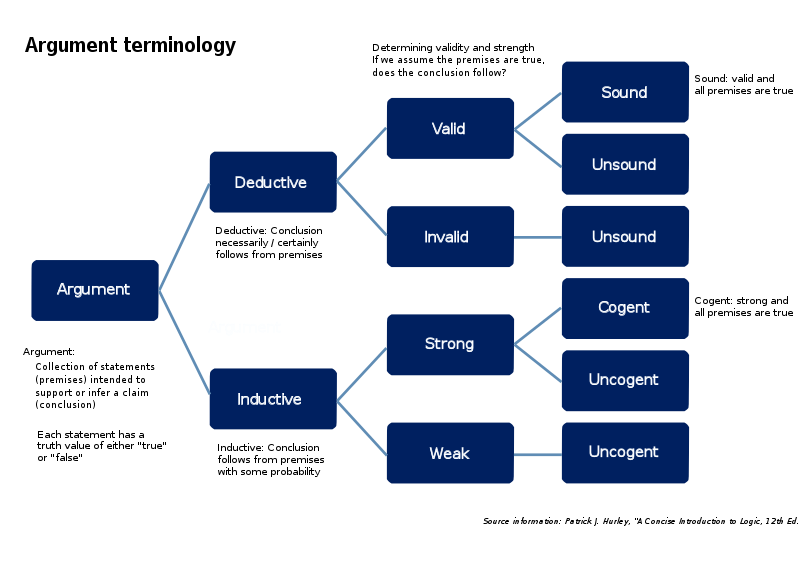
File:Argument_terminology_used_in_logic_(en).svg · Wikimedia Commons · See Wikimedia Commons
inductive reasoning
Sign in to saveAlso known as induction, inductive logic, inductive analysis, solving a problem starting with what you know already
method of reasoning in which a body of observations is synthesized to hypothesize a general principle
Inductive reasoning is a method where you observe many specific examples and use those observations to develop a general rule or principle that explains them. It matters because it's how we often learn patterns from experience and form working theories about how the world works, though conclusions reached this way aren't guaranteed to be true.
AI-generated from the Wikipedia summary — may contain errors.
Wikidata facts
Show 5 more facts
- topic's main category
- Category:Inductive reasoning
- Commons category
- Inductive reasoning
- opposite of
- deductive reasoning
- different from
- magnetic flux density
- has characteristic
- generalization
via Wikidata · CC0
~40 min read
Encyclopedic overview
Inductive reasoning refers to a variety of methods of reasoning in which the conclusion of an argument is supported not with deductive certainty, but at best with some degree of probability. Unlike deductive reasoning (such as mathematical induction), where the conclusion is certain, given the premises are correct, inductive reasoning produces conclusions that are at best probable, given the premises provided.
Types
Excerpted from Wikipedia’s “inductive reasoning” article, available under the CC BY-SA 4.0 licence.
Available in 66 languages
- Español
- Français
- Deutsch
- 中文
- 日本語
- Русский
- Português
- Italiano
- العربية
- हिन्दी
- Albanian
- Armenian
- Azerbaijani
- Bahasa Indonesia
- Basque
- Bosnian
- Bulgarian
- Catalan
Show 47 more
- Central Kurdish
- Croatian
- Czech
- Danish
- Esperanto
- Estonian
- Finnish
- Galician
- Ganda
- Greek
- Hebrew
- Hungarian
- Icelandic
- Kazakh
- Kikuyu
- Latvian
- Lithuanian
- Macedonian
- Mazanderani
- Mongolian
- Nederlands
- Norwegian
- Pashto
- Polski
- Romanian
- Scots
- Serbian
- Serbian (Latin)
- simple
- Slovak
- Slovenian
- Svenska
- Tajik
- Tamil
- Tatar
- Tiếng Việt
- Türkçe
- Turkmen
- Ukrainian
- Urdu
- Uzbek
- Western Panjabi
- Wu Chinese
- zh_yue
- فارسی
- ไทย
- 한국어
via Wikidata sitelinks · CC0