Category
page 1Conifer genera

Cedrus
Cedrus, with the common English name cedar, is a genus of coniferous trees in the plant family Pinaceae (subfamily Abietoideae). They are native to the mountains of the western Himalayas and the Mediterranean region at high altitudes. The trees grow tall with a cylindrical trunk and a wide leafy crown. The cones are erect; the leaves grow in tufts of 15–45 needle leaves, which can be bright green or blue-green with a waxy coat. When the cones are mature, they disintegrate to release the seeds, which are winged. Both pollen and seeds are wind-dispersed.

Cupressus
Cupressus (common name cypress) is one of several genera of evergreen conifers within the family Cupressaceae; for the others, see cypress. It is considered a polyphyletic group. Based on genetic and morphological analysis, the genus Cupressus is found in the subfamily Cupressoideae. The common name "cypress" comes via the Old French from the Latin , which is the latinisation of the Greek κυπάρισσος (kypárissos). The name derives from Cyparissus, a mythological figure who was turned into a tree after killing a stag.

Taxus
Taxus is a genus of coniferous trees or shrubs known as yews in the family Taxaceae. Yews occur around the globe in temperate zones of the northern hemisphere, northernmost in Norway and southernmost in the South Celebes. Some populations exist in tropical highlands.

Thuja
Thuja ( ) is a genus of coniferous tree or shrub in the Cupressaceae (cypress family). There are five species in the genus, two native to North America and three native to eastern Asia. The genus is monophyletic and sister to Thujopsis. Members are commonly known as arborvitaes (from the Latin term for 'tree of life'), thujas, or New World false cedars.
.jpg)
Araucaria
Araucaria (; original pronunciation: [a.ɾawˈka. ɾja]) is a genus of evergreen coniferous trees in the family Araucariaceae. While today they are largely confined to the Southern Hemisphere, during the Jurassic and Cretaceous they were globally distributed. There are 20 extant species in New Caledonia (where 14 species are endemic, see New Caledonian Araucaria), eastern Australia (including Norfolk Island), New Guinea, Argentina, Brazil, Chile and Uruguay.

Pseudotsuga
Pseudotsuga () is a genus of evergreen coniferous trees in the family Pinaceae (subfamily Laricoideae). Common names for species in the genus include Douglas fir, Douglas-fir, Douglas tree, Oregon pine and Bigcone spruce. Pseudotsuga menziesii (Douglas fir proper) is widespread in western North America and is an important source of timber. The number of species has long been debated, but two in western North America and two to four in eastern Asia are commonly acknowledged.

Agathis
Agathis, commonly known as kauri or dammara, is a genus of evergreen coniferous trees, native to Australasia and Southeast Asia. It is one of three extant genera in the family Araucariaceae, alongside Wollemia and Araucaria (being more closely related to the former). Its leaves are much broader than most conifers. Kauri gum was historically commercially harvested from living New Zealand kauri and from swamp ground.

Taxodium
Taxodium is a genus of one to three species (depending on taxonomic opinion) of extremely flood-tolerant conifers in the cypress family, Cupressaceae. The name is derived from the Latin word taxus 'yew' and the Greek word εἶδος (eidos) 'similar to'. Within the family, Taxodium is most closely related to Chinese swamp cypress (Glyptostrobus pensilis) and sugi (Cryptomeria japonica).

Tsuga
thumb|Tsuga heterophylla
Tsuga (, from Japanese (), the name of Tsuga sieboldii) is a genus of conifers in the subfamily Abietoideae of Pinaceae, the pine family. The English-language common name "hemlock" arose from a perceived similarity in the smell of its crushed foliage to that of the unrelated plant hemlock. Unlike the latter, Tsuga species are not poisonous.

Chamaecyparis
Chamaecyparis, common names cypress or false cypress (to distinguish it from related cypresses), is a genus of conifers in the cypress family Cupressaceae, native to eastern Asia (Japan and Taiwan) and to the western and eastern margins of the United States. The name is derived from the Greek khamai (χαμαί), meaning "on the earth", and kuparissos (κυπάρισσος) for "cypress".

Keteleeria
Keteleeria is a genus of three species of coniferous trees in the family Pinaceae first described as a genus in 1866.

Sequoia
genus of plants

Callitris
Callitris is a genus of coniferous trees in the Cupressaceae (cypress family). There are 16 recognized species in the genus, of which 13 are native to Australia and the other three (C. neocaledonica, C. sulcata and C. pancheri) native to New Caledonia. Traditionally, the most widely used common name is cypress-pine, a name shared by some species of the closely related genus Actinostrobus. Alongside Eucalyptus, Callitris is one of the dominant tree genera in Australia.
==Description==
They are small to medium-sized trees or large shrubs, reaching tall (to in C. macleayana).

Torreya
Torreya is a genus of conifers comprising six or seven species placed in the family Taxaceae, though sometimes formerly placed in Cephalotaxaceae. Four species are native to eastern Asia; the other two are native to North America. They are small to medium-sized evergreen trees reaching 5–20 m, rarely 25 m, tall. Common names include nutmeg yew.

Cephalotaxus
Cephalotaxus, commonly called plum yew or cowtail pine, is a genus of conifers comprising 11 species, either considered the only member of the family Cephalotaxaceae, or in the Taxaceae when that family is considered in a broad sense. The genus is endemic to eastern Asia, though fossil evidence shows it had a wider Northern Hemisphere distribution in the past. The species are evergreen shrubs and small trees reaching (rarely to ) tall.

Calocedrus
upright=0.9|thumb|California incense cedar, in Lassen Volcanic National Park

Cunninghamia
Cunninghamia is a genus of one or two living species of evergreen coniferous trees in the cypress family Cupressaceae. They are native to China, northern Vietnam and Laos, and perhaps also Cambodia. They may reach in height. In vernacular use, it is most often known as Cunninghamia, but is also sometimes called "China-fir" (though it is not a fir). The genus name Cunninghamia honours Dr. James Cunningham, a British doctor who introduced this species into cultivation in 1702 and botanist Allan Cunningham.

Athrotaxis
thumb|left|Athrotaxis selaginoides|A. selaginoides seed cones.

Widdringtonia
Widdringtonia is a genus of coniferous trees in the Cupressaceae (cypress family). The name was Austrian botanist Stephan Endlicher's way of honouring an early expert on the coniferous forests of Spain, Capt. Samuel Edward Widdrington (1787–1856). There are four species, all native to southern Africa, where they are known as cedars or African cypresses.

Libocedrus
Libocedrus is a genus of five species of coniferous trees in the cypress family Cupressaceae, native to New Zealand and New Caledonia. The genus is closely related to the South American genera Pilgerodendron and Austrocedrus, and the New Guinean genus Papuacedrus, both of which are included within Libocedrus by some botanists. These genera are rather similar to the Northern Hemisphere genera Calocedrus and Thuja: in earlier days, what is now Calocedrus was sometimes included in Libocedrus. They are much less closely related, as recently confirmed (Gadek et al. 2000). The generic name means "te

Actinostrobus
Actinostrobus is a genus of coniferous trees in the Cupressaceae (cypress family). Common names include cypress, sandplain-cypress and cypress-pine, the last of these shared by the closely related genus Callitris.
==Species==
There are three species in the genus, all endemic to southwestern Western Australia:
.jpg)
Amentotaxus
thumb|Amentotaxus formosana

Sequoiadendron
Sequoiadendron is a genus of evergreen trees, with three species, only one of which survives to the present:

Metasequoia
Metasequoia, or dawn redwood, is a genus of fast-growing coniferous trees. It contains one extant (living) species, Metasequoia glyptostroboides, which is one of three extant species of conifers known as redwoods in the world. Metasequoia glyptostroboides is native to Lichuan county in Hubei, China. Although the shortest of the redwoods, it grows to at least in height. Local villagers refer to the original tree from which most others derive as Shuǐshān (水杉), or "water fir", which is part of a local shrine. Since its rediscovery in 1944, the dawn redwood has become a popular ornamental, with ex

Cordaites
Cordaites is a genus of extinct gymnosperms, related to or actually representing the earliest conifers. These trees grew up to tall and stood in dry areas as well as wetlands. Brackish water mussels and crustacea are found frequently between the roots of these trees. Cordaites fossils are most commonly found in rock sections from the Upper Carboniferous () of Europe and the Americas.
thumb|left|Leaves of Cordaites lungatus
A number of many types from this line are:
Cordaites principalis
Cordaites ludlowi (named after Ludlow, a coal area in England)
Cordaites hislopii. Found in Paleorrota g
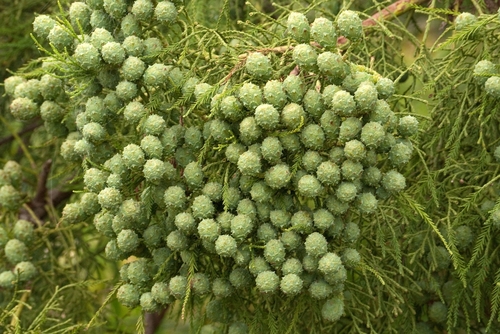
Glyptostrobus
Glyptostrobus is a small genus of conifers in the family Cupressaceae (formerly in the family Taxodiaceae). The sole living species, Glyptostrobus pensilis, is native to subtropical southeastern China, from Fujian west to southeast Yunnan, and also very locally in northern Vietnam and Bolikhamsai province of eastern Laos near the Vietnam border.
Walchia
Walchia is a primitive fossil conifer found in upper Pennsylvanian (Carboniferous) and lower Permian (about 310-290 Mya) rocks of Europe and North America. A forest of in-situ Walchia tree-stumps is located on the Northumberland Strait coast at Brule, Nova Scotia.
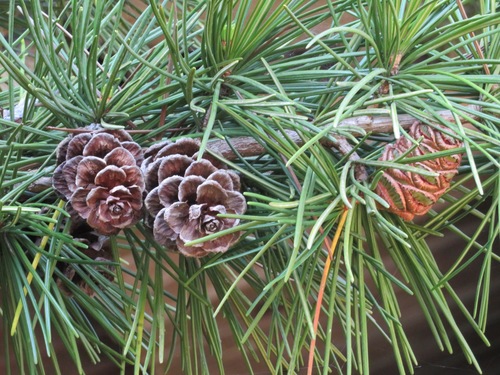
Sciadopitys
Sciadopitys, commonly called kōyamaki trees, are a genus of conifers endemic to Japan. It is the sole living genus of umbrella pines in the family Sciadopityaceae. The oldest fossils of Sciadopitys are from the Late Cretaceous of Japan, and the genus was widespread in Laurasia during most of the Cenozoic, especially in Europe until the Pliocene. Sciadopitys has one extant member, S. verticillata. The genus existed in the United States as recently as the Pliocene.
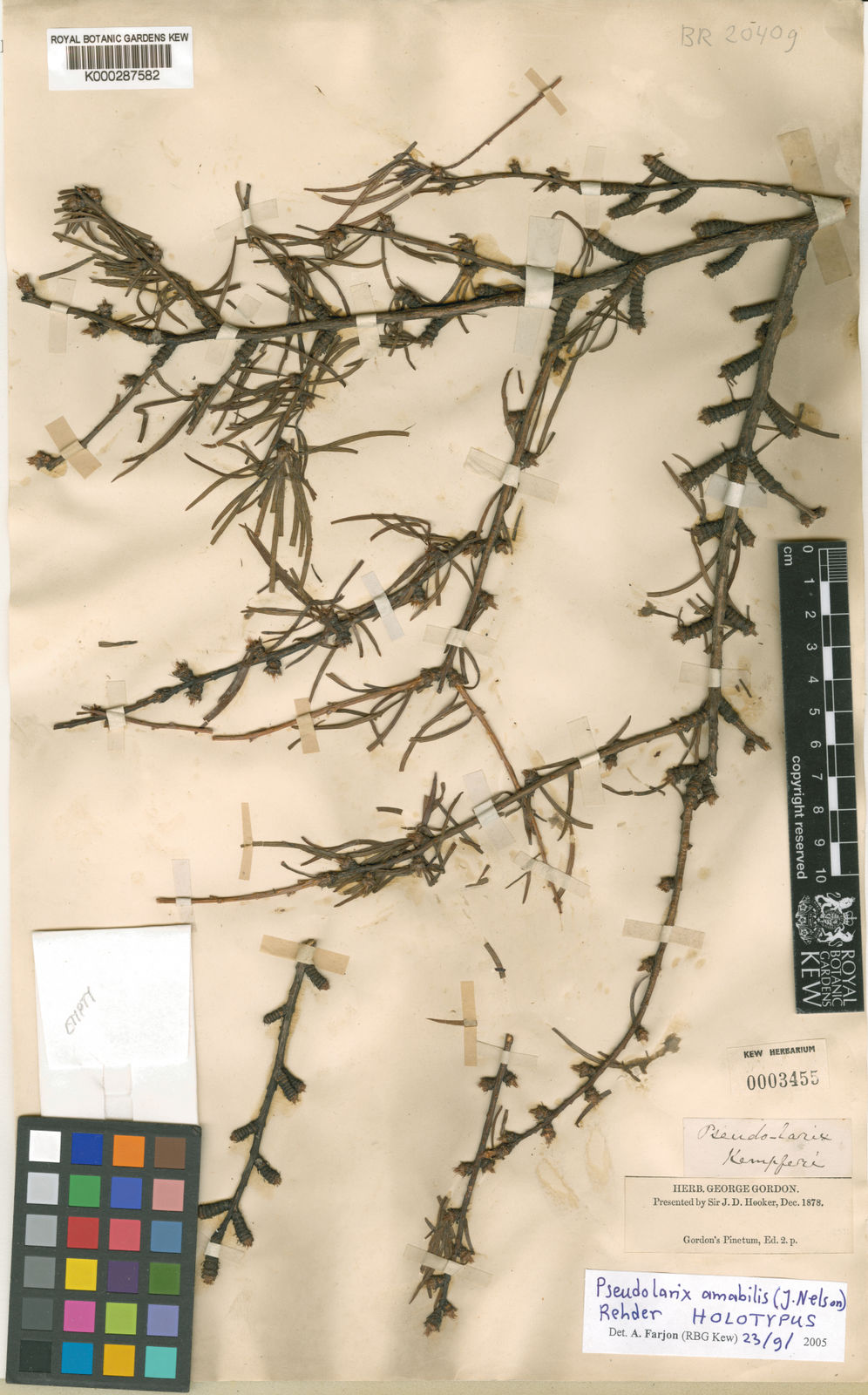
Pseudolarix
Pseudolarix is a genus of coniferous trees in the pine family Pinaceae containing three species, the extant Pseudolarix amabilis and the extinct species Pseudolarix japonica and Pseudolarix wehrii. Pseudolarix species are commonly known as golden larch, but are not true larches (Larix) being more closely related to Keteleeria, Abies and Cedrus. P. amabilis is native to eastern China, occurring in small areas in the mountains of southern Anhui, Zhejiang, Fujian, Jiangxi, Hunan, Hubei and eastern Sichuan, at altitudes of . P. wehrii is described from fossils dating to the Early Eocene (Ypresian)

Hesperocyparis
Hesperocyparis (western cypress) is a genus of trees in the family Cupressaceae, containing North American species otherwise assigned to the genus Cupressus. They are found throughout western North America. Only a few species have wide ranges, with most being restricted-range endemics.
Samaropsis
Samaropsis is a form genus named by Goeppert in 1864. Later Sewart (1917) redefined the taxon to refer only to the seeds.