Category
page 1Coolants

helium
Helium (from ) is a chemical element; it has symbol He and atomic number 2. It is a colorless, odorless, non-toxic, inert, monatomic gas and the first in the noble gas group in the periodic table. Its boiling point is the lowest among all the elements, and it does not have a melting point at standard pressures. It is the second-lightest and second-most abundant element in the observable universe, after hydrogen. It is present at about 24% of the total elemental mass, which is more than 12 times the mass of all the heavier elements combined. Its abundance is similar to this in both the Sun and

nitrogen
Nitrogen is a chemical element; it has symbol N and atomic number 7. Nitrogen is a nonmetal and the lightest member of group 15 of the periodic table, often called the pnictogens. It is a common element in the universe, estimated at seventh in total abundance in the Milky Way and the Solar System. At standard temperature and pressure, two atoms of the element bond to form N2, a colourless and odourless diatomic gas. N2 forms about 78% of Earth's atmosphere, making it the most abundant chemical species in air. Because of the volatility of nitrogen compounds, nitrogen is relatively rare in the s

mercury
chemical element with symbol Hg and atomic number 80

neon
Neon is a chemical element; it has the symbol Ne and the atomic number 10. It is the second noble gas in the periodic table. Neon is a colorless, odorless, inert monatomic gas under standard conditions, with approximately two-thirds the density of air.

gallium
Gallium is a chemical element; it has symbol Ga and atomic number 31. Discovered by the French chemist Paul-Émile Lecoq de Boisbaudran in Paris, France, 1875,
elemental gallium is a soft, silvery metal at standard temperature and pressure. In its liquid state, it becomes silvery white. If enough force is applied, solid gallium may fracture conchoidally. Since its discovery in 1875, gallium has widely been used to make alloys with low melting points. It is also used in semiconductors, as a dopant in semiconductor substrates.

carbon dioxide
chemical compound

kerosene
right|thumb|upright|A kerosene bottle, containing blue-dyed kerosene

dry ice
solid carbon dioxide

brine
Brine (or briny water) is a high-concentration solution of salt (typically sodium chloride or calcium chloride) in water. In diverse contexts, brine may refer to the salt solutions ranging from about 3.5% (a typical concentration of seawater, on the lower end of that of solutions used for brining foods) up to about 26% (a typical saturated solution, depending on temperature). Brine forms naturally due to evaporation of ground saline water but it is also generated in the mining of sodium chloride. Brine is used for food processing and cooking (pickling and brining), for de-icing of roads and ot

antifreeze
An antifreeze is an additive which lowers the freezing point of a water-based liquid. An antifreeze mixture is used to achieve freezing-point depression for cold environments. Common antifreezes also increase the boiling point of the liquid, allowing higher coolant temperature. However, all common antifreeze additives also have lower heat capacities than water, and do reduce water's ability to act as a coolant when added to it.
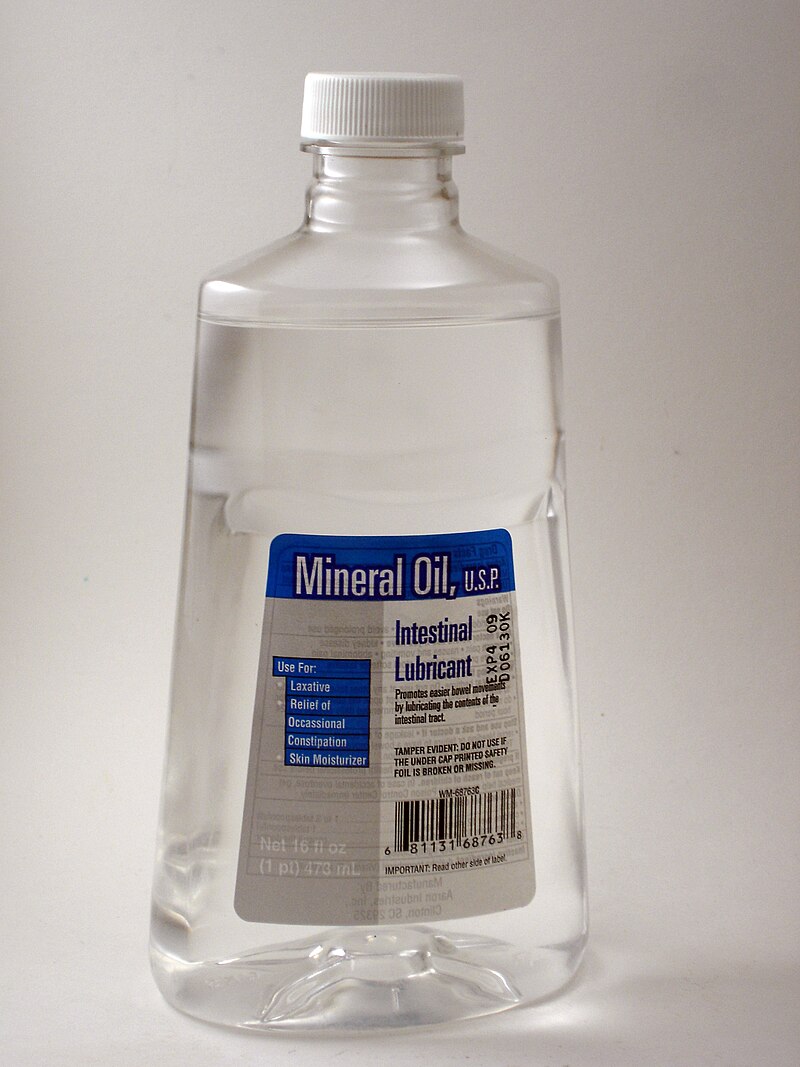
mineral oil
liquid mixture of higher alkanes from a mineral source, particularly a distillate of petroleum
liquid hydrogen
liquid state of the element hydrogen
liquid nitrogen
liquid state of the element nitrogen
liquid helium
liquid state of the element helium

coolant
A coolant is a substance, typically liquid, that is used to reduce or regulate the temperature of a system. An ideal coolant has high thermal capacity, low viscosity, and low cost, is non-toxic and chemically inert, and neither causes nor promotes corrosion of the cooling system. Some applications also require the coolant to be an electrical insulator.
polyethylene glycol
polymer
cutting fluid
type of coolant and lubricant designed specifically for metalworking processes, such as machining and stamping
sodium-potassium alloy
alkali metal alloy which is liquid at room temperature
perfluoro(2-methyl-3-pentanone)
Perfluoro(2-methyl-3-pentanone) is a fluorinated ketone with the structural formula CF3CF2C(=O)CF(CF3)2, a fully-fluorinated analog of ethyl isopropyl ketone. It is used as an electronics coolant liquid and fire protection fluid sold commercially by 3M under brand names such as Novec 1230, Novec 649, and FK-5-1-12. It is also known as "waterless water" or "dry water".
purified water
water treated to remove dissolved solutes or suspended impurities
liquid air
air that has been condensed into a liquid
perfluorohexane
Perfluorohexane (), or tetradecafluorohexane, is a fluorocarbon. It is a derivative of hexane in which all the hydrogen atoms are replaced by fluorine atoms. It is used in one formulation of the electronic cooling liquid/insulator Fluorinert for low-temperature applications due to its low boiling point of 56 °C and freezing point of −90 °C. It is odorless and colorless. Unlike typical hydrocarbons, the structure features a helical carbon backbone. In medical imaging it is used as a contrast agent.
perfluorodecalin
Perfluorodecalin () is a fluorocarbon, a derivative of decalin in which all of the hydrogen atoms are replaced by fluorine atoms. It is chemically and biologically inert and stable up to 400 °C. Several applications make use of its ability to dissolve gases.
fusible alloy
metal alloy capable of being easily fused at relatively low temperature
perfluorooctane
Perfluorooctane, also known as octadecafluorooctane, is a fluorocarbon liquid—a perfluorinated derivative of the hydrocarbon octane. It can be a good substitute for insulating oil in high voltage electronics. In addition to heat transfer applications, it has also been used as a breathable fluid in partial liquid ventilation.
Field's metal
eutectic fusible alloy of indium, bismuth, and tin

perfluoro-2-butyltetrahydrofuran
FC-75 is a fluorocarbon derivative of tetrahydrofuran with the chemical formula C8F16O. It is practically insoluble in water.
perfluorotributylamine
Perfluorotributylamine (PFTBA), also referred to as FC43, is an organic compound with the chemical formula . It is a colorless liquid. A molecule of this chemical compound consists of three butyl groups connected to one nitrogen atom, in which all of the hydrogen atoms are replaced with fluorine atoms. The compound is produced for the electronics industry, along with other perfluoroalkylamines. The high degree of fluorination significantly reduces the basicity of the central amine due to electron-withdrawing effects.
Slush hydrogen
combination of liquid hydrogen and solid hydrogen
perfluorotripentylamine
Perfluorotripentylamine is an organic compound with the chemical formula . A molecule of this chemical compound consists of three pentyl groups connected to one nitrogen atom, in which all of the hydrogen atoms are replaced with fluorine atoms. It is a perfluorocarbon. It is used as an electronics coolant, and has a high boiling point. It is colorless, odorless, and insoluble in water. Unlike ordinary amines, perfluoroamines are of low basicity. Perfluorinated amines are components of fluorofluids, used as immersive coolants for supercomputers.
Fluorinert
Fluorinert is the trademarked brand name for the line of electronics coolant liquids sold commercially by 3M. As perfluorinated compounds (PFCs), all Fluorinert variants have an extremely high global warming potential (GWP), and so they should be used with caution (see below). It is an electrically insulating, stable fluorocarbon-based fluid, which is used in various cooling applications. It is mainly used for cooling electronics. Different molecular formulations are available with a variety of boiling points, allowing it to be used in "single-phase" applications, where it remains a liquid, or
freeze spray
aerosol spray for rapid cooling
hydrofluoroether
Hydrofluoroethers (HFEs) are a class of organic solvents. As non-ozone-depleting chemicals, they were developed originally as a replacement for CFCs, HFCs, HCFCs, and PFCs. They are typically colorless, odorless, tasteless, low toxicity, low viscosity, and liquid at room temperature. The boiling point of HFEs vary from to nearly . Although 3M first developed HFEs, other manufacturers have begun producing them. They are chemically related to the fluorinated ether inhalational anaesthetics sevoflurane and desflurane.