Category
page 1Cruelty to animals

hunting
Hunting is the human practice of seeking, pursuing, capturing, and killing wildlife or feral animals. The most common reasons for humans to hunt are to obtain the animal's body for meat and useful animal products (fur/hide, bone/tusks, horn/antler, etc.), for recreation/taxidermy (see trophy hunting), although it may also be done for resourceful reasons such as removing predators dangerous to humans or domestic animals (e.g. wolf hunting), to eliminate pests and nuisance animals that damage crops/livestock/poultry or spread diseases (see varminting), for trade/tourism (see safari), or for ecol

bullfighting
thumb|upright=1.3|Spanish-style bullfighting|Spanish bullfight in [[Las Ventas in Madrid]]
.jpg)
zoophilia
thumb|"Ancient Greek sodomising a goat", plate XVII from by F. K. Forberg, illustrated by Édouard-Henri Avril
Zoophilia is a paraphilia in which a person experiences a sexual fixation on non-human animals. Bestiality instead refers to cross-species sexual activity between humans and non-human animals. Due to the lack of research on the subject, it is difficult to conclude how prevalent bestiality is. Zoophilia was estimated in one study to be prevalent in 2% of the population in 2021.

Kim Ki-duk
South Korean film director (1960–2020)
.jpg)
cockfight
thumb|Cockfight in London, c. 1808
thumb|Colonel Colonel Mordaunt's Cock Match|Mordaunt's cockfight in [[Lucknow, 1784–1786, by Johann Zoffany]]
thumb|The wantilan, a Balinese pavilion that can be used for cockfighting
Cockfighting is a blood sport involving domesticated roosters as the combatants. The first documented use of the word gamecock, denoting use of the cock as to a "game", a sport, pastime or entertainment, was recorded in 1634, after the term "cock of the game" used by George Wilson, in the earliest known book on the sport of cockfighting in The Commendation of Cocks and Cock

poaching
thumb|The Poacher by Frédéric Rouge (1867–1950)

foie gras
French culinary dish

kopi luwak
Indonesian coffee drink

cruelty to animals
human infliction of suffering or harm upon non-human animals, for purposes other than self-defense or survival
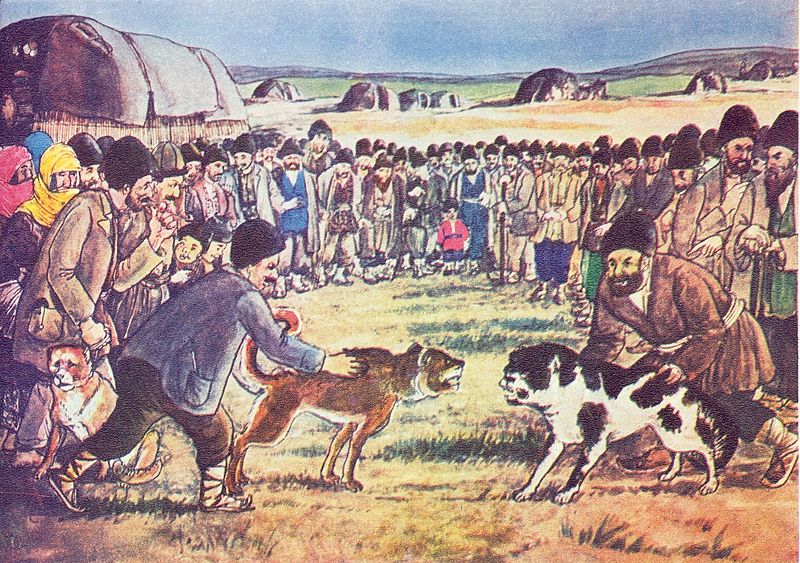
dog fighting
dog bloodsport

Blondi
Blondi (1941 – 29 April 1945) was Adolf Hitler's German Shepherd, a gift as a puppy from Martin Bormann in 1941. Hitler kept Blondi even after his move into the Führerbunker located underneath the garden of the Reich Chancellery on 16 January 1945.
intensive animal farming
type of intensive agriculture, specifically an approach to animal husbandry designed to maximize production, while minimizing costs
War of Currents
an era of clash between use of Alternating and Direct Current for electric power distribution
Mary
circus elephant (died 1916)
animal sacrifice
formal, ritualized killing of an animal as a sacred act
san-nakji
thumb|right|Video of San-nakji
San-nakji () is a variety of hoe (raw dish) made with long arm octopus (Octopus minor), a small octopus species called nakji in Korean and is sometimes translated into "baby octopus" due to its relatively small size compared to the giant octopus (Enteroctopus dofleini). The octopus is most commonly killed before being cut into small pieces and served, with the nerve activity in the octopus's tentacles making the pieces move posthumously on the plate while served. The octopus's highly complex nervous system, with two-thirds of its neurons localised in the nerve co
fur farming
breeding or raising animals for their fur
Spanish-style bullfighting
bullfighting in Spain

Jallikattu
Jallikattu (or Sallikkattu), also known as Eru Taḻuvuṭal and Manju-virattu, is a traditional event in which a zebu bull (Bos indicus), such as the Pulikulam or Kangayam breeds, is released into a crowd of people, and many people attempt to grab the large hump on the bull's back with both arms and hang on to it while the bull attempts to escape. They hold the hump for as long as possible, attempting to bring the bull to a stop. In some cases, they must ride long enough to remove flags on the bull's horns or cross a finish line.
seal hunting
hunting of seals
Harry Harlow
American psychologist (1905–1981)
blood sport
category of sports that involve bloodshed
livestock branding
technique for marking livestock so as to identify the owner, traditionally with a hot iron
boiling frog
metaphor for the inability of people to react to significant changes that occur gradually

force-feeding
thumb|right|upright|A suffragette is force-fed in HM Prison Holloway in the UK during [[hunger strikes for women's suffrage, approximately 1911.]]
Force-feeding is the practice of feeding a human or animal against their will. The term gavage (, , ) refers to supplying a substance by means of a small plastic feeding tube passed through the nose (nasogastric) or mouth (orogastric) into the stomach.
shark finning
removal and retention of shark fins while the remainder of the living shark is discarded in the ocean
Yulin Festival and Dog meat Consumption in China
annual festival and consumption in China
Tame bear
wild bear raised for entertainment
bile bear
bears kept in captivity to harvest their bile
Chilean rodeo
type of sport
animal captivity
condition of an animal being held by humans
battery cage
A housing system used for various animal production methods, but primarily for egg-laying hens
tail docking
practice of removing a portion of an animal's tail

Even Dwarfs Started Small
1970 film by Werner Herzog

cruelty-free
thumb|Laboratory rat
laboratory mouse
animal used in labs
Crush fetish
fetish and paraphilia in which sexual arousal is associated with the crushing of objects
Cave of Dogs
cave in Italy
animal hoarding
keeping more domestic pets than can be cared for
American Society for the Prevention of Cruelty to Animals
American nonprofit organization
livestock dehorning
process of removing the horns of livestock
chick culling
process of killing newly hatched poultry for which the industry has no use
debeaking
The trimming of a bird's beak, usually performed on domesticated birds
The Four Stages of Cruelty
series of prints by William Hogarth
Osama bin Laden
rogue bull elephant in India

feedlot
alt=|thumb|350x350px|Beef cattle in a feedlot in Texas
A feedlot or feed yard is a type of animal feeding operation (AFO) which is used in intensive animal farming, notably beef cattle, but also swine, horses, sheep, turkeys, chickens or ducks, prior to slaughter. Large beef feedlots are called concentrated animal feeding operations (CAFO) in the United States and intensive livestock operations (ILOs) or confined feeding operations (CFO) in Canada. They may contain thousands of animals in an array of pens.

trapping
thumb|Trap nets used to trap birds (tacuinum sanitatis casanatensis); 14th century
zoosadism
Zoosadism is a type of Sadism in which it involves pleasure derived from cruelty to animals. It can also be a paraphilia, where people are sexually aroused by torturing animals. Zoosadism is part of the Macdonald triad, a set of three behaviors that have been considered a precursor to psychopathic behavior.
Bambi effect
Objection against killing of animals perceived as "cute" or otherwise desirable
ethics of eating meat
food ethics topic
dolphin drive hunting
type of hunting

onychectomy
thumb|Close-up of a declawed paw
thumb|Diagram showing location of amputation
Onychectomy, popularly known as declawing, is an operation to remove an animal's claws surgically by means of the amputation of all or part of the distal phalanges, or end bones, of the animal's toes. Because the claw develops from germinal tissue within the third phalanx, amputation of the bone is necessary to fully remove the claw. The terms onychectomy (origin: Greek , 'nail' + , 'excision') and declawing imply mere claw removal, but a more appropriate description would be phalangectomy, excision of toe bone.
.jpg)
bear-baiting
thumb|Bear-baiting in the 14th century
thumb|Bear-baiting in the 17th century

habushu
thumb|Pit vipers immersed in a bottle of
thumb|Bottles of habushu
is an -based liqueur made in the Ryukyu Islands. Other common names include habu sake or Okinawan snake wine. is named after the habu snake, Protobothrops flavoviridis, which belongs to the pit viper subfamily of vipers, and is closely related to the rattlesnake and copperhead. Like all vipers, Habu snakes are venomous. These snakes are native to parts of Southeast Asia, including large island groups such as the Philippines, Ryukyus, and Japan.

Kambala
thumb|Famed Kambala Race of Kadri, Mangalore
thumb|A Kambala Race at Pilikula Nisargadhama
thumb|Tulu Folk Song Kambla
The Kambala, Kambla or Kambula is an annual buffalo race held in the southwestern Indian state of Karnataka. It is similar to Maramadi of Kerala. Traditionally, it is sponsored by local Tuluva landlords and households in the coastal districts of Dakshina Kannada, Udupi and Bhatkal of Karnataka and Kasaragod of Kerala, a region collectively known as Tulu Nadu.
gestation crate
metal enclosure used in intensive pig farming

pain in animals
overview about pain in animals
Foie gras controversy
Status of legal issue concerning ethical food consumption and animal welfare
puppy mill
type of commercial dog breeding facility

animal culling
thumb|300px|Drafting out culled sheep