Category
page 1Crusade places

Antakya
Antakya (), Turkish form of Antioch, is a municipality and the capital district of Hatay Province, Turkey, with an area of and a population of around 400,000 people as of 2022. It is in the Hatay Province, which is the southernmost region of Turkey. The city is located in a well-watered and fertile valley on the Orontes River, about from the Levantine Sea.

Holy Land
Abrahamic term for Israel and Palestine

Kahramanmaraş
Kahramanmaraş (), historically Marash (; ) and Germanicea (), is a city in the Mediterranean region of Turkey and the administrative centre of Kahramanmaraş province. After 1973, Maraş was officially named Kahramanmaraş with the prefix kahraman (Turkish word meaning "heroic") to commemorate the Battle of Marash. The city lies on a plain at the foot of Mount Ahır.

Antioch
Antioch was a city located in northern Syria at the site of modern Antakya, Turkey. Founded in 300 BC, Antioch became one of the most important cities of the ancient eastern Mediterranean. The capital of the Hellenistic Seleucid Empire, it remained significant under the Roman and Byzantine Empires, and during the Crusades was the centre of the Principality of Antioch.
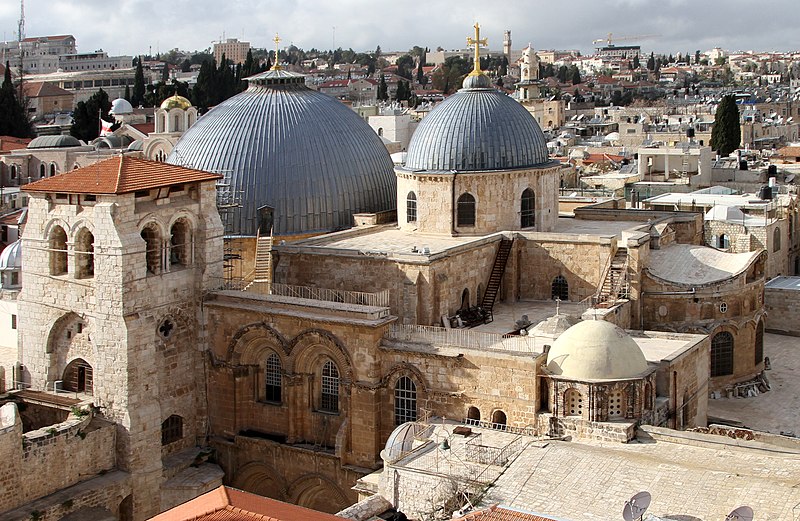
Church of the Holy Sepulchre
church in Jerusalem, containing the two holiest sites in Christianity

Damietta
Damietta ('''' ) is a port city and the capital of the Damietta Governorate in Egypt. It is located at the Damietta branch, an eastern distributary of the Nile Delta, from the Mediterranean Sea, and about north of Cairo. The city was a Catholic bishopric and is a multiple titular see. Damietta is also a member of the UNESCO Global Network of Learning Cities.

Aigues-Mortes
Aigues-Mortes (; ) is a commune in the Gard department in the Occitania region of southern France. The medieval city walls surrounding the city are well preserved. Situated on the junction of the Canal du Rhône à Sète and the Chenal Maritime to Le Grau-du-Roi, the town is a transit center for canal craft and Dutch barges.

Mansoura
city in Egypt
.jpg)
Nicaea
Nicaea (also spelled Nicæa or Nicea, ; ), also known as Nikaia (, Attic: , Koine: ) or Nice ( or ), was an ancient Greek city in the northwestern Anatolian region of Bithynia.

Edessa
thumb|400px|Upper Mesopotamia and surrounding regions during the [[Early Christian period, with Edessa in the upper left quadrant]]
Edessa (; ) was an ancient city (polis) in Upper Mesopotamia, in what is now Urfa or Şanlıurfa, Turkey. It was founded during the Hellenistic period by Macedonian general and self proclaimed king Seleucus I Nicator (), founder of the Seleucid Empire. He named it after an ancient Macedonian capital. The Greek name (Édessa) means "tower in the water". It later became capital of the Kingdom of Osroene, and continued as capital of the Roman province of Osroene. In Lat

Bethany
Bethany (, Syriac: ܒܝܬ ܥܢܝܐ Bēṯ ʿAnyā), locally called in Arabic al-Eizariya or el-Aizariya (, "[[Arabic nouns and adjectives#Nisba|[place] of]] Lazarus"), is a Palestinian town in the Jerusalem Governorate of Palestine, bordering East Jerusalem, in the West Bank. The name al-Eizariya refers to the New Testament figure Lazarus of Bethany, who according to the Gospel of John, was raised from the dead by Jesus in the town. The traditional site of the miracle, the Tomb of Lazarus, in the city is a place of pilgrimage.
Le Puiset
commune in Eure-et-Loir, France

Banias
Banias (; ; Judeo-Aramaic, Medieval Hebrew: , etc.; ), also spelled Banyas, is a site in the Israeli-occupied Golan Heights, Syria near a natural spring, once associated with the Greek god Pan. It had been inhabited for 2,000 years, until its Syrian population fled and their homes were destroyed by Israel following the 1967 Six-Day War. It is located at the foot of Mount Hermon, north of the Golan Heights, the classical Gaulanitis, in the part occupied by Israel. The spring is the source of the Banias River, one of the main tributaries of the Jordan River. Archaeologists uncovered a shrine ded

Dorylaeum
thumb|right|300px|Stele dedicated to [[Zeus Chryseos, 3rd century AD, Dorylaeum]]
Dorylaion or Doryleion (; ) was an ancient city in Anatolia, now an archaeological site located in the Şarhöyük village near the city of Eskişehir, Turkey. It was located at the Şar Höyük mound on a hillock.

Muristan
The Muristan (; ) is a complex of streets and shops in the Christian Quarter of the Old City of Jerusalem. It was the location of the first Bimaristan of the Knights Hospitaller. The name Muristan is derived from the Persian word Bimārestān, meaning "hospital".

Adramyttion
Adramyttium ( Adramyttion, Ἀδραμύττειον Adramytteion, or Ἀτραμύττιον Atramyttion) was an ancient city and bishopric in Aeolis, in modern-day Turkey. It was originally located at the head of the Gulf of Adramyttium, at Ören in the Plain of Thebe, 4 kilometres west of the modern town of Burhaniye, but later moved 13 kilometres northeast to its current location and became known as Edremit.
Horns of Hattin
mountain
Well of Souls
Cave in the Dome of the Rock, Jerusalem, underneath the Foundation stone
Daughters of Jacob Bridge
bridge in Israel

Beit Wazan
municipality in Nablus
.png)
Ascalon
Ascalon or Ashkelon was an ancient Near East port city on the Mediterranean coast of the southern Levant of high historical and archaeological significance. Its remains are located in the archaeological site of Tel Ashkelon, within the city limits of the modern Israeli city of Ashkelon. Traces of settlement exist from the 3rd millennium BCE, with evidence of city fortifications emerging in the Middle Bronze Age. During the Late Bronze Age, it was integrated into the Egyptian Empire, before becoming one of the five cities of the Philistine pentapolis following the migration of the Sea Peoples.
Carmel
Biblical city
Ain Diwar Bridge
ruined roman bridge in Syria